
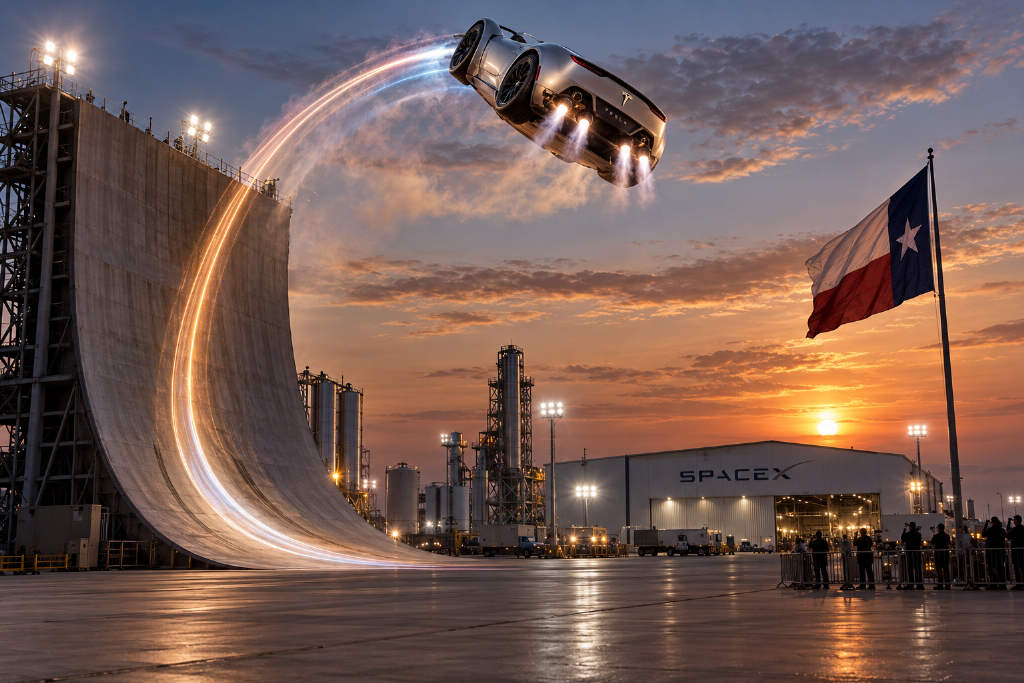
Tesla used a launch event at SpaceX’s test site in McGregor, Texas, to put the next-generation Roadster through two live demonstrations: one with the car hanging nearly upside down on a curved wall, and another with the vehicle flipping through the air before landing and continuing forward.
Elon Musk opened the presentation by saying, “We need the live audience to prove this isn’t AI. You can tell people you saw it with your own eyes, because what you saw with your own eyes will be hard for you to believe.”
How the Roadster performed the stunt sequence
In the first demonstration, the Roadster drove onto a track shaped like a half-pipe skateboard ramp. The far end was close to vertical and curved inward. The car climbed all the way to the top, reached a near-inverted position, paused there, then rolled backward down the track before charging up again and flipping in the air on the way down.
Live telemetry on the broadcast showed the car reaching a 170-degree pitch angle at the top. Height was shown at about 69 feet, or roughly 21 meters, and downforce was displayed at about 4,700 kilograms.
The driver’s seat did not hold a person. It held a robot in a white spacesuit named Starman, a reference to the original Roadster sent into space in 2018. Musk joked that the demonstration was technically autonomous driving because it “ensures we don’t kill anyone.”
The second display ran longer. The Roadster accelerated, lifted off, flipped in the air, and cleared a full row of Tesla vehicles on the ground, including the Semi electric truck. Telemetry showed a peak height of about 26 feet, or roughly 8 meters, before the car landed and continued to roll.
SpaceX-derived hardware shown on site
According to the presentation, the flying sequence relied on technology borrowed from SpaceX. Vehicle engineering chief Lars Moravy said the car carries two carbon-fiber composite pressure vessels with a combined capacity of 600 liters. Those tanks hold about 250 kilograms of air, which is expelled through 10 nozzles.
Musk said the car can refill the air tanks by itself and does not require a special propellant, allowing the stunt system to be used whenever needed. Additional details given on site said the four rear thrusters produce supersonic exhaust, with visible Mach diamonds in the footage, and generate more than 80 kilonewtons of thrust. A fan-based suction system under the car can pull up to 2G, allowing the vehicle to stick to the wall while inverted.
A live 0-to-60 mph run came in at 0.81 seconds
Tesla also demonstrated the Roadster’s straight-line acceleration. The 0.81-second figure refers to the car’s time from 0 to 60 mph, or about 97 km/h. At maximum setting, the live run posted exactly that number: 0.81 seconds.
Musk said that makes it the fastest production car in the world from 0 to 60 mph. He also said the Roadster could cover half a mile in the time other cars take to run a quarter mile.
That figure, however, came from the live demonstration and may not match the certified production specification. Musk said the production version will be even quicker, though it will be kept within a limit that does not “detach the retinas” of the people inside.
Production targeted for 2028, price still not disclosed
Musk said on the livestream that the Roadster is set to enter production in 2028. Tesla did not disclose pricing during the event. Reservations are expected to open in the coming weeks, and buyers in the U.S., Canada, and China will be able to place a $50,000 deposit.
Road legality remains unresolved. Musk said this will be a real road-going car, but added that he is “not sure it will be legal in all regions,” and he also said it is “not necessarily designed with safety as the priority.” The report added that the Roadster’s high-price, low-volume positioning is likely to limit its contribution to Tesla’s revenue.
Musk also said the Roadster will likely remain Tesla’s only manually driven car over the long term, while the rest of the lineup shifts toward autonomous driving. For the next demonstration, he said Tesla plans to attempt a jump over Snake River Canyon, the stunt made famous by Evel Knievel’s failed attempt, which would require a very long runway.