
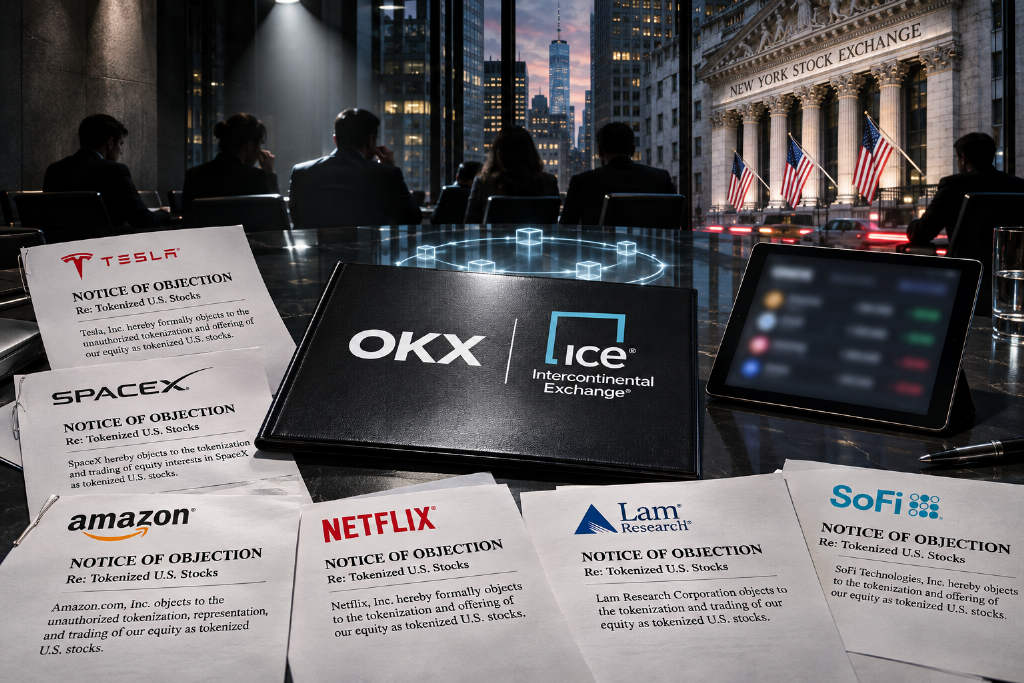
Tesla and SpaceX have moved to keep their shares off OKXICE TSV, the planned tokenized stock venue backed by Intercontinental Exchange and OKX.
In an updated notice dated Monday, OKXICE TSV added six new objecting issuers: Tesla, SpaceX, Amazon, Netflix, Lam Research, and SoFi Technologies. That pushed the total number of companies that have objected to 56.
List of objecting issuers keeps growing
The venue’s Oct. 30 notice listed 50 companies, with Nvidia, Costco, and Nike making up the largest wave at that point. Before that, the count reached 38 on Oct. 28 after Walmart joined. The first objectors appeared on Oct. 15, when nine companies were listed.
The latest additions expand the roster of megacap holdouts. Amazon, Tesla, and Netflix now sit alongside Microsoft, Alphabet, and Nvidia. SoFi Technologies, a fintech company that offers crypto trading, also appears on the list. SpaceX completes the latest batch and is identified under the ticker SPCX.
How the SEC framework works
Under the Securities and Exchange Commission’s innovation exemption, unveiled in September after the Clarity Act stalled in the Senate, a venue must notify a company before offering a version of its shares tokenized by an unaffiliated third party.
If the company objects in writing within 30 days, the venue cannot make that stock available for trading, according to the SEC’s order. The objection applies only to that specific venue.
How OKXICE TSV plans to operate
OKXICE TSV is a 50-50 joint venture between Intercontinental Exchange, the parent of the New York Stock Exchange, and OKX’s U.S. holding company. The platform plans to offer 24/7 trading in tokenized U.S. stocks through permissioned Uniswap v4 pools on OKX’s XLayer blockchain, paired with stablecoins including USDC.
To trade on the venue, users must pass identity and sanctions checks. They must also hold a nontransferable soulbound token, which the venue’s smart contracts verify before every transaction.
Objections do not shut every route
Apple remains one of the few megacap companies not yet listed among the objectors.
Even so, the objections do not block every possible structure. The notice says OKXICE TSV can still list shares tokenized by the issuers themselves, though it does not name any issuer using that route. It also says tokenized stocks offered by the venue are not limited to trading only on OKXICE TSV.



