
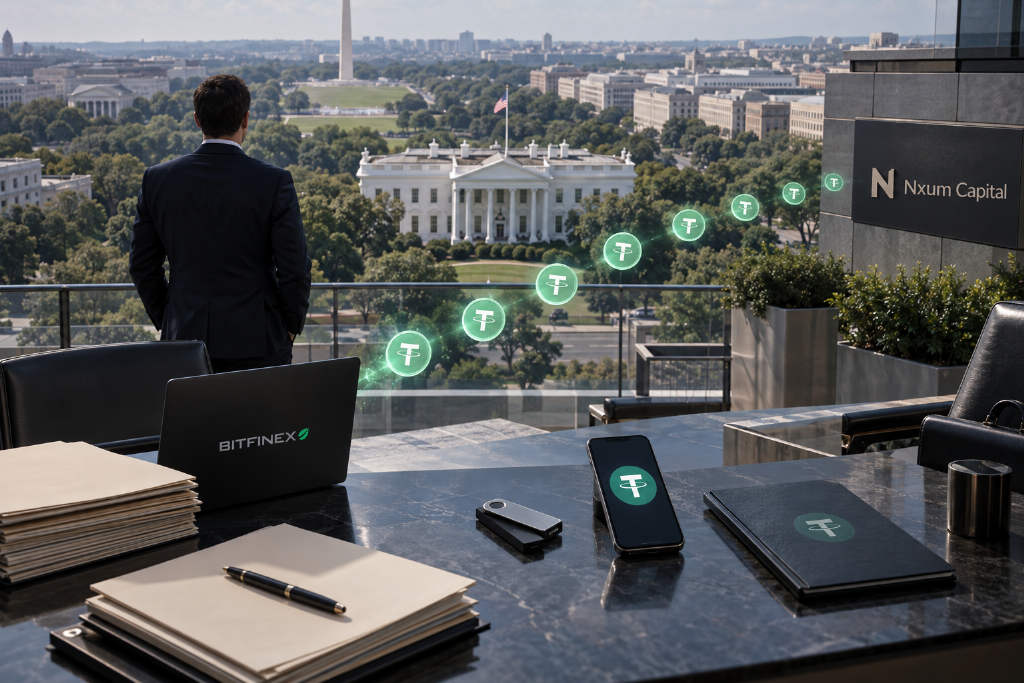
The Wall Street Journal reported that Tether worked with Nxum Capital, a firm started by Bo Hines and his father, while Hines was serving in the White House and helping advance stablecoin legislation. Before becoming chief executive of Tether-backed stablecoin USAT, Hines had served as executive director of President Donald Trump’s Council of Advisers on Digital Assets.
According to the Journal, Nxum earned $6.3 million under the arrangement to help build a strategic brand and public affairs plan for Tether. The report said the money moved through Bitfinex, described as Tether’s sister fund, to Notorious, a firm led by Peter Vincer, who then sent most of the funds on to Nxum.
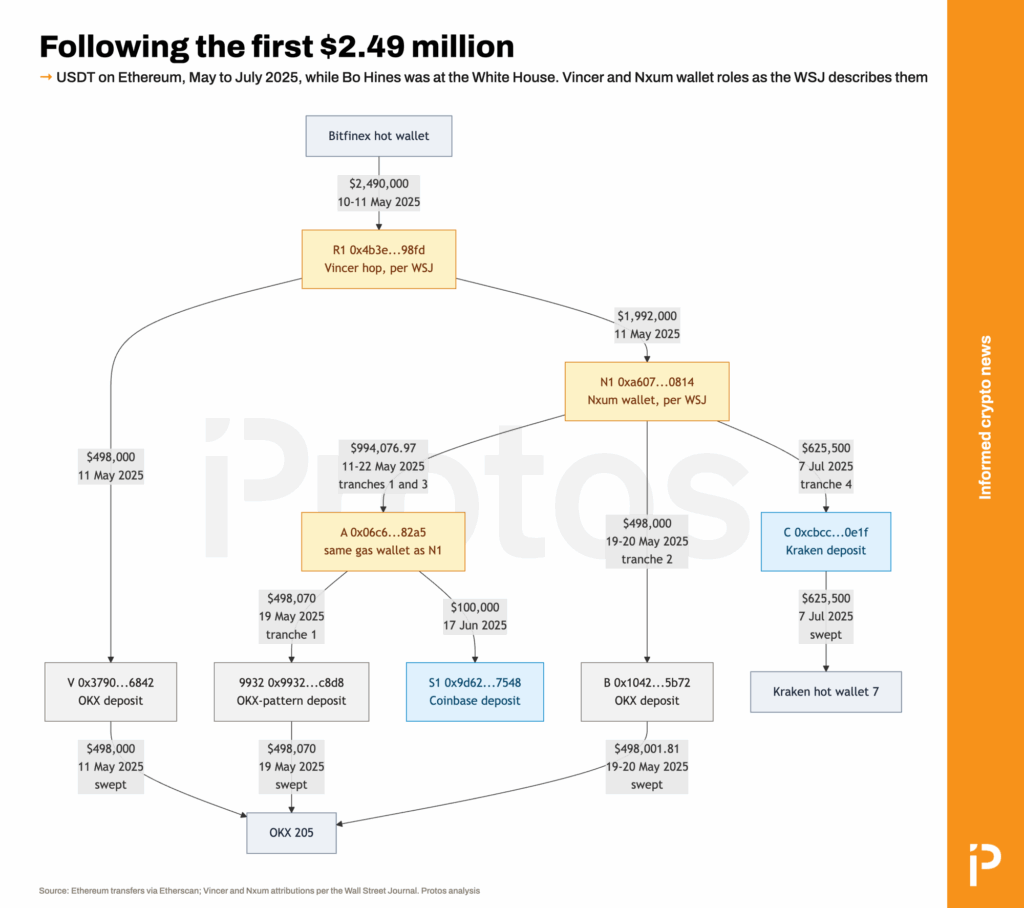
The report said Tether made its first $2.49 million payment from Bitfinex to Vincer on May 11, 2025. Vincer kept $498,000 and sent the remainder to a Nxum wallet, where the funds were then split three ways.
On-chain transfers cited by Protos track the reported payment flow
Protos said that on May 11, 2025, an address labeled "Bitfinex: Hot Wallet" on Etherscan, 0x77134cbC06cB00b66F4c7e623D5fdBF6777635EC, sent $2.49 million in USDT to 0x4b3e4956a5Bf253Cf28f8cf9b9F71BfD100E98Fd in two transactions. The $1 test transfer took place the day before.
After that, all but $498,000 was transferred to 0xA6078664175FCfb093989EC778C03FAe58170814. Protos said it could not be absolutely certain these were the exact same transactions described by the Journal, but said they matched the details available so far.
The Journal also reported that Vincer said he acted as the intermediary on the deal, and that after Hines left the White House, the contract was transferred directly to Nxum.
Nxum says Hines had no economic relationship with Tether while in office
A Nxum representative told the Journal that Hines did not receive any Tether-derived funds during that period and had no economic relationship of any kind with Tether while serving in the White House.
The report also said Hines continued exchanging Signal messages with his business partners while he was in the White House. It said he shared details about the GENIUS Act with Nxum leaders who were working with Tether.
Nxum’s ties to political fundraising also appear in the report
The Journal report, as cited by Protos, said Nxum was also active in politics and supported Fellowship PAC, a super PAC chaired by Jesse Spiro, Tether’s head of government affairs.
That super PAC raised $11 million, with $10 million coming from Tether custodian Cantor Fitzgerald, the firm previously led by Commerce Secretary Howard Lutnick. The rest came from Anchor Labs, Inc., a firm associated with Anchorage Digital, the bank behind USAT.
The report said the super PAC paid out $11 million to Nxum, although there was also a $300,000 refund.
Timeline runs from GENIUS Act signing to Hines taking the USAT role
The GENIUS Act was signed into law in July 2025. Tether chief executive Paolo Ardoino appeared at the White House to show support for the measure, according to the report. The next month, Hines announced he was leaving the White House. A month later, it was announced that he would lead USAT, with Tether pointing to his entrepreneurial background as part of the rationale.
Protos said it contacted Tether for comment and also tried to reach Nxum, but said the firm’s previous contact email was no longer deliverable. Tether did not immediately respond, according to the report.