
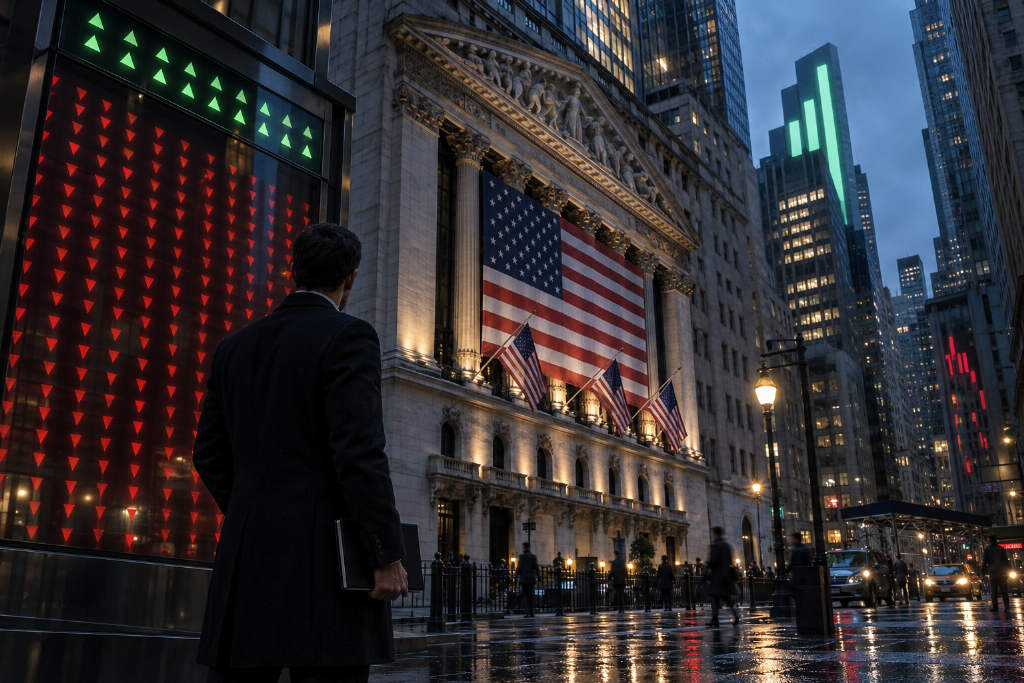
The S&P 500 may be trading within about 2% of its record high, but The Kobeissi Letter says the market is still sitting in what it calls an "invisible" bear market.
In a note authored by The Kobeissi Letter and translated by Odaily Planet Daily’s Golem, the research outlet argues that this is one of the most important opportunities in the market right now. Its main point is straightforward: the index looks strong on the surface, while much of the market underneath it remains under pressure.
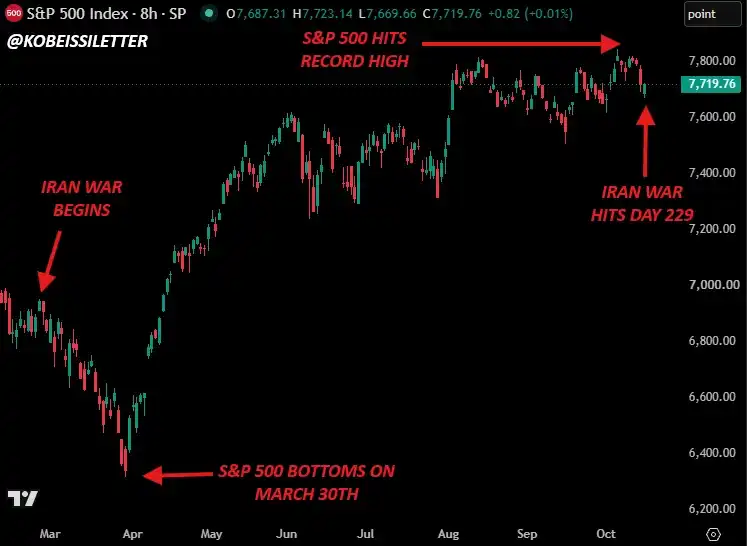
229 days after the Iran war began, the index is still near its peak
The note says this is day 229 since the start of the Iran war. Since Feb. 28, the S&P 500 has gained 900 points. From its March 30 low, it has risen by nearly 1,500 points, adding $14 trillion in market value.
Compared with 229 days ago, the macro backdrop has changed sharply, according to The Kobeissi Letter. Inflation has nearly doubled, the Federal Reserve is raising rates, the world is in what the note describes as the worst energy crisis in history, and a major technology revolution is unfolding at the same time. Even so, many investors still believe market fundamentals are worse than they were eight months ago.
Rate expectations flipped, but equities stayed elevated
At the start of 2026, markets expected at least three Federal Reserve rate cuts this year, for a total of 75 basis points, the note says. That expectation had been a major pillar of the bullish case because investors were pricing in lower capital costs, more investment activity, and record capital expenditure from technology companies.
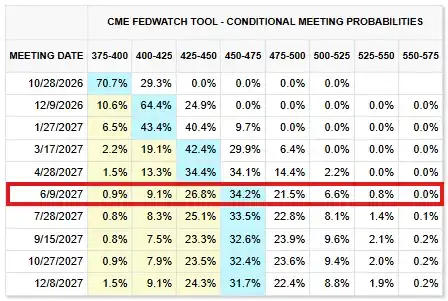
Instead, the Fed has already delivered one rate hike this year, and markets now expect three more hikes by June 2027. Including the September move, that would amount to 100 basis points of tightening. The Kobeissi Letter says the swing in rate expectations totals 175 basis points, yet the S&P 500 still sits near all-time highs.
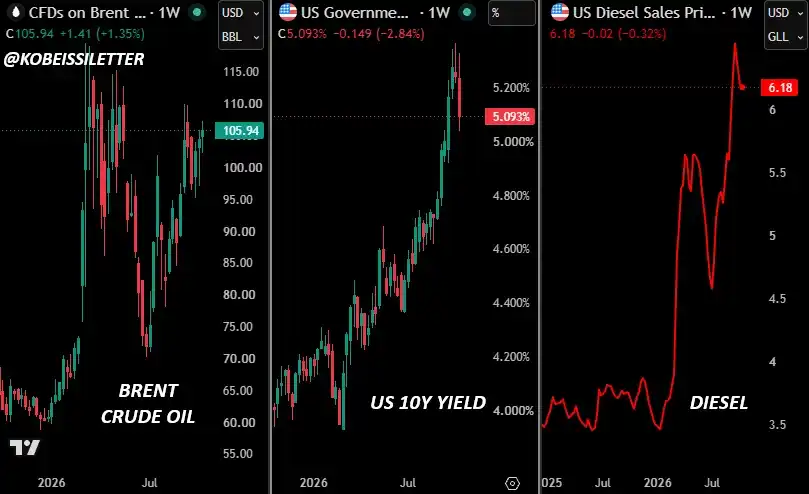
It links that reversal to a surge in oil prices. Diesel prices have climbed more than 80% from their January 2026 low, while Brent crude has reached $106 per barrel. Inflation has doubled, the Fed is still hiking, the U.S. fiscal deficit is nearing $2 trillion, and borrowing costs have jumped as a result.
Most S&P 500 stocks are still well below their highs
The note says the real story is inside the index. While the S&P 500 itself is close to a fresh high, most of its components are not.
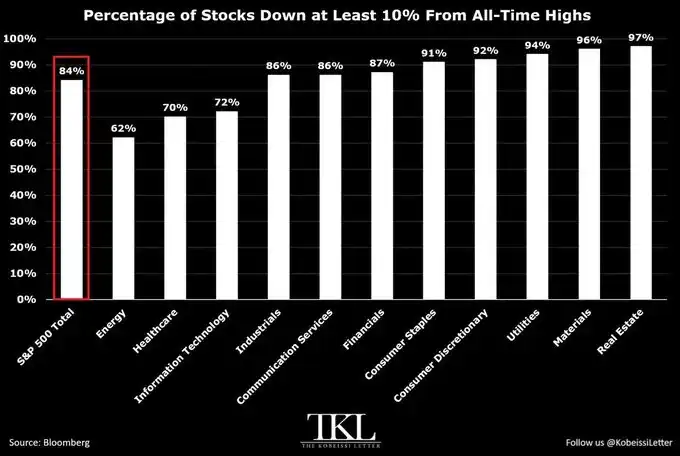
According to The Kobeissi Letter, 84% of S&P 500 stocks are down at least 10% from their record highs. Real estate leads the list, with 97% of stocks down at least 10%, followed by materials at 96%, utilities at 94%, and consumer discretionary at 92%.
It also says 59% of the index is down at least 20% from peak levels, 41% is down more than 30%, and 17% has fallen by over 50%. In other words, most stocks inside the S&P 500 are still in a bear market even while the headline index remains near records.
Ten stocks drove 70% of the rebound from March 30
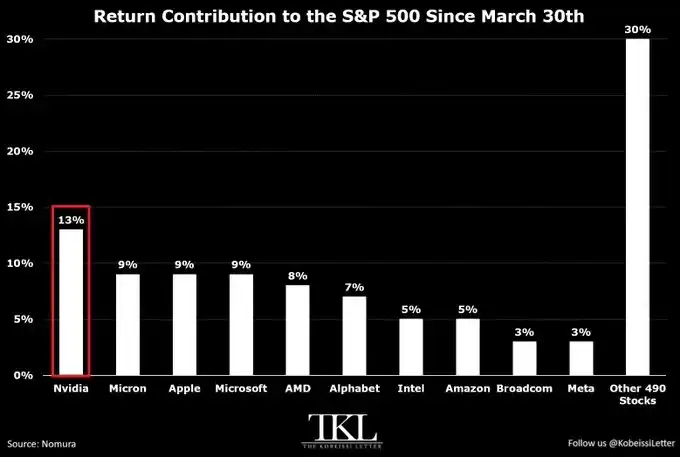
The Kobeissi Letter also breaks down the rally since the March 30 bottom. The S&P 500 has gained 23% over that stretch, and 70% of the advance came from just 10 stocks, which together accounted for 16 percentage points of the move.
Nvidia (NVDA) made the largest contribution, responsible for 13% of the S&P 500’s gain, or 3 percentage points. It was followed by Micron Technology (MU), Apple (AAPL), and Microsoft (MSFT), which each contributed 9% of the advance, or 2 percentage points apiece. Advanced Micro Devices (AMD) and Alphabet (GOOGL) contributed 8% and 7%, respectively.
The other 490 stocks in the index accounted for only 30% of the gain, or 7 percentage points. The Kobeissi Letter says that concentration is not necessarily a problem at this stage. In its view, it actually points to valuation pressure elsewhere in the index that could reverse if participation broadens.
Without the war, the S&P 500 could be above 9,000, the note says
The Kobeissi Letter argues that, absent the Iran war, the S&P 500 could have been trading above 9,000. It calls the index one of the most resilient assets in history, saying it has stayed within roughly 2% of its high even with inflation near 4%, rising gasoline prices, and continued Fed tightening.
That leads to its next question: if the war ends, oil prices fall, and the Fed returns to cutting rates, where could the index trade then?
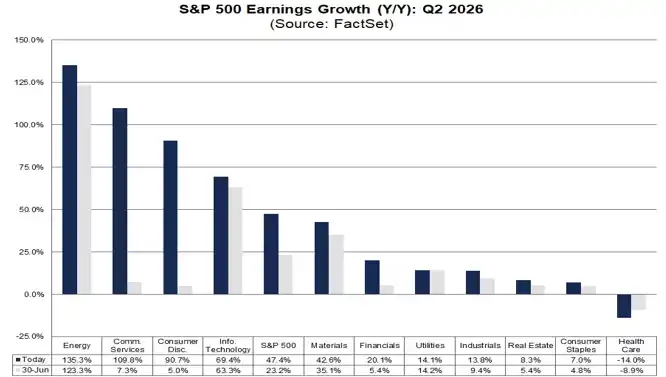
The note also points to earnings. During the seven months of the Iran war, blended earnings growth for the S&P 500 reached 52% in the second quarter of 2026, the highest level since the second quarter of 2021. The Kobeissi Letter contrasts that with a period when the global economy was reopening from lockdowns and the U.S. government had introduced $4 trillion in stimulus.
Large-cap tech valuations are described as discounted
The note says the AI outlook is stronger than many people realize and that earnings growth is enough to support that case even though inflation has remained above 2% for 67 straight months.
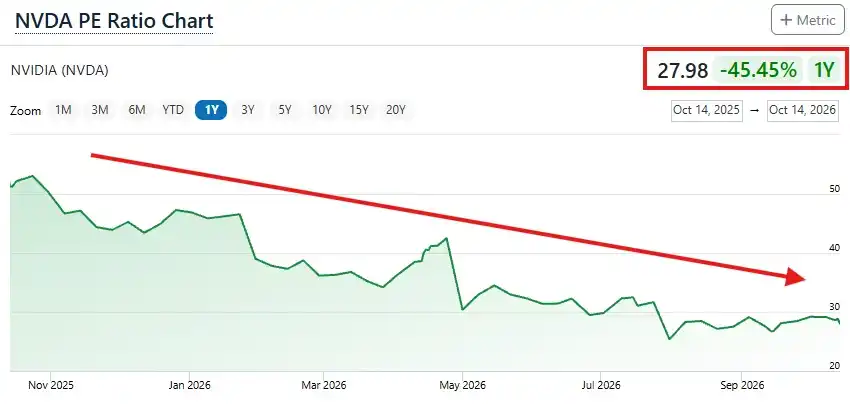
Nvidia is one example. The Kobeissi Letter says the stock rose 21% over the last 12 months, yet its price-to-earnings ratio fell by 46%. Nvidia’s forward P/E now stands at roughly 24, close to the S&P 500’s 22, even after the stock has climbed 900% over the last five years.
It says many large technology stocks show the same pattern. The note adds that the S&P 500 and the S&P 500 information technology sector are now trading at nearly the same forward P/E multiple, even though tech has historically carried a premium to the broader index.
For that reason, The Kobeissi Letter says the large-cap technology names that have supported the market still include a sizable discount in their valuations, despite trading at or near record prices.
The March 30 low is described as a "gift" to investors
The Kobeissi Letter says it issued a strong buy signal on the S&P 500 and the broader stock market when the index fell below 6,400. In a prior article, it said the bond market was one of the main reasons behind that bullish call and argued that the sell-off in technology shares, which dragged down the broader market, appeared irrational.
The index then staged what the note describes as a V-shaped rebound. The Kobeissi Letter later raised its S&P 500 target to 7,800 and said the Trump administration would intervene in the bond market.
It now says the Trump administration is indeed trying to intervene, though those efforts have not yet worked, and that further action is unavoidable. The note adds that its bullish view on the S&P 500 was already in place on March 30 and has become more convincing as 2027 approaches.
Persistent inflation is pushing investors toward more assets
Beyond discounted equity valuations, The Kobeissi Letter says long-running inflation is another reason investors want more exposure to assets. U.S. CPI inflation has stayed above the Fed’s 2% target for 67 consecutive months, and the last reading below that level came in January 2021, when the global economy was still under lockdown conditions.
During that period, the U.S. dollar lost 22.5% of its purchasing power, the note says. Goods and services that cost $100 in 2021 now require $129. On that basis, it argues that investors are more likely to increase holdings of stocks and hard assets over time, not reduce them.
The Kobeissi Letter says any sign that the Iran conflict is ending and the global energy crisis is easing could set off a chain reaction: lower energy prices, softer inflation expectations, a more dovish Fed stance, less of a discount in technology shares, and broader participation in the rally. At the same time, it says the AI buildout is still accelerating, and many large-cap tech stocks have become more attractive on forward earnings even after their share prices moved higher.
A bear market inside a bull market
The note’s final framing is that the S&P 500 is in a bear market within a bull market. The broader bull run is now in its fifth year, but The Kobeissi Letter says a meaningful discount still exists across the market. It describes that discount as an invisible bear market that has weighed on the valuations of some of the world’s largest and fastest-growing companies.
In its view, if conditions line up, the S&P 500 could enter a sharp new leg higher, with 2027 shaping up as a year of major uncertainty and potentially major moves.