
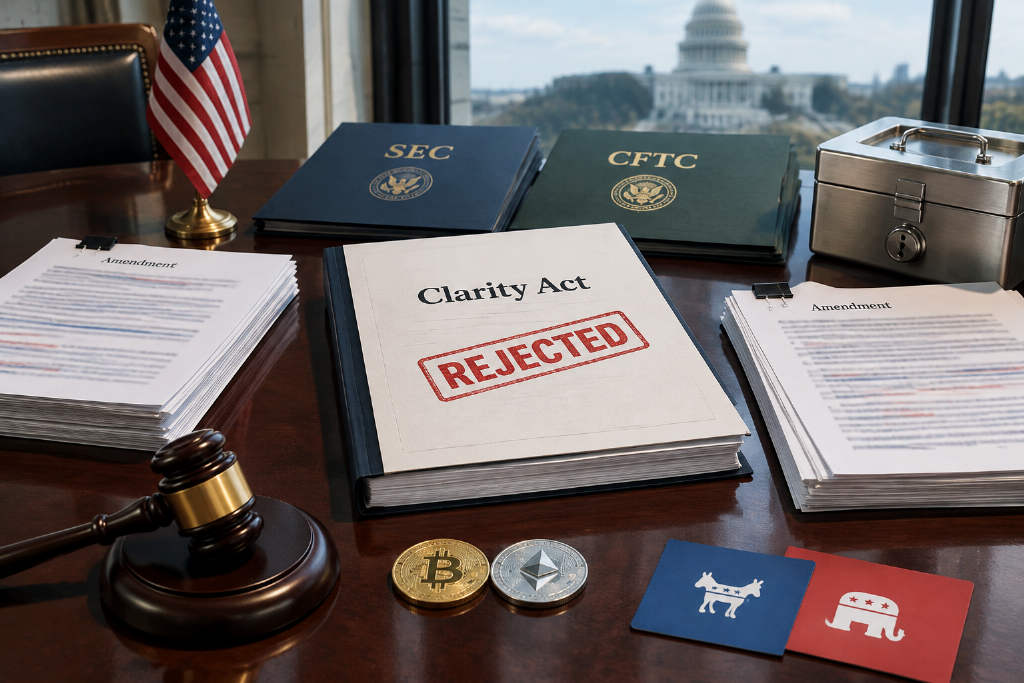
U.S. Senator Tim Scott of South Carolina said Democrats sank the Clarity Act in the Senate after more than a year of talks and about 120 concessions. In a CoinDesk opinion column, he argued that raw political calculation beat out the public interest.
Scott wrote that Senate Democrats rejected the bill last week without a single vote in favor. His argument was blunt: the problem was not that Democrats did not want a bill, but that they preferred to stop what he called a bipartisan win for President Donald Trump.
Scott says Democrats put politics ahead of policy
Scott began the column with his own story, saying he was raised by a single mother in South Carolina. Then he turned to Democrats, arguing they had lost sight of the people they represent. He wrote, "Democrats should remember the people they represent and do what benefits the people, not what benefits their political calculations, advisers, and special interests."
He framed the Senate defeat of the Clarity Act as a clear case of election-year politics taking precedence over legislation that, in his view, would help Americans and give the crypto sector clearer rules. Plain and simple.
He says about 120 compromises produced no Democratic support
Scott laid out what he described as Republican concessions made over more than a year of negotiations with Democrats. His point: Democrats asked for each of these items, and Republicans agreed to them.
- Expanded ethics provisions
- Ethics language involving President Trump
- Ethics rules covering public officials and their spouses
- A meaningful enforcement role for state attorneys general
- Additional anti-money-laundering investigative tools for law enforcement
Scott summed up the whole process like this: "Every time Republicans met Democrats' demands, they moved the goalposts."
He also said at least 12 Senate Democrats had signaled they were willing to negotiate. But when the vote came, not one did.
Scott describes three goals for the Clarity Act
According to Scott, the bill had three basic goals: protect ordinary Americans' money, give entrepreneurs a fair shot to compete, and make it harder for criminals and foreign adversaries to exploit the financial system.
Scott said that before joining the Senate, he ran a small business. He added that entrepreneurs constantly ask practical questions: which rules apply, and which agency is in charge? Those answers, he argued, shape day-to-day operations and customer service. Real-world stuff.
Column was written less than 40 days before Election Day
Scott said he wrote the piece with fewer than 40 days remaining before Election Day. He accused Democrats of choosing what helps them politically over what makes for good policy.
He wrote, "They would rather stab President Trump in the back and stop him from securing a major bipartisan legislative achievement than do what is right for the American people."
Scott also linked the Clarity Act fight to Democratic tax positions, saying Democrats voted to raise taxes on overtime pay, tips, and Social Security benefits. He said that if they got their way, Americans would pay hundreds of dollars more each month.
After the bill’s collapse, Scott points to the SEC and CFTC
With the Clarity Act stalled, Scott said the Securities and Exchange Commission and the Commodity Futures Trading Commission should go first and write clearer digital asset rules while Congress keeps working on legislation.
He said both agencies are focused on companies that deal directly with customers, and on the rules those businesses are supposed to follow.
Regulatory uncertainty remains in place for the crypto market
The opinion piece is openly political. Still, the issue underneath it is practical for the crypto market. The report says more than a year passed between the Clarity Act's introduction and its collapse. During that stretch, there were positive signals from seven Democratic senators, persuasion efforts by a White House crypto adviser, and continued lobbying by the ETH community and the industry.
The same report says Democrats stayed focused on what they viewed as Trump-related crypto conflicts of interest. And with Election Day getting close, the window for more bipartisan talks is now nearly shut.
Scott's backup plan, agency-led rulemaking by the SEC and CFTC, may sound workable. But the market has already seen nonbinding staff guidance. BlockTempo reported earlier that recent SEC and CFTC staff guidance said repurchases and staking are not necessarily securities, while also carrying no binding force.
So the central question is still hanging there. The problem is not just which agency should oversee crypto, but when the rules will actually be settled. Scott's column blames Democrats, yet the report also says Republicans have not offered a post-election legislative timetable either. For the industry, what is missing is not another opinion essay. It is enforceable statutory language.
The report adds that if the November election leaves the current balance in place, with Senate Democrats still holding effective blocking power, the chances of the Clarity Act passing before the end of 2026 are very low. If that happens, the industry may have to keep operating in a gray zone, or keep putting compliance budgets toward its best reading of SEC and CFTC positions while waiting for the next legislative cycle.