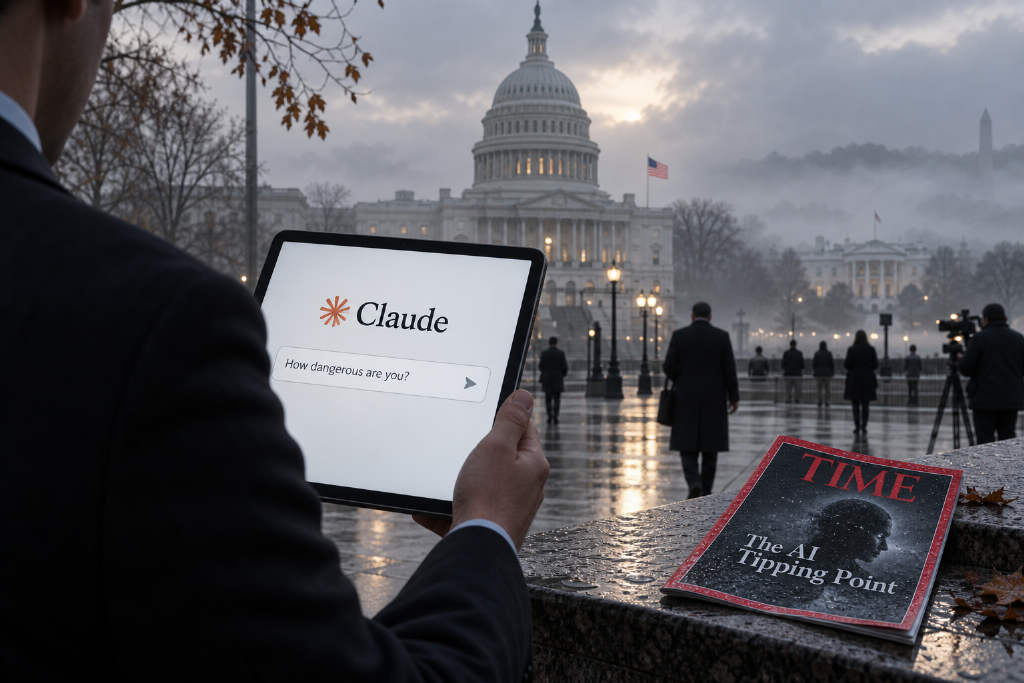
TIME devoted its latest cover story to AI risk under the headline "The AI Tipping Point," pushing a debate once mostly confined to AI safety circles further into the U.S. mainstream. The cover itself featured a Claude prompt asking, "How dangerous are you?"\n\nThe timing follows a week in which an Anthropic researcher resigned over concerns about AI going out of control, while tech leaders including Dario Amodei, Sam Altman, and Elon Musk publicly called for slowing down AI development. According to the source material, the discussion has also quickly spread from industry circles into Washington, drawing in both the White House and Congress.\n\nWhat had been a narrower argument over whether superintelligence could become uncontrollable is now being treated as a broader political and social issue in the United States. The shift, as framed by the magazine cover and the surrounding public debate, shows how AI safety concerns are no longer staying within specialist communities.
TIME made AI risk the subject of its latest cover story, running with the headline "The AI Tipping Point." The cover also showed a Claude prompt asking, "How dangerous are you?"
Over the past week, an Anthropic researcher resigned over concerns that AI could go out of control. Dario Amodei, Sam Altman, and Elon Musk also publicly called for slowing development. The debate quickly drew in the White House and Congress.
A question that had largely stayed within AI safety circles — whether superintelligence could become uncontrollable — is now turning into a mainstream political and social issue in the United States.
This article was originally published by Bit.Fan. For more cryptocurrency news and market insights, visit www.bit.fan. Disclaimer:
The market information, project data, and third-party content displayed on this platform are for industry information sharing only and do not constitute any form of investment advice or return commitment.
Cryptocurrency trading carries high risks. Users should fully assess their risk tolerance and make independent decisions. All profits, losses, and legal responsibilities are borne by the users themselves.