

Tokenized stocks have now surpassed $3.7 billion in total market capitalization, and about 95% of those assets track U.S.-listed equities and core index ETFs, according to the latest data compiled by Token Terminal.

But the issuance base is not in the United States. Token Terminal said 90.4% of the market’s total capitalization comes from legal entities registered outside the U.S., a structure the report describes as a clear sign that issuers move to jurisdictions where market access is faster and regulatory resistance is lower.
Market cap is concentrated in offshore jurisdictions
Within the roughly $3.7 billion tokenized-stock market, offshore entities account for 90.4% of issuance by market value. Jersey leads with a 28.9% share, followed by Abu Dhabi at 27.4% and the British Virgin Islands at 26.3%.
Token Terminal said most onchain exposure to U.S. equities available to global investors now comes from offshore issuers that explicitly do not directly serve U.S. residents. Even U.S.-listed companies such as Coinbase and Robinhood issue tokenized assets through offshore vehicles, the report said.
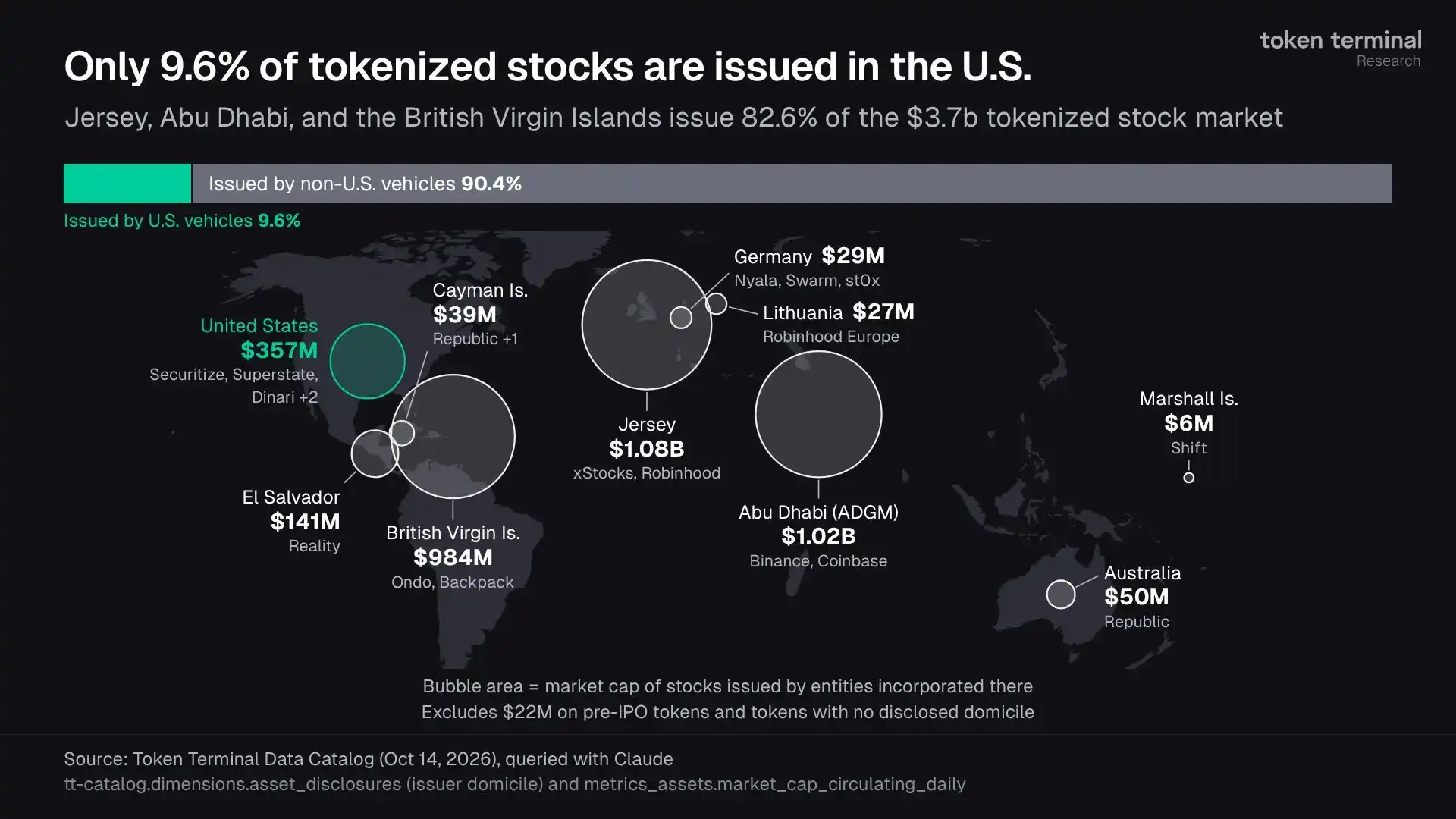
No single offshore jurisdiction has established absolute control over the sector. In Token Terminal’s view, that means a ban in one country would be more likely to shift issuance demand elsewhere than to stop the broader market.
Holder counts show the same pattern
The report puts the number of tokenized-stock holders across the market at 5 million. Of that total, 97.8% hold assets issued by offshore entities, while tokens issued domestically in the United States account for just 2.2% of holders.
By issuer group, Jersey-based xStocks and Robinhood-related platforms account for 2.4 million holders. Abu Dhabi-based Binance bStocks and the Coinbase group account for 1.5 million. Ondo and Backpack, operating from the British Virgin Islands, account for 894,700 holders.
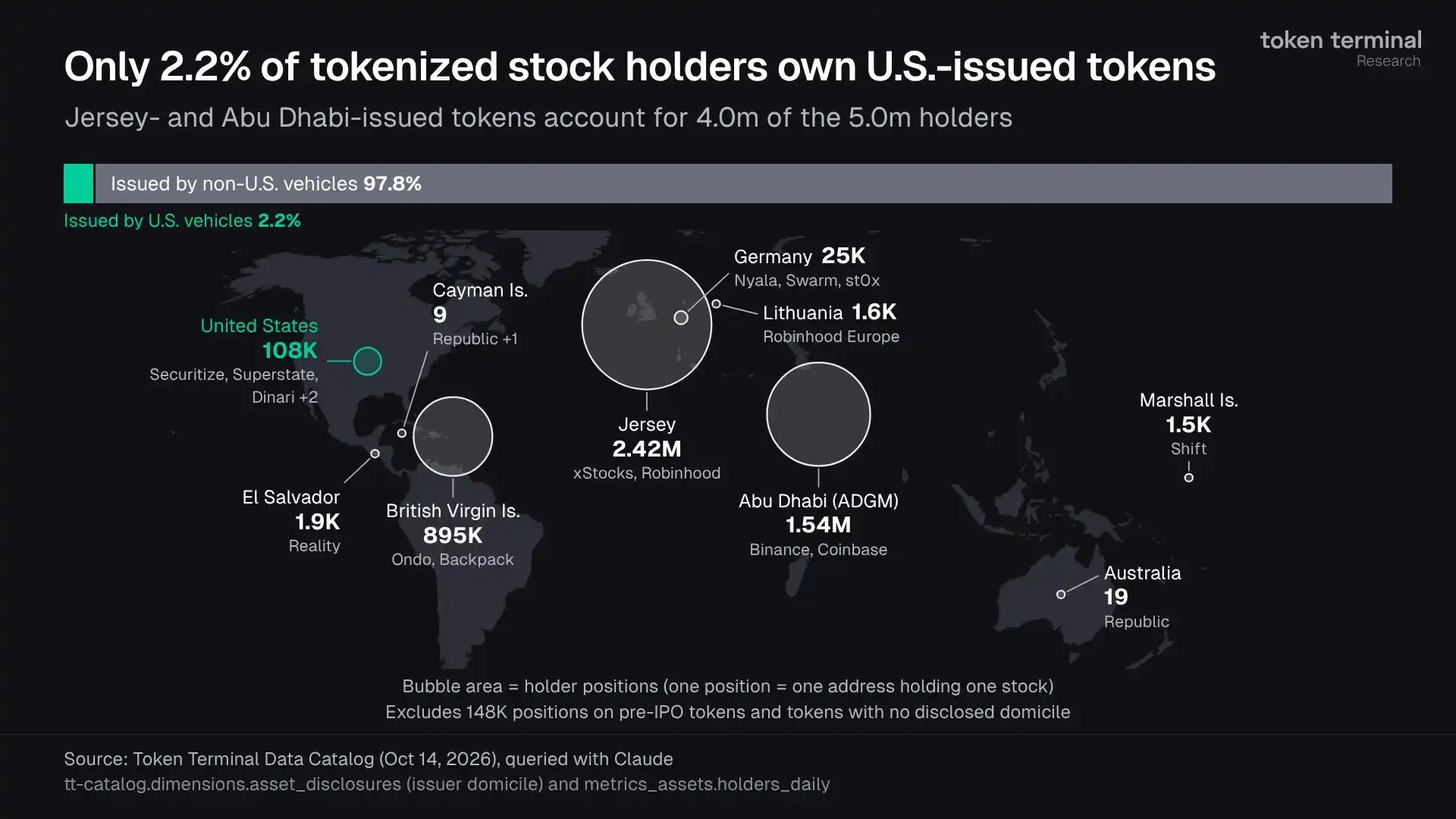
Token Terminal said the BVI cohort shows a pattern of larger average positions and more concentrated ownership per holder. The report frames that as evidence of strong global demand for tokenized U.S. equities that can trade around the clock.
DeFi usage favors offshore-issued assets
Tokenized stocks deposited in DeFi lending markets, yield vaults and decentralized exchange liquidity pools total $271.7 million, and offshore-issued assets make up 90.4% of that amount, the report said.
xStocks and Robinhood-issued tokenized equities from Jersey account for $176.9 million of those DeFi deposits, equal to 65.1% of the total.
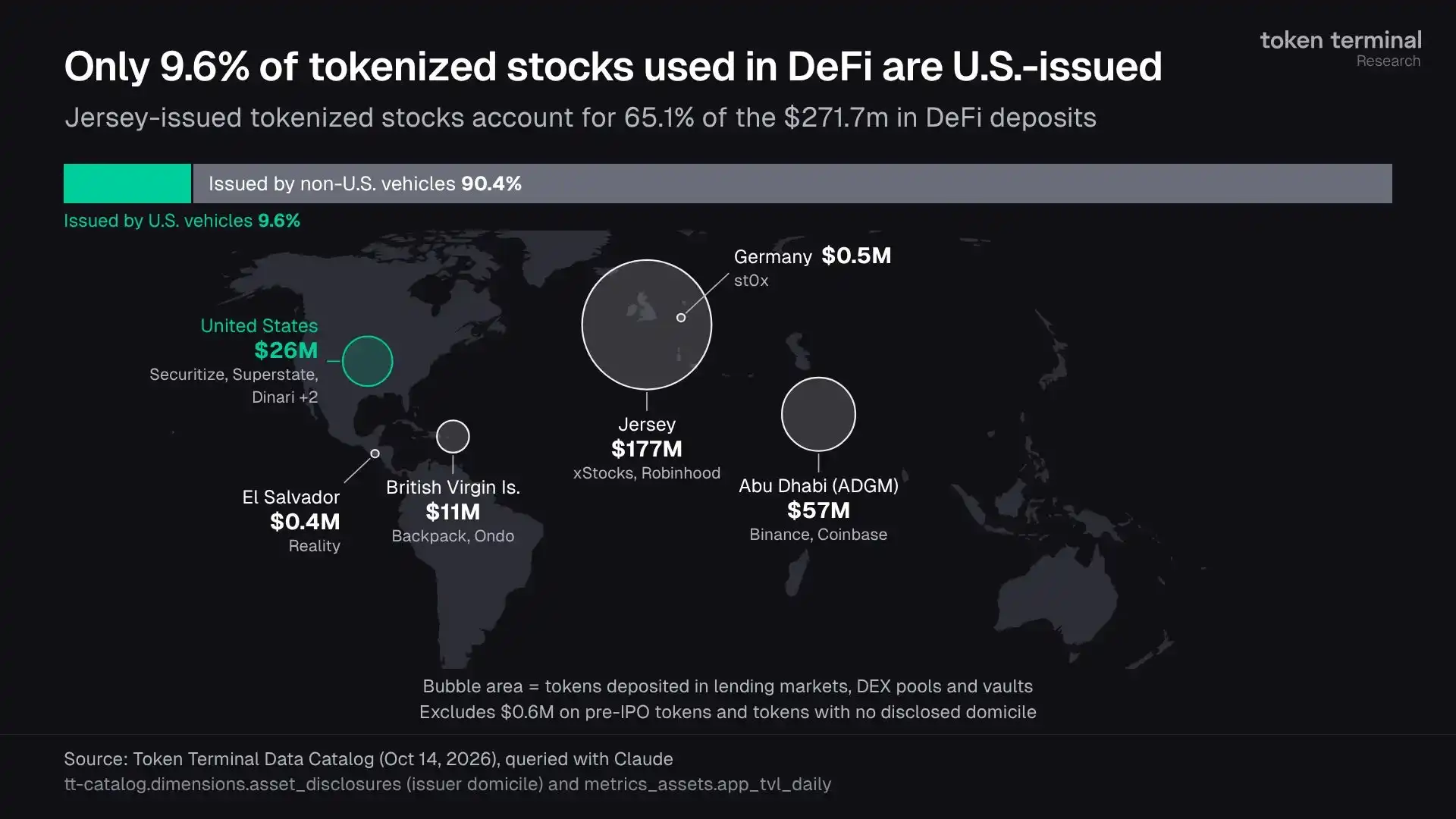
The contrast with Ondo is sharp. Token Terminal said the BVI-registered issuer has a tokenized market cap of $951 million, the largest in that jurisdiction, but only about $3 million is currently deposited in DeFi. The report’s point is simple: scale in market value does not automatically translate into deep DeFi utility.
Offshore assets dominate onchain trading volume
Over the past 30 days, tokenized stocks recorded $14.4 billion in onchain trading volume. Offshore-issued assets represented 99.3% of that flow, according to Token Terminal.
Jersey-linked platforms xStocks and Robinhood contributed $6.7 billion in trading volume during that period, while Abu Dhabi-based Binance bStocks and Coinbase contributed $6 billion. U.S.-issued tokens, by comparison, generated just $104.5 million in volume over the same period, despite representing 9.6% of total market capitalization.
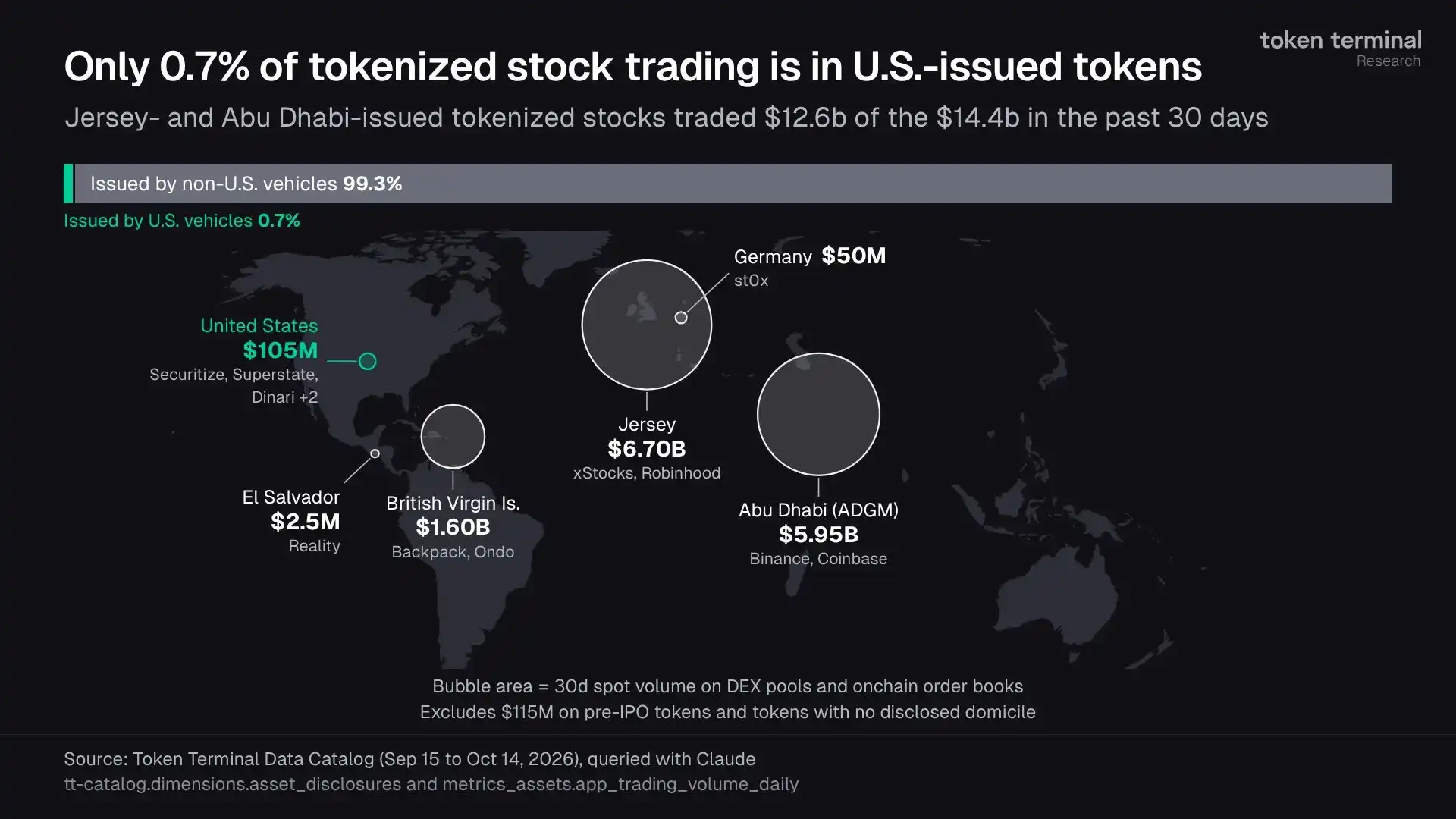
The report said that if a user is matching a tokenized U.S. stock trade onchain today, the odds are overwhelming that the token involved was issued offshore.
Alpaca emerges as a key backend winner
Beneath the offshore issuance layer, Token Terminal identified a major point of concentration in custody. It said 83.5% of the market capitalization of tokenized stocks is backed by real shares custodied by a single U.S.-licensed broker, Alpaca.
Ondo, xStocks, Binance bStocks, Robinhood, Coinbase and Reality are registered across four different countries and operate under different offshore legal and regulatory structures, but all of them rely on Alpaca as the custodian for the underlying equities, the report said.
That creates a split structure in the market. Issuance, holding and trading happen largely offshore and onchain, while the real-world shares remain held inside the regulated U.S. financial system. Token Terminal described Alpaca as the biggest hidden winner of the current tokenized-stock wave, while also noting the concentration risk implied by that level of backend reliance.
SEC signal could become a turning point
Token Terminal also pointed to a recent signal from the U.S. Securities and Exchange Commission around an “Innovation Exemption,” which the report said suggests a tentative opening in the domestic regulatory stance toward tokenized stocks.
If U.S. rules loosen, issuance activity could return to the domestic market as quickly as it previously moved offshore, the report said. In Token Terminal’s view, tokenization follows liquidity, and the onchain rebuild of global financial infrastructure is still at an early stage.