
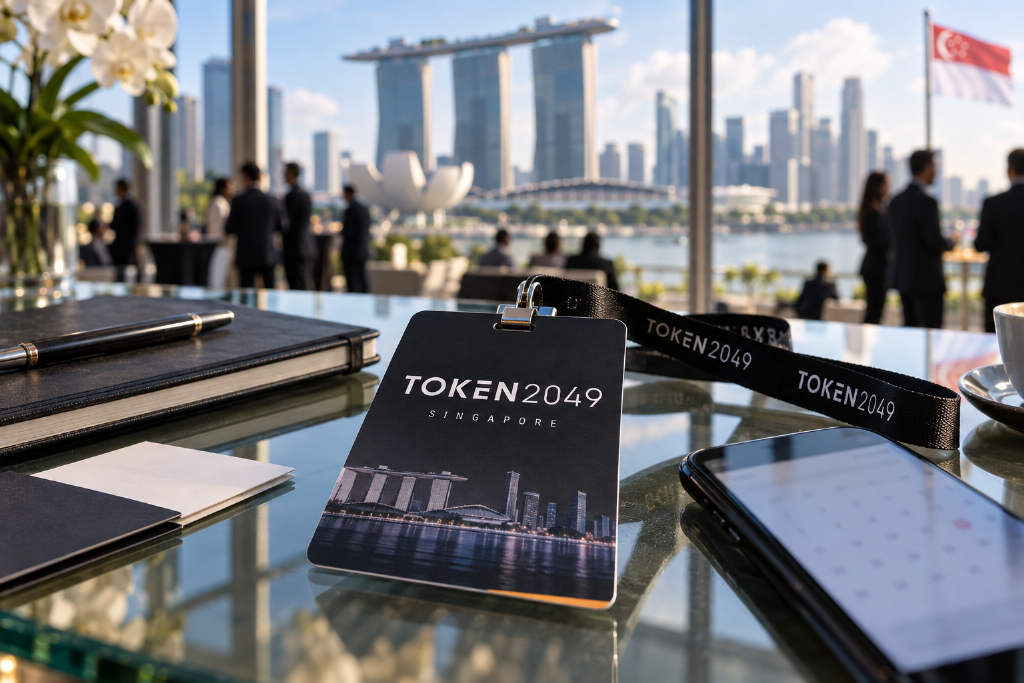
Foresight News columnist Joe Zhou described TOKEN2049 in Singapore as something bigger than a conference. In his telling, it is a giant information marketplace that opens for only a few days each year, drawing people from around the world who arrive with projects, capital, opinions, information and ambition, then trade those things with one another.

After five days, he wrote, some people leave with stacks of business cards, photos and party memories. Others leave with something more valuable. Zhou, who said he has attended the Singapore edition of TOKEN2049 for four straight years, organized his experience into 10 lessons he wishes he had known the first time.
Cut back on parties and make room for deep conversations
Zhou said one of the most common mistakes newcomers make is treating TOKEN2049 like a music festival. During the event, there can be hundreds of gatherings: conferences during the day, parties at night and after-parties that run into the early morning, only for the cycle to repeat the next day.
By the end of five days, someone may have attended 17 events, added 100 contacts and spent 2,000 yuan on rides alone. The schedule looks packed. The problem, he argued, is that once the day ends, it can feel as though everything was attended and nothing was actually gained.
What matters most, in his view, often does not happen on stage. It may happen in a hotel lobby, a coffee shop, over a meal, or during a 40-minute walk with one person. His advice is simple: skip two parties and use that time to talk with one genuinely interesting person for 40 minutes. More concretely, he suggested attending no more than one or two parties a day and reserving the rest of the time for deep talk. The most valuable part of TOKEN2049 is not how many events you showed up to, but who you spoke with and what you discussed.
Prepare one sentence that tells people who you are
Zhou wrote that TOKEN2049 puts attendees in front of a huge number of strangers, and first interactions usually last only a few seconds. The standard opener is often: “Hi, what do you do?”
If the answer is just “I’m working in Crypto VC,” “I work in Crypto media,” “I’m from a CEX,” or “I work for a wallet,” the other person may forget immediately. But a more specific line changes the interaction. He used an example: “I’m Bella from X Wallet. I’m researching stablecoin payments across emerging markets, particularly in the Middle East and South America.” That gives the listener three pieces of information right away: who you are, what you are studying and what you want to talk about.
For that reason, Zhou recommended preparing a 30-second self-introduction before arriving. He also said one version is not enough. Different settings may call for different angles, including stablecoins, exchanges, Wall Street and regulation, or AI × Crypto. Since conversations with strangers are short, the real goal is not to introduce yourself to everyone. It is to quickly locate topics that interest you and find people who care about those same topics. He called that one of the easiest ways to raise the information density of the week.
Bring non-consensus information and good questions
Zhou compared TOKEN2049 to Panjiayuan in Beijing, one of China’s largest antique markets. Just as dealers bring objects there to trade, appraise and sell, attendees at TOKEN2049 bring information. In a marketplace like that, he said, what you know determines whether others want to keep talking.
If you bring nothing beyond what everyone already knows, conversations can stay stuck at the level of consensus and quickly become dull. People carrying non-consensus information are different. He compared them to someone walking into an antique market with an authentic piece that draws attention immediately.
Before the event, he said, his team usually prepares around major themes already moving through the industry, including Robinhood, Hyperliquid, prediction markets, stablecoins, and the continued push into crypto by the US government and Wall Street.
Experienced crypto participants, in his view, should prepare at least five directions of non-consensus information within their own sector: what is happening, why it is happening and where their view diverges from the market mainstream. Newcomers should at least understand the basics of those themes so they know what people are discussing.
He also stressed that attendees should not prepare only answers. They should prepare questions. His examples included: Why has Hyperliquid found a new position between CEX and DEX? How exactly are Robinhood, Futu, BlackRock and Stripe entering crypto? The value of these questions, he argued, is not that you already know the answer. A good question can be the key that opens a deep conversation.
Without that preparation, he warned, someone can travel a long way to the world’s biggest crypto conference, attend dozens of events, meet hundreds of people, spend 20,000 yuan and still fail to understand what the people nearby are talking about, while gaining no new knowledge from the trip.
Carry gum
This may sound minor, Zhou wrote, but after four years of attending TOKEN2049, it is one of the things he most wants to tell newcomers. During those five days, attendees may end up speaking with dozens of people at very close range. At times the distance between faces is only a few inches.
In that setting, he said, few things can end a deep talk faster than bad breath. The problem gets worse because many people try to squeeze every possible activity into the schedule: daytime events, nighttime parties and after-parties that stretch toward morning, repeated for days in a row.

Zhou’s advice is to carry a pack of gum. Use it when you need it, and hand it to someone else when they do. He added that gum can function as a natural social tool in its own right. “Want some gum?” can become an easy opener and lead into a conversation.
Do not give all five days to crypto events
Zhou called TOKEN2049 a very unnatural kind of event: meetings in the morning, meetings in the afternoon, dinner at night, parties after midnight, then the same again the next day. After five days, people are not only overloaded with information. They are physically drained.
He suggested setting aside time for running, training, swimming, hiking, meditation or ball sports, noting that many of those activities also have their own side events. In his experience, asking someone to run, race or play sports can produce a better conversation than inviting them out for drinks.
He wrote that he often meets interesting crypto professionals at tennis courts, football fields and morning run side events. Once people leave the conference room and the dinner table, interactions can become more natural. By contrast, the more upscale the cocktail party, the more clearly people seem to know how they are supposed to perform.
His conclusion was that some of the best deep talk during TOKEN2049 happens while people are sweating together, not while they are sitting at a bar table.
Do not wait until arrival to figure out whom to meet
Zhou called this point especially important. He said people should not land at TOKEN2049 and only then start asking themselves whom they ought to meet that day. Anyone who wants to get real value from those five days should make a target list before departing.
He suggested dividing that list into three groups:
- S tier: people you must meet, around 5 to 10 names. These are the people most closely tied to your work and the ones you most want to speak with. Meetings should be arranged in advance.
- A tier: people you should ideally meet, around 10 to 20 names. This group includes important figures in the industry, project teams, investors and media people you care about. If a meeting can be set up, do it.
- B tier: people you can meet by chance, with no fixed limit. Save the remaining time for unexpected encounters on site.
Once the list is ready, he said, send messages and lock in times early. Do not assume you can wait until the event itself. During TOKEN2049, the schedules of many sought-after people are already full from morning to night. That is why Zhou said the event does not begin when you arrive in Singapore. It begins before you leave. The quality of that preparation helps determine what you end up taking home.
Do not let food or swag dictate your schedule
Zhou said he has noticed an interesting pattern during TOKEN2049. Some people are not attending conferences for the conference itself. They are attending for the food. In some group chats, he wrote, the discussion is not who will be at a session but which event serves the best meal.
That can lead people to visit events they never cared about in the first place just to get a free buffet. Zhou acknowledged the appeal of free food, but added that during TOKEN2049 most hotels serve buffet meals. Several straight days of high-carb, oily food can leave people sleepy and unable to function in the afternoon.
His advice is not to trade away a valuable conversation for one meal.
He said the same logic applies to conference merchandise. People sometimes go out of their way, stand in line or even rearrange an entire day to pick up a limited T-shirt, cap, blind box or other item. Zhou argued that the trade-off rarely makes sense. During TOKEN2049, a single hotel night may cost 3,000 yuan. Spending two hours, or changing a full day’s schedule, to get merchandise worth 200 yuan is not an efficient deal. Swag is fine, he wrote, but it should not determine your agenda. The point of coming to TOKEN2049 is to mine for value, not shop.
Build your own database, not just a photo album
Zhou also pointed to another common pattern. Many attendees spend the week taking photos: a shot with Vitalik, a check-in post from TOKEN2049, a picture with someone they met that day. By the end of the event, the phone is full of images and social feeds have been updated often. Then they go home, with little left besides the record of being there.
If the goal is to bring something useful back, he argued, what matters more is writing down who a person is, what they do, which comment surprised you, where their judgment differs from yours and whether there is anything worth following up on.
He suggested spending a little time each day recording those details. By the end of the five days, what you should have is not just an album but a personal TOKEN2049 database. He outlined what that database might include:

- the three most important people you met
- four new trends you identified
- five viewpoints that gave you the most to think about
- 16 potential business clients
That, in his view, is the real ore mined from TOKEN2049. Photos only prove you were there. The database is the actual output.
Look for non-consensus views and industry bugs
Zhou returned repeatedly to the theme of non-consensus information. Before arriving, he said, it helps to prepare your own. But once on the ground, the more important task is to look for non-consensus views held by other people.
What deserves attention in any industry, he wrote, is often not the answer that everyone already knows. “Stablecoins are important” is consensus. The more valuable question is what stablecoins will actually change next: whether they could redefine banking, become a new payment infrastructure for internet companies, create new giants, or elevate companies that look minor today into very different positions tomorrow.
Those are the questions he believes people should be searching for at TOKEN2049. Thousands of people come to Singapore carrying their own perspective, experience, network and information. Some of what they know has already appeared in the news. Some circulates only inside the industry. Some exists only in judgments formed from direct frontline experience. Zhou argued that this last category is often the most useful, because it can force a real reassessment of what you thought you knew.
Over the previous few days, he said he heard several comments that did exactly that. One public-market investor with a Wall Street perspective told him, “Ethereum has no value at all. It still has no future in the next few years,” because, in that investor’s view, Ethereum is too weak at generating revenue. A partner at a quantitative firm told him that a 15% return is now considered pretty good for quant strategies, whereas only a few years ago people in that space were talking about returns measured in multiples. A VC founder said 30% of the firm’s current portfolio is already AI + Crypto. Another project founder told him directly that only five sectors in crypto have real long-term value and are unlikely to disappear: Bitcoin, stablecoins, exchanges, derivatives and prediction markets.
Zhou said he does not necessarily agree with those judgments, but that is not the point. What matters is that they are different enough to make him re-examine his own framework. That is what he means by “finding bugs.” A bug does not have to be a hidden secret. It can be a viewpoint that conflicts with your prior belief, a piece of frontline information, a question you had never seriously considered, or even one sentence that suddenly reveals another way to understand the industry.
That, he wrote, is one of the most valuable parts of TOKEN2049. It temporarily places people from different countries, companies and sectors into the same information market. You never know whether the next casual conversation will expose a bug you had never noticed before. That may be the real thing worth mining there.
Do not lose yourself in the process
Zhou closed with a warning: do not try to become the busiest person at TOKEN2049.
He said the event creates a powerful atmosphere in which it seems everyone else is doing something big. Exchange founders worth billions are on stage talking about vision. Star VCs are discussing investments worth hundreds of millions of dollars. KOLs with 100,000 users are talking about traffic. Project founders are talking about valuations in the tens of millions. Even many young people who have only recently entered crypto already appear energetic, ambitious and accomplished.
In that environment, it becomes easy to feel that everyone else is more capable than you are. The response is often to rush from place to place, add contacts compulsively and try to meet as many people as possible for fear of missing an opportunity.
Zhou said that instinct is exactly what attendees should resist. Crypto, in his words, is an industry that never lacks bubbles or polished stories. There is no need to know everyone or prove your own importance. The essential thing is to remember why you came.
After attending several TOKEN2049 events, he wrote, what remains is not the number of contacts added or the number of parties attended. What remains is whether you found genuinely valuable non-consensus information, whether you built real connections with a few interesting people and whether a conversation changed what you plan to do next.
If the answer is yes, then the trip was worth it. Zhou ended by saying that five days are short. No one can meet everyone, attend everything or fully understand every development in the industry. An effective TOKEN2049 is not a schedule packed to the edge. It is a week in which you find a few truly important people, discuss a few truly important questions and discover a few things you had not seen before. TOKEN2049 will come back every year. The bugs and opportunities that belong to you may not.
The article ended with a disclaimer saying that markets carry risk and investment should be approached with caution. It does not constitute investment advice, and readers should decide whether any opinions, views or conclusions in the piece fit their own circumstances and bear responsibility for their own decisions.
