
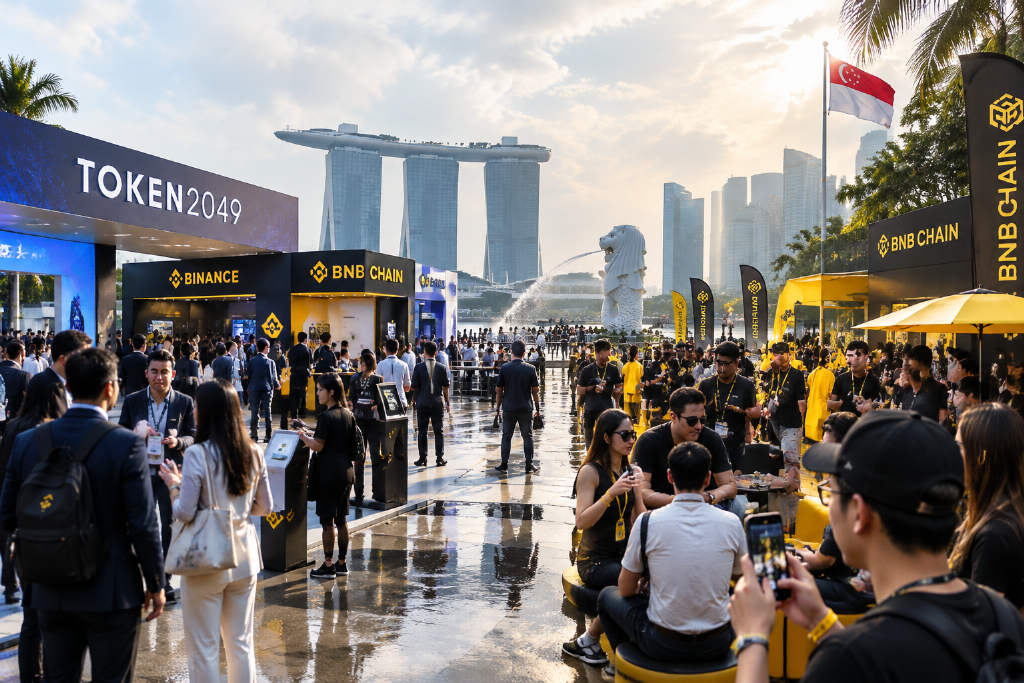
PANews writer Yue Xiaoyu shared what she saw after going to TOKEN2049 in Singapore. Her takeaway was pretty blunt: the main TOKEN2049 venue and the BNB Chain venue felt like two different worlds, even though both were part of the same industry event.
Her team set up booths at both sites, one inside the main TOKEN2049 event and one at the BNB Chain venue. That put them in a good spot to compare the two directly: who showed up, what kinds of exhibitors were there, and what people actually wanted to talk about.
Two venues, two distinct crowds
Yue said the split was impossible to miss. At the main TOKEN2049 venue, roughly 80% of the crowd was foreign. At the BNB Chain venue, roughly 80% was Chinese.
She said the booths at the main venue mostly fell into two buckets: exchanges and crypto payment projects. To her, that was a simple read on what the industry cares about right now.
The BNB Chain venue was another story. Yue said it was packed with leading BNB Chain projects across meme coins, stablecoin payments, on-chain contracts, and prediction markets. In her view, those tracks showed where the chain’s hottest areas are right now.
The people were different too. The main TOKEN2049 venue was filled mostly with project teams and industry professionals. The BNB Chain event pulled in more KOLs, traders, and whale holders. And she pointed out one more contrast: ticket checks at the main TOKEN2049 venue were strict, while the BNB event was semi-open.
Yue put it like this: if the main venue was a business bureau for crypto projects, then the BNB venue felt more like a fairground for Chinese-speaking market players.
Three kinds of people approached them at the main venue
At the main TOKEN2049 venue, Yue said the people who came up to start conversations mostly fit into three groups.
- The first group was crypto payment providers pitching fiat or crypto payment solutions.
- The second group was marketing agencies working on promotion across places such as Europe, the Americas, and Africa.
- The third group included other project teams and industry workers who were stopping by to browse and learn more about the project.
From her talks with payment companies, she said two-way fiat/crypto payment solutions already looked fairly mature. In her account, compliant overseas on-ramp and off-ramp channels, along with localized payment infrastructure, have already become standard needs for projects trying to expand globally.
On the marketing side, she said teams that want to grow overseas have to move toward more precise local operations by region. Different countries and markets are wildly different. What works in one place may not work in another. Simple as that.
As for the third group, Yue said they might not convert directly. But those conversations still matter. They help build awareness and raise the project’s visibility inside industry circles.
Online sentiment was gloomy, offline conversations were not
One thing hit her hard during the trip: the mood online and the mood offline did not match.
She said online communities are often flooded with market noise and negative emotion, and the overall tone tends to be pessimistic. Offline, though, she ran into a very different reality. A lot of industry participants and users were genuinely interested in the project, optimistic about where it was heading, and open to getting more involved.
She also said some highly engaged users gave useful feedback and wanted to help make the project better. That pushed her toward a broader view: online discussion is shaped more by emotion and price swings, while offline events are shaped more by value and relationships.
As she sees it, plenty of people online complain about a weak market and no opportunities. Offline, people are hunting for credible projects and making connections on purpose. Her argument was direct: people vote with their feet, and strong projects are easier to spot in person than they are online.
Should projects pay for a booth?
Yue also weighed in on a practical question: is it worth going to conferences, and should projects pay for booth space?
Her answer was direct. For early-stage startups, she does not recommend renting a booth at the main venue because the ROI is low. But for projects in a high-growth phase or already at a mature stage, she said it does make sense.
In her view, the real job of a booth at the main venue is not direct conversion, user acquisition, or instant partnership discussions. It is about brand display and showing visible strength. The biggest value is exposure—letting the industry know the project is there—while also giving teams an offline place to meet partners and contacts across the ecosystem.
She said that approach fits better for leading projects with strong resources and a branding need. That is also why the best booth spots on each floor are usually taken by major exchanges: the whole point is to show strength.
At the same time, she stressed that skipping a booth does not mean skipping the event. Quite the opposite. Just showing up in person and meeting face to face is still one of the most cost-effective things a team can do in crypto right now.
During the trip, she said the team had deep conversations with long-term partners, KOLs, and core power users, and built a strong sense of trust. She closed with a line that summed up her view of the trip: “Ten online chats are not as good as one in-person meeting. The noise is online, but the opportunities are offline.”