

On June 2, at the “Proof of Talk 2026” conference held at the Louvre in Paris, Tom Lee, Chairman of Bitmine (NYSE: BMNR)—the largest corporate treasury holding Ethereum—delivered a keynote titled “Crypto Spring: ETH is the Future of Money.” Lee asserted that the prevailing bearish sentiment actually marks a market bottom for Bitcoin and Ethereum, and forecast that as artificial intelligence and tokenization revolutionize financial infrastructure, Ethereum could eventually hit $250,000. On the day of his speech, BTC slipped below $66,000 and ETH touched $1,820, leaving Bitmine with an unrealized loss of roughly $8.86 billion on its ETH position. Lee also disclosed that Bitmine recently purchased an additional 111,942 ETH, bringing its total holdings to nearly 5.4 million ETH—approximately 4.47% of the circulating supply. In stark contrast, the Ethereum Foundation has been selling for years and now holds only 100,000 ETH, a negligible 0.1% of the supply.
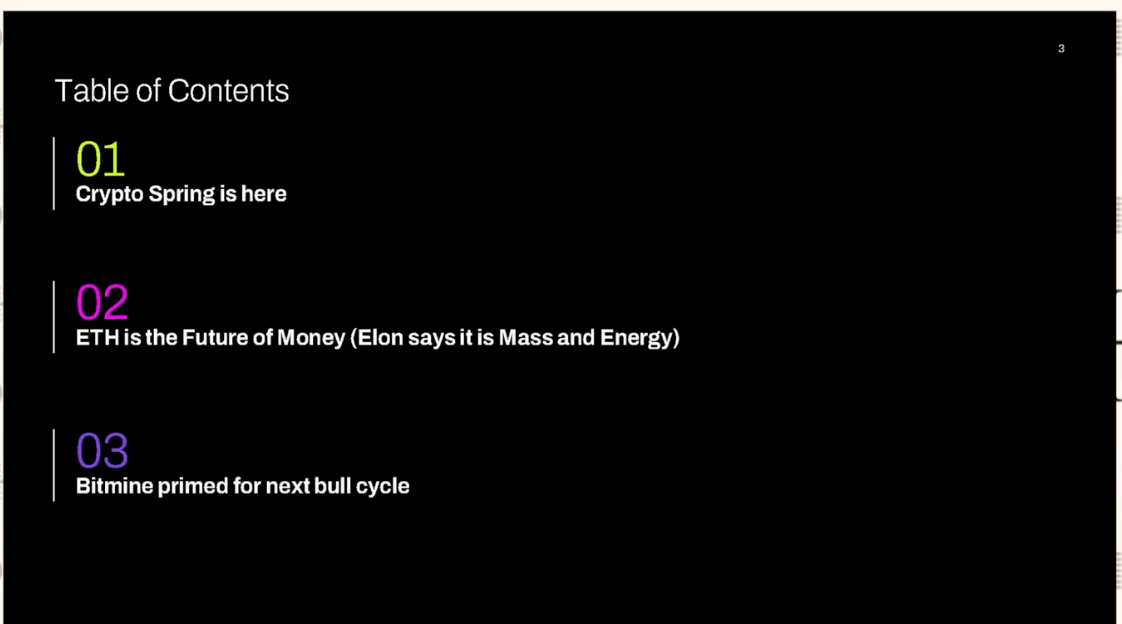
Five Tailwinds Fueling Crypto Spring
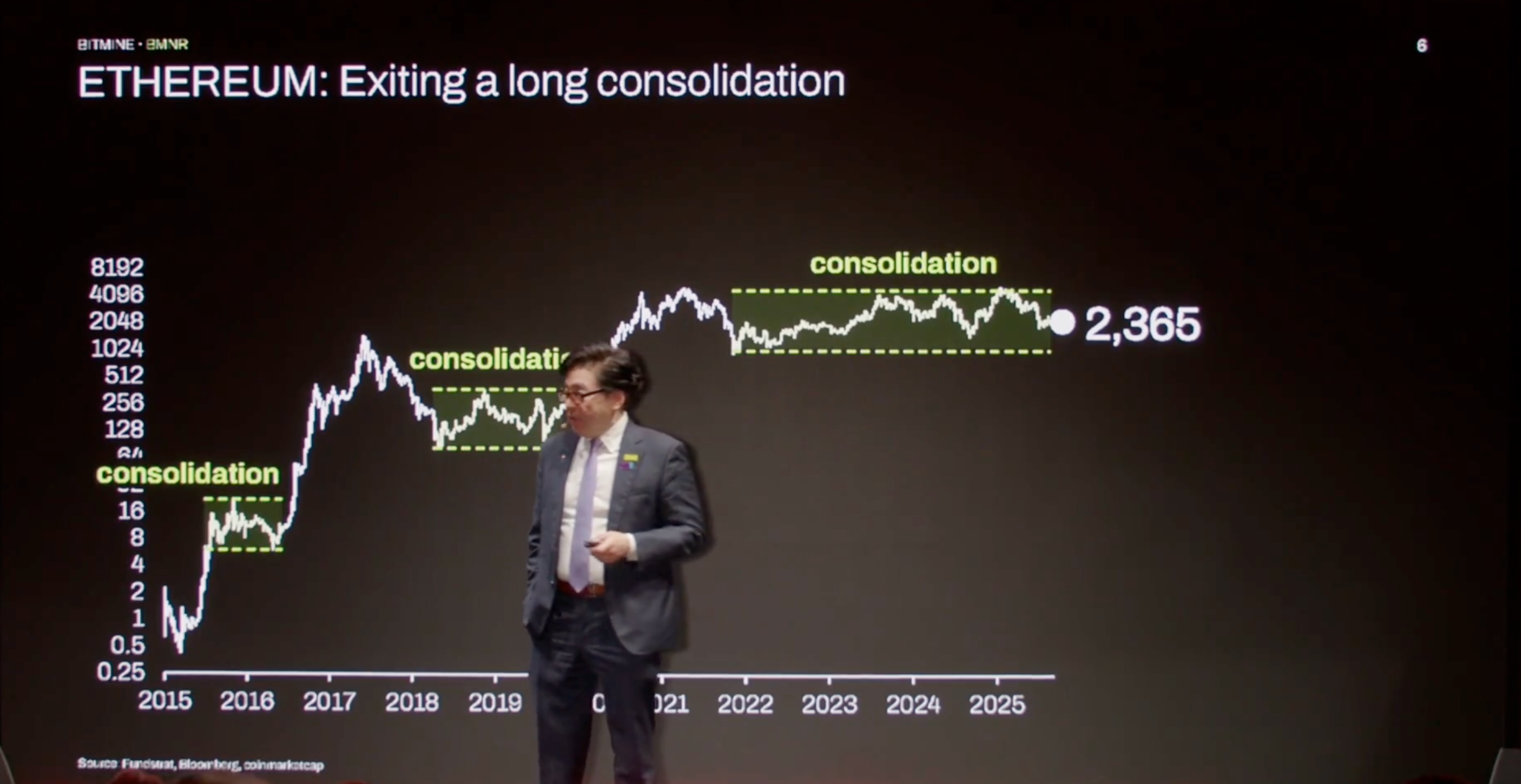
Lee attributed his bullish stance to five macroeconomic catalysts. The first is geopolitical relief on inflation: the Iran war has driven up oil prices, forcing central banks to tighten, but once the conflict ends the fear premium evaporates, potentially sending crude to $40 per barrel. Ethereum is currently exhibiting a historically high negative correlation with oil, so a drop in oil would be a substantial tailwind for ETH.
The second catalyst is the Clarity Act, which would provide a comprehensive legal framework for crypto in the United States. Although prediction markets price only a 56% probability of the bill being signed, Lee believes the real odds are much higher, and its passage would be a game-changer. Third, the White House’s support for Bitcoin and crypto, particularly around stablecoins, creates favorable dollar-policy dynamics. Fourth, new Federal Reserve Chair Kevin Warsh is openly pro-Bitcoin, adding a friendlier monetary backdrop.
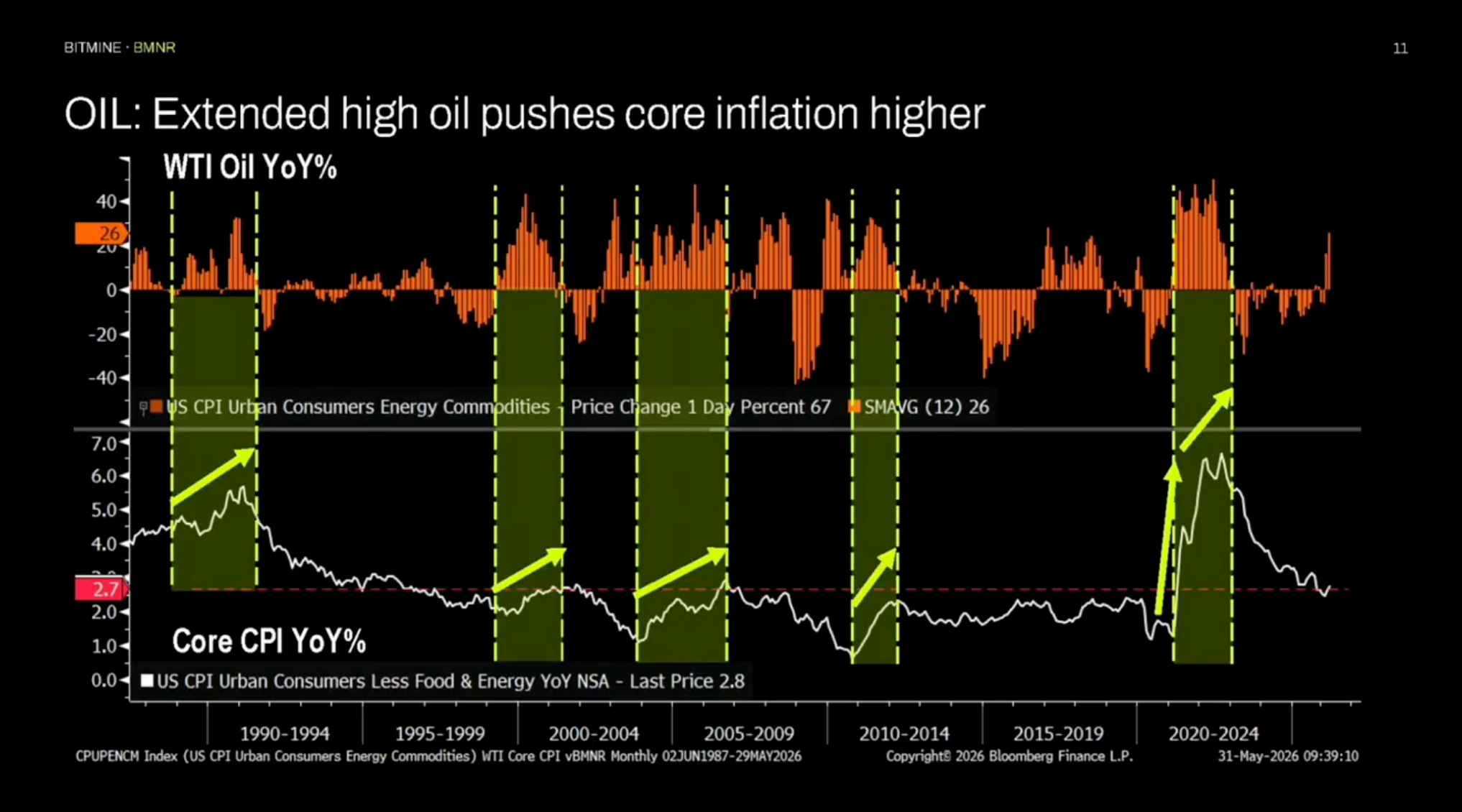
Fifth, demographic trends also work in crypto’s favor. Lee presented data showing that the size of the U.S. population aged 30–50 is tightly correlated with economic growth and equity returns, and with Millennials, Gen Z, and Gen Alpha entering their prime years, the S&P 500 could reach 15,000–18,000 by the end of this decade—a long-term tailwind for digital assets.
AI, Tokenization, and Ethereum’s Future
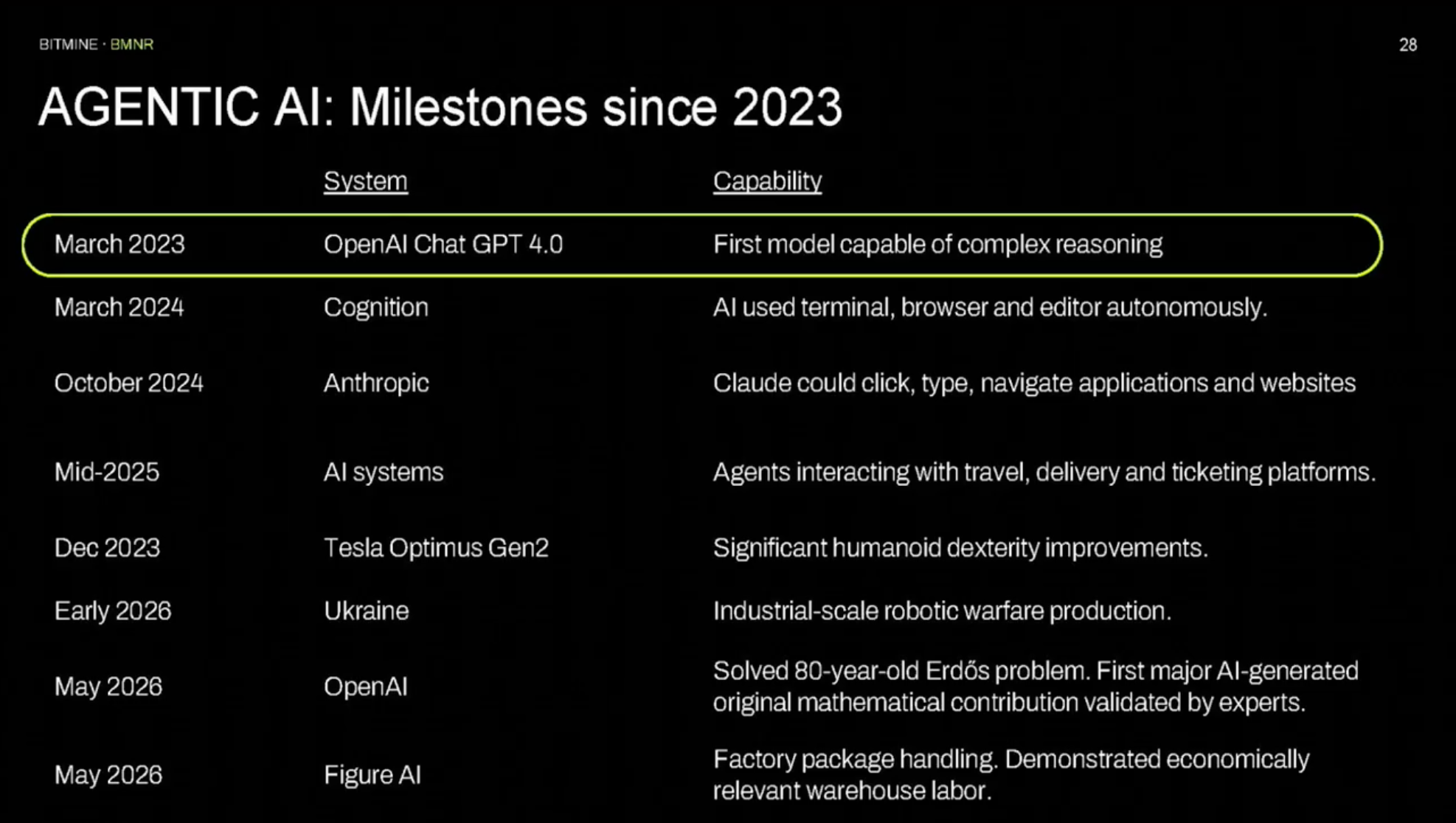
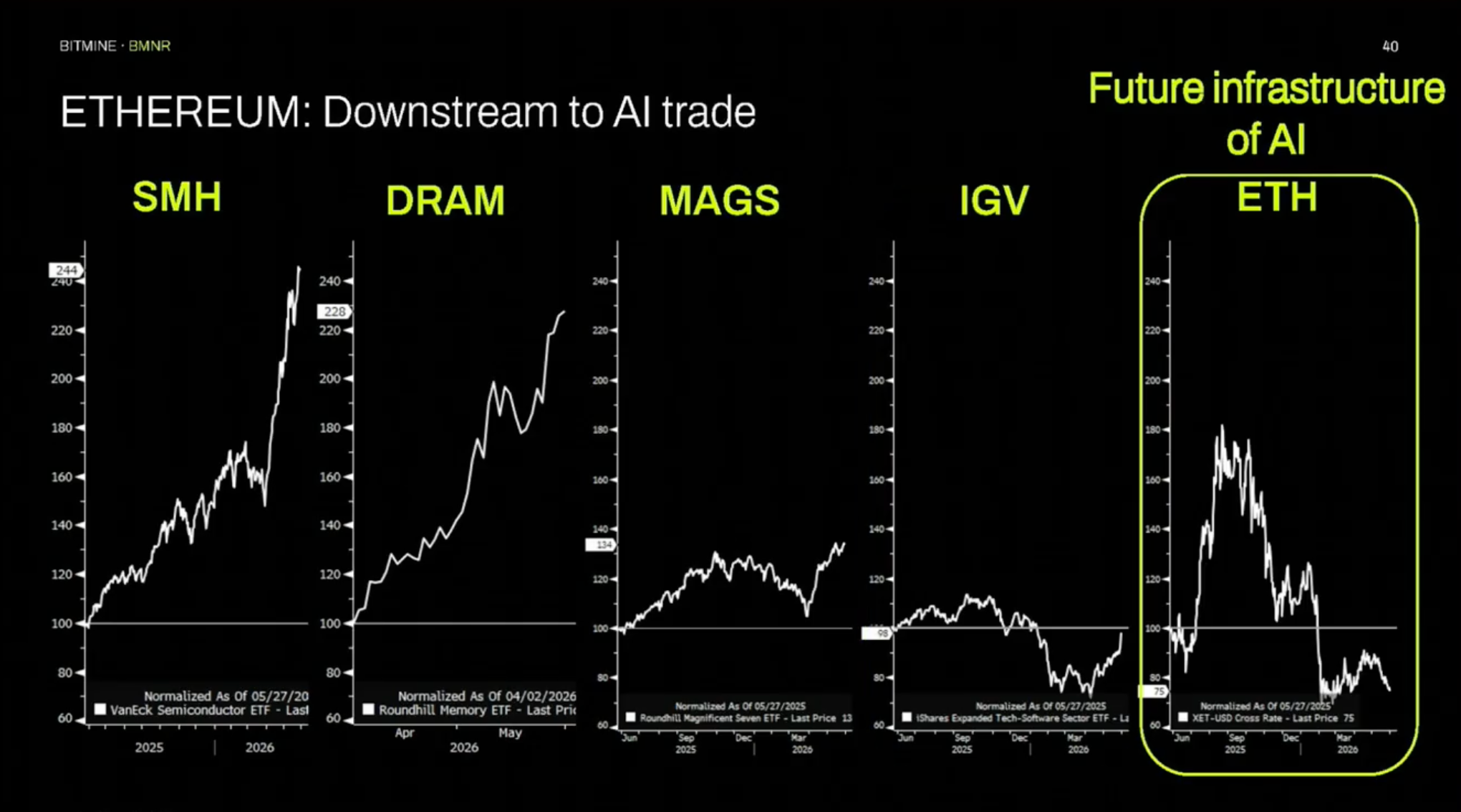
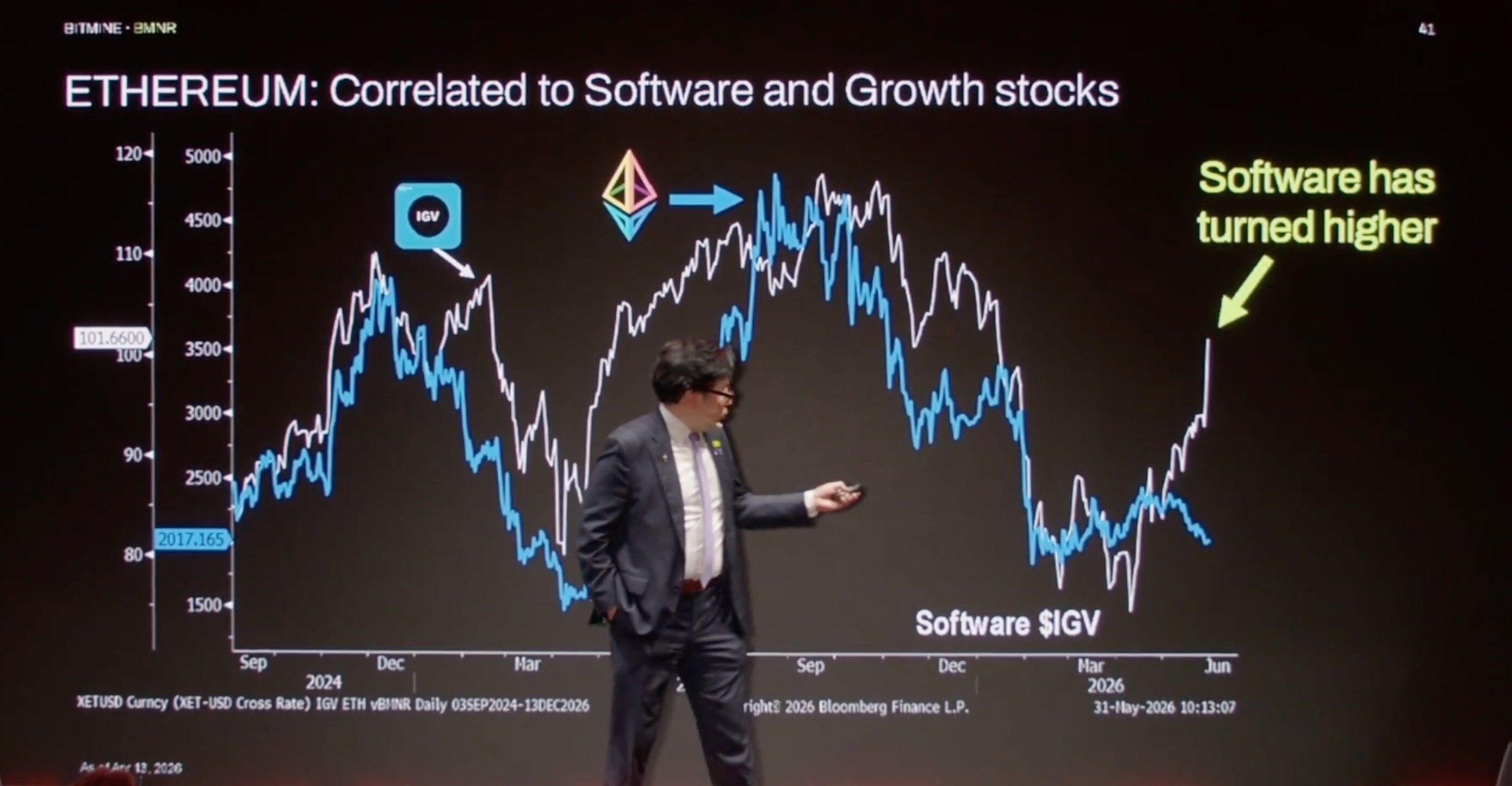
Lee stressed that artificial intelligence and tokenization are the two pillars of the crypto narrative. Since ChatGPT’s debut, breakthroughs in agentic AI, robotic web operation, and superhuman capabilities have accelerated, with robots set to dominate most internet traffic. Blockchain’s inherent advantages in identity verification, payment speed, and control make it the ideal infrastructure for governing robotic behavior. The stock market is already rewarding AI beneficiaries: semiconductors rallied first, then storage, and now software stocks have entered a parabolic phase. Given Ethereum’s long-standing correlation with software equities, Lee expects ETH to catch up within weeks.
On tokenization, stablecoin volumes have already surpassed Visa, and tokenized securities markets could reach $300 trillion, encompassing real estate, fixed income, equities, and derivatives. Crypto asset prices are closely linked to tokenized asset volumes, so Ethereum’s total value locked could expand dramatically from today’s levels. Lee illustrated the efficiency of crypto-native finance with Jane Street and Tether: Jane Street, with just 3,000 employees, generates $40 billion a year, nearing JPMorgan’s $60 billion in revenue; Tether, with only 300 staff, may earn $15 billion this year. Combined, they out-earn the world’s most profitable bank, and Lee forecast that within a decade, five of the top ten global financial institutions will be crypto-native companies.
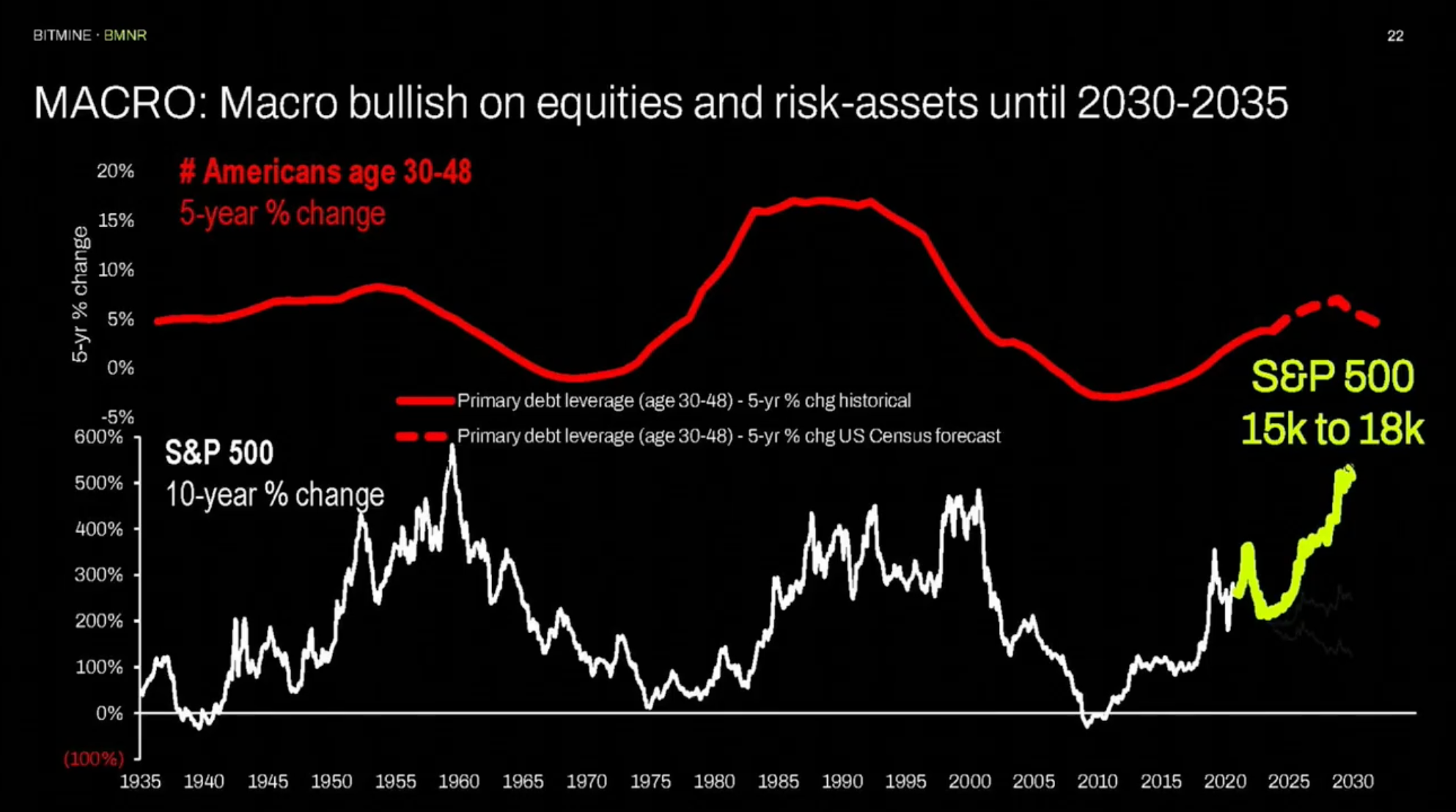
Lee also cited a Standard Chartered report comparing Ethereum to Amazon in its early days, when the stock stagnated at $6 before surging more than 1,000-fold. He sees roughly 50x upside for ETH as AI and tokenization take hold.
Ethereum Foundation’s Shrinking Role and the Rise of Treasuries
The Ethereum Foundation’s holdings have shrunk from an initial 17% to just 0.1% today—100,000 ETH, which at a 5% annual return would fund only about $10 million in grants. Lee pointed out that Ethereum treasuries such as Bitmine and Sharplink now control 7% of the circulating supply and generate $500 million annually in staking rewards, effectively replacing the foundation as the core funding source for the ecosystem. Bitmine alone holds 4.5% of the ETH supply, representing 65% of all ETH held by treasuries.
Lee argued that the Ethereum network—a $240 billion entity that has run for 11 years without a single outage, with 1,500 nodes across 89 countries and 15,000 developers—has grown too large for a single foundation to coordinate. Drawing analogies to the CTIA in mobile telecom, the Semiconductor Industry Association, and the National Association of Broadcasters, he suggested Ethereum already possesses the decentralized governance structure of such industry bodies, with multiple private companies and foundation spin-offs collectively managing the ecosystem. Bitmine is ready to fund these spin-offs.
Bitmine: Positioning for the Next Wave
Lee then detailed Bitmine’s strategic moves during this crypto winter. First, the company invested in Eightco (ticker ORBS), the largest publicly traded holder of Worldcoin, whose World ID provides critical proof-of-humanity in a robot-dominated internet. ORBS’s balance sheet also holds 28% of OpenAI equity, 8% of MrBeast, and 8% in ETH. Compared to peer Found Fund Rise (VCX), which trades at 13 times net asset value, ORBS looks dramatically undervalued at $1 per share—its fair value could be closer to $15.
Second, Bitmine launched MAVAN, the world’s largest Ethereum staking operation, managing about $14 billion in assets and extending to Solana, Hyperliquid, and other chains. Its own ETH staking generates roughly $1 million daily; cumulatively, across all managed assets, staking rewards during Lee’s 30-minute speech nearly touched $200,000. Third, Bitmine became a major shareholder in MrBeast, the world’s largest content creator, whose business has surpassed $1 billion in revenue with over 50% growth. MrBeast is now entering banking through the acquisition of Step Financial, and Lee sees him as the next Robinhood or SoFi for Gen Z and Gen Alpha. These two cohorts stand to inherit $50–60 trillion over the next two decades.
On the capital markets front, Bitmine has uplisted to the NYSE and is set to join the Russell 1000 index on June 26. Over $4 trillion in global funds benchmark to the Russell 1000, and currently only 25 institutions own Bitmine shares; approximately 1,575 active managers will need to decide whether to include it, creating a powerful catalyst for the stock.
Regarding ETH accumulation, Bitmine reached 1% of supply last August, 4% on April 10, and 4.5% on the day of the speech, with 5% possible by the end of June. Lee cautioned that the company will be judicious about crossing the 5% threshold and may slow purchases until a formal decision is made. He underscored that crypto treasury stocks have historically outperformed the underlying tokens: in the second half of last year, ETH rose 22% while Bitmine surged 500%; even during ETH’s decline this year, Bitmine has held up significantly better. Based on the 90% correlation between ETH price and Bitmine’s stock, a $250,000 ETH would value Bitmine shares at $5,000; a more modest $22,000 ETH would still yield a $500 stock price against the current $18.
Lee concluded by urging investors to consider crypto treasury stocks as a superior vehicle for gaining Ethereum exposure compared to holding the token directly.