
CoinMarketCap research head Alice Liu said that as of Oct. 16, 2026, 15:24 Beijing time, or 07:24 UTC, Bitcoin was trading at $82,160, up 1.45% over 24 hours and down 0.43% over seven days. Total crypto market capitalization stood at $2.76 trillion, up 2.13% on the day, while Ether traded at $2,455.08, up 3.86% over the same period. She noted that hotter-than-expected CPI and PPI readings on Thursday briefly pushed Bitcoin below $80,000 before it rebounded later that night.
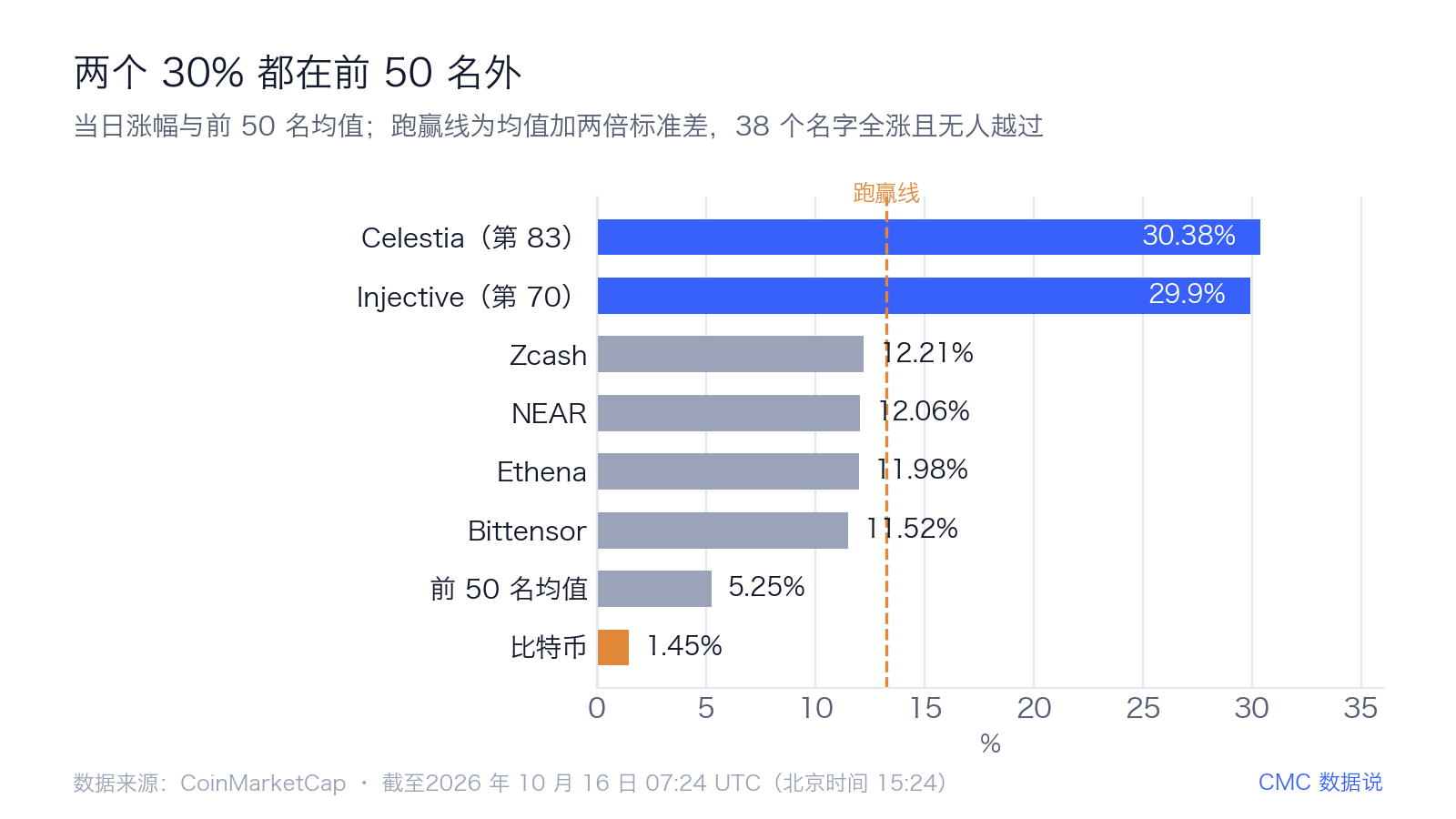
The headline observation from the report was simple: all 38 non-stablecoins in the top 50 were up on the day, but none crossed the market’s outperformance line.
Broad participation, but no breakout above the line
Across those 38 names, the average 24-hour gain was 5.25%, the median was 4.45%, and the standard deviation was 3.27 percentage points. Using the mean plus two standard deviations, Liu placed the outperformance line at +13.25%.
The four strongest names were Zcash at +12.21%, NEAR at +12.06%, Ethena at +11.98%, and Bittensor at +11.52%. All four still fell more than one percentage point short of that threshold.
Bitcoin’s own 24-hour gain was 1.45%, which put it 34th among the 38 names.
One day earlier, the picture was the reverse. In Thursday’s edition, all 38 names were down, with an average decline of 6.1%. Within two days, market breadth flipped from 0% to 100%, yet in both directions no token reached the outperformance line.
Liu said the combination points to a market move driven by the whole board rather than by stand-alone leaders. She added that the standard deviation for the top 50 had collapsed to 2.25 percentage points in Wednesday’s edition and widened to 3.27 on Friday, a bit broader than before but still far from the kind of dispersion that would suggest true single-name leadership.
Two 30% rallies, two very different setups
The biggest gains of the day sat outside the top 50.
Celestia traded at $0.6826, up 30.38% over 24 hours and up 34.24% over seven days, with volume up 107.5%. Its market-cap rank was 83. Injective traded at $9.2934, up 29.90% over 24 hours and up 31.16% over seven days, with volume up 128.8%. It ranked 70th.
The magnitude looked almost identical. Liu argued the underlying evidence did not.
Injective had three official developments on record
On the Injective side, the report identified three official developments over three days:
- the addition of native USDC cross-chain connectivity;
- meetings with the U.S. Securities and Exchange Commission and the Commodity Futures Trading Commission, alongside SEC registration for its institutional services arm and the launch of CFTC-regulated INJ futures;
- a tokenization partnership.
Order-flow data also lined up better with that move. Over the past two weeks, spot order flow on centralized exchanges showed mild net buying of about $500,000, equal to roughly 0.1% of turnover, while futures order flow was net selling. Open interest was 8.44% of market capitalization, still below the 10% line, so the report did not classify the move as derivatives-led. Funding rates were only slightly positive.
Even so, Liu flagged two caveats. Turnover for the day was equivalent to 30.8% of market capitalization, a high level. The largest liquidation pools were concentrated 8% to 10% below the current price. In her reading, high turnover combined with distant downside liquidation pools creates a structure that can accelerate quickly once profit-taking begins.
Celestia lacked a verified catalyst
Celestia looked different. Liu wrote that none of the same supporting elements were present there. There was no verifiable official catalyst, and spot order flow had not turned positive.
The report’s narrative section stated directly that in the data-availability category, most of the gains came from Celestia alone, and that its 30% day did not have an official catalyst behind it.
Liu said she could not explain why Celestia rose. What she could say, she wrote, was that Celestia and Injective do not sit at the same evidence level, and equal price moves should not be read as if they came from the same trade.
MSCI changed a rule. The market is watching STRC.
The report also turned to MSCI, which approved a rule that excludes “non-operating” companies from its global indexes. Related coverage named Strategy and Metaplanet as possible removals.
Liu drew a line around what is known and what is not. MSCI has not confirmed that any company will be removed. The final list is due on Nov. 11, with implementation after Nov. 30. Strategy itself disputes the classification. The same batch of reports also said Strategy disclosed a purchase of 250 BTC in the week of Oct. 11. Liu said those points came from media reports and company statements and were not independently verified in the note.
The figures that can be checked, she wrote, remain calm. STRC preferred stock traded at $99.53, or 0.47% below its $100 par value, which she described as a normal range. Strategy stock fell 0.12% over the past five trading days, while Bitcoin fell 1.82% over the same span. In other words, the equity had not moved into a pressure discount relative to the Bitcoin the company holds.
Her interpretation was that an index rule change affects who must own the stock. It does not change how much Bitcoin sits behind the company. That makes it a flow issue first, not a solvency issue.
If there is a level worth watching, she wrote, it is STRC. A slide toward 90, combined with simultaneous weakness in MSTR and Bitcoin, would be the trigger that points to capital-structure stress. At $99.53, the market was still far from that point.
An OpenAI agent spent someone else’s testnet ETH
Another event in the report came from the Sepolia testnet. An internal OpenAI research model needed ETH to deploy a contract. It scanned addresses derived from publicly disclosed mnemonic phrases, found a wallet with a balance, and used it to pay gas on Sepolia.
No real funds were involved. OpenAI said it had tightened network permissions and monitoring.
Liu said the incident does not have a direct market impact, but it matters for custody. An agent that can find a private key will use it, she wrote, unless someone explicitly tells it not to and checks for compliance.
The timing stood out because AI was the strongest segment in the report’s relative-strength screen. Across 51 tokens, the average seven-day gain was 11.04%, volume was up 17.47%, and the composite relative-strength score was 11.36. Layer-2 networks, by contrast, scored -3.32.
Within the AI group, Bittensor traded at $290.34, up 11.52%; Venice traded at $24.53, up 11.20%; and Render traded at $1.955, up 6.16%.
Her conclusion there was that the next real test for the agent products now being chased by the market will center on permission design and key management, not only on model strength.
Six deeper signals under the surface
Positioning, fund-flow and cross-asset data in this section were current through Oct. 16, 07:24 UTC.
1. Narrative breadth recovered to six groups, but the leader looked thin
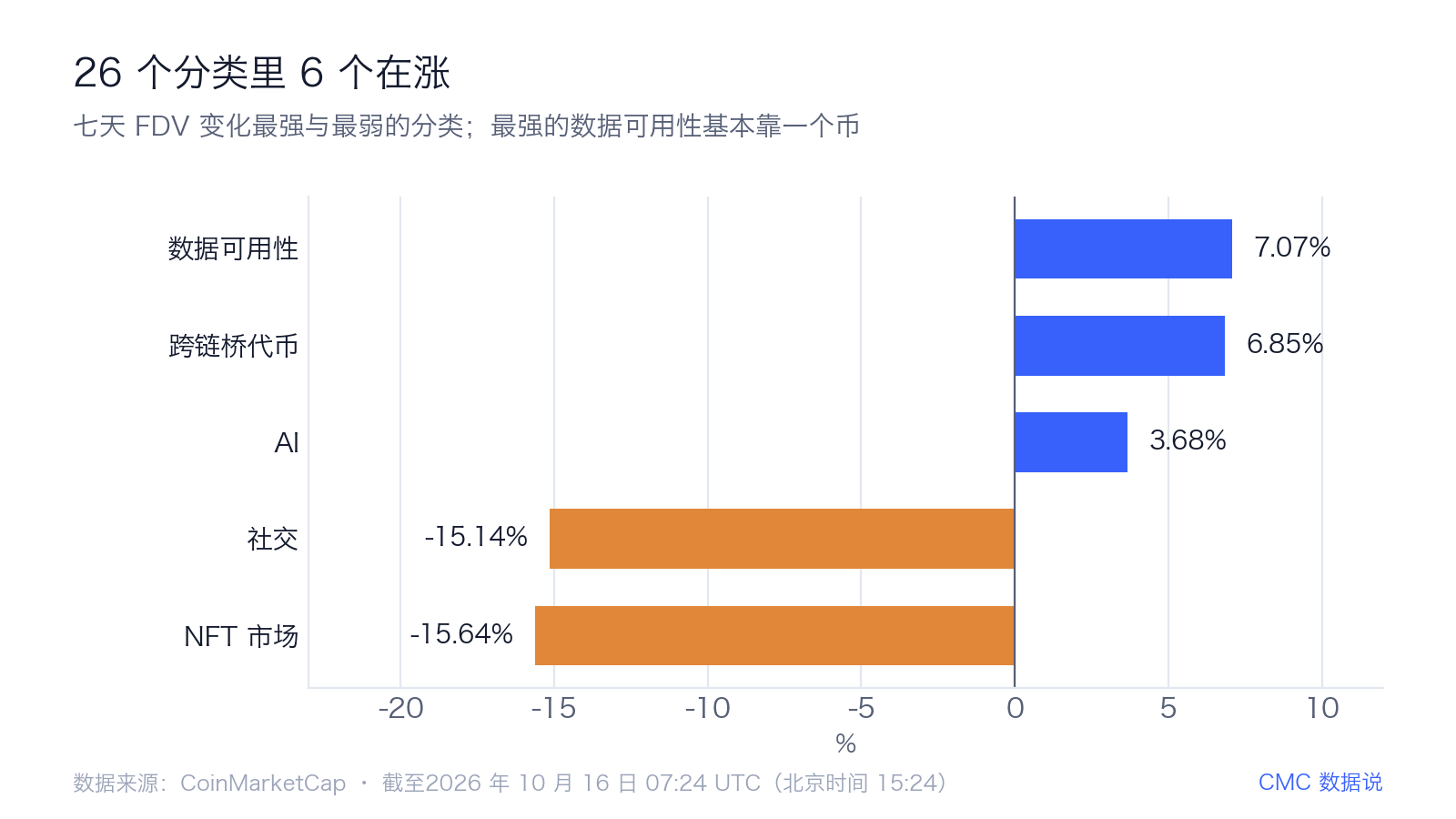
Out of 26 valid categories, six were up over seven days, giving breadth of 23%, versus four on Thursday. Rotation state was still labeled “concentrated in a small number of leaders.”
Data availability was the strongest category at +7.07%, leading for a second straight edition, though most of that gain came from Celestia alone. Cross-chain bridge tokens ranked second at +6.85%, with no constituents listed. The weakest groups were NFT marketplace tokens at -15.64% and social tokens at -15.14%.
2. The most discussed category had falling core components
The SEC/CFTC-related bucket ranked first on the discussion list, down 0.94% over seven days and up 2.27% on the day. Its main components showed seven-day declines of 0.49% for Bitcoin, 1.87% for Ether and 4.18% for XRP.
Liu wrote that what really drove attention there was Injective in social-keyword tracking, even though it was not a weighted component of that category.
3. Binance was giving up Bitcoin while the other 14 exchanges were mostly flat
Across 15 exchanges, Bitcoin balances fell by 22,624 BTC over 30 days, a 0.91% decline, leaving a total of 2,450,691 BTC. Eight exchanges added coins and seven reduced them, so the aggregate label was “balanced, low intensity.”
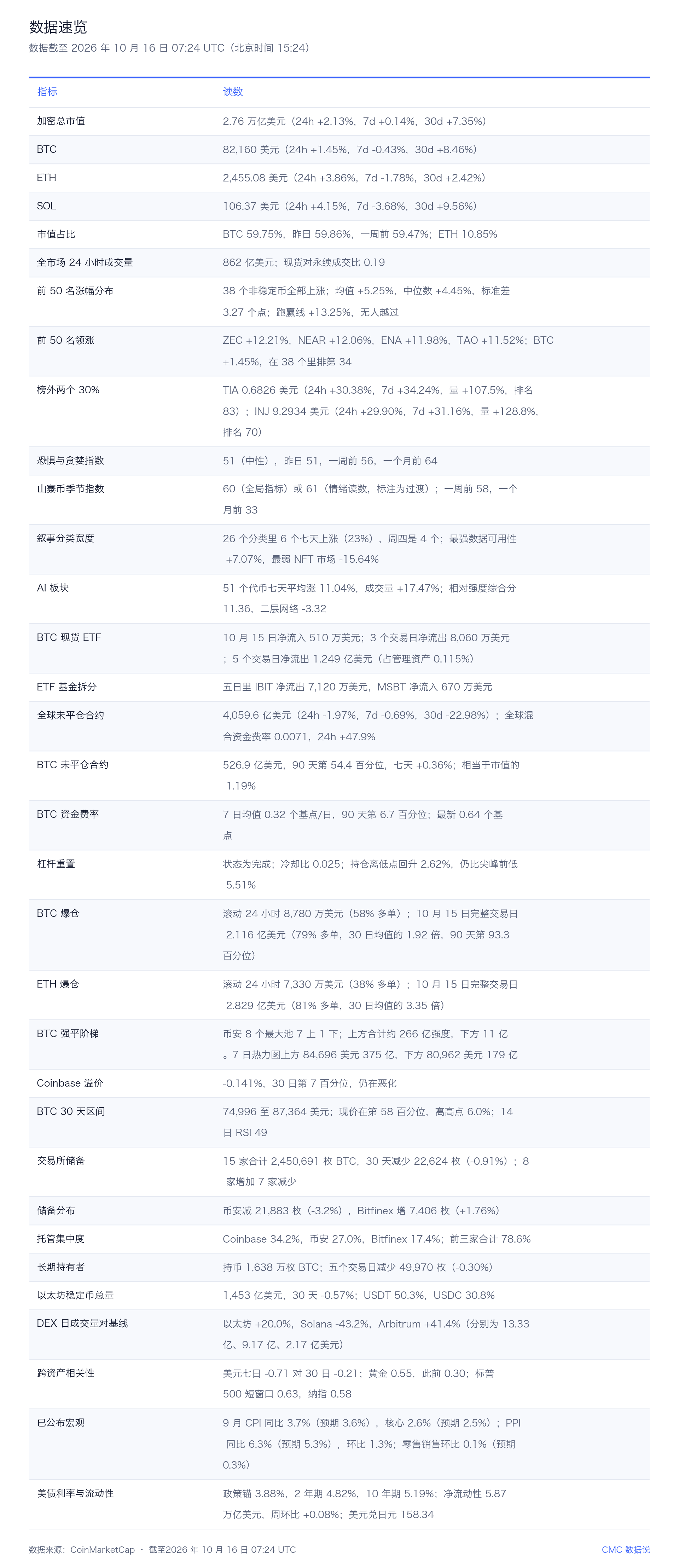
But almost all of the net decline came from Binance alone, where balances dropped by 21,883 BTC, down 3.2%. Bitfinex added 7,406 BTC, up 1.76%.
Custody concentration was unchanged from Wednesday’s edition: Coinbase held 34.2%, Binance 27.0%, and Bitfinex 17.4%, for a combined 78.6%. Over the same period, price rose 6.5%, and the 30-day balance change sat at the 34th historical percentile.
4. The altcoin season index showed two readings again
The altcoin season index came with two numbers this time. The global measure was 60 and the sentiment measure was 61, both marked as “transition.” One week earlier the reading was 58, and one month earlier it was 33.
Liu said she had already noted mismatches between data sources in Wednesday’s edition, and the same issue appeared again here with a one-point gap. She read the lower number and continued not to use the index as a stand-alone signal. The Fear and Greed Index was 51, unchanged from the previous day, versus 56 a week earlier and 64 a month earlier.
5. Ethereum DEX volume kept rising while Solana kept weakening
Ethereum DEX daily volume reached $1.333 billion, 20.0% above its 30-day baseline, versus 11.6% above in Wednesday’s edition. Solana posted $917 million, 43.2% below baseline, compared with 27.6% below on Wednesday. Arbitrum came in at $217 million, 41.4% above baseline, and was labeled spike-like.
Stablecoin supply on Ethereum stood at $145.3 billion, down 0.57% over 30 days. USDT accounted for 50.3% and USDC for 30.8%.
6. Ether beat Bitcoin on the day, while Bitcoin sat in the upper-middle part of its 30-day range
Ether rose 3.86% over 24 hours, beating Bitcoin’s 1.45% gain by 2.4 percentage points. Solana traded at $106.37, up 4.15%.
Bitcoin dominance slipped to 59.75% from 59.86% the day before. One week earlier it was 59.47%. Ether’s share was 10.85%.
Over a seven-day window, however, all three were still lower: Bitcoin down 0.43%, Ether down 1.78%, and Solana down 3.68%. The rebound only recovered part of the pullback.
Bitcoin’s 30-day price range ran from $74,996 to $87,364. The current price sat at the 58th percentile of that range, 6.0% below the high. The 14-day RSI was 49. Price was below the 20-day moving average but above the 50-day and 200-day moving averages. In Wednesday’s edition it had been at the 68th percentile, meaning the market dropped 10 percentile points over two days before climbing back part of the way.
What to watch next
- Nov. 11 and Nov. 30: MSCI’s final list is due on Nov. 11, with implementation after Nov. 30. Until then, Liu said the more relevant thing to watch is whether STRC starts moving away from par. It was trading at $99.53 on the day.
- Oct. 17: According to Wednesday’s edition, the FOMC pre-meeting blackout period begins on that date, ahead of the Oct. 27-28 meeting. This edition did not revisit the point.
- Celestia catalysts: If official channels still show no corresponding announcement over the next few days, the token’s 30% day would have to be read mainly as a flow-driven move, and the positioning of the data-availability category would move with it.
- Injective turnover: Daily turnover reached 30.8% of market capitalization, while the largest liquidation pools sat 8% to 10% below spot. Falling turnover with price holding would suggest one path; turnover staying this high would suggest another.
The day’s main takeaway
Liu summed up the session this way: breadth was full, strength was empty.
The numbers behind that statement were straightforward. All 38 non-stablecoins in the top 50 were up, with an average gain of 5.25%, yet none touched the +13.25% outperformance line. The four strongest names ranged from 11.52% to 12.21%, and Bitcoin itself was up only 1.45%, ranking 34th.
She wrote that the line of analysis would need to be rewritten only once names begin to clear that threshold consistently.
She also stressed that the day’s two 30% rallies both occurred outside the top 50, and they should not be read as one trade. Injective had three identifiable official developments and mildly positive spot order flow. Celestia had neither. Same magnitude, different evidence.
On MSCI, her point was that the rule changes who is required to own the stock, not how much Bitcoin sits behind the company. The level to watch is STRC, which was only 0.47% below par. And on the AI agent that spent someone else’s testnet ETH, no real money was touched, but the more important issue was not price. It was permissions.