
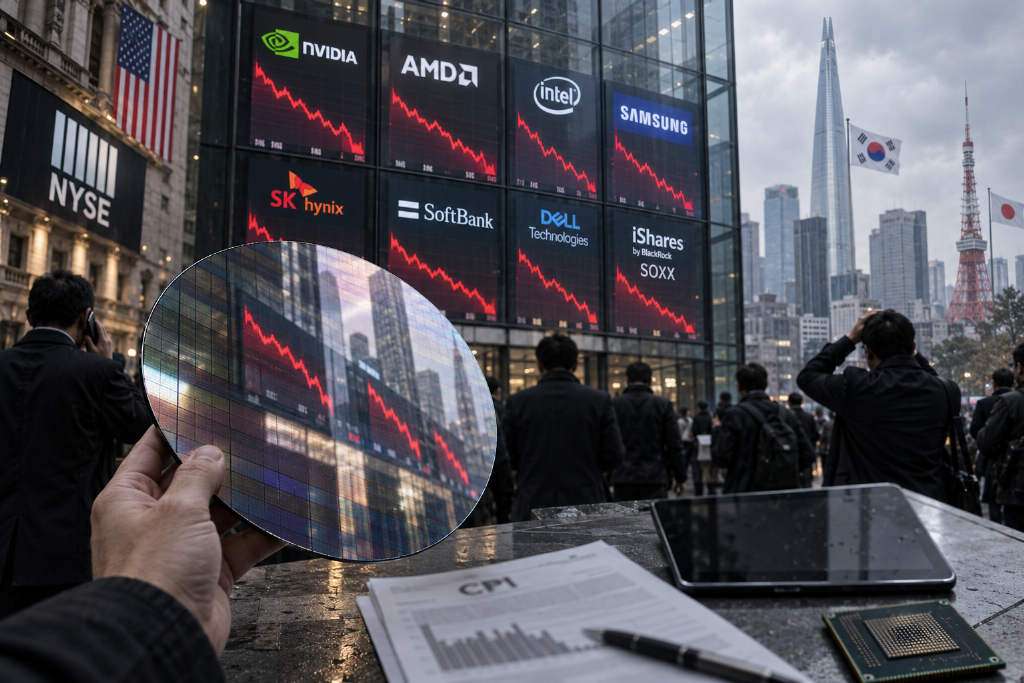
Global technology stocks remained under pressure this week, with CNBC reporting that more than $1 trillion in market value had been wiped from the world’s 20 largest AI and semiconductor stocks by Thursday.
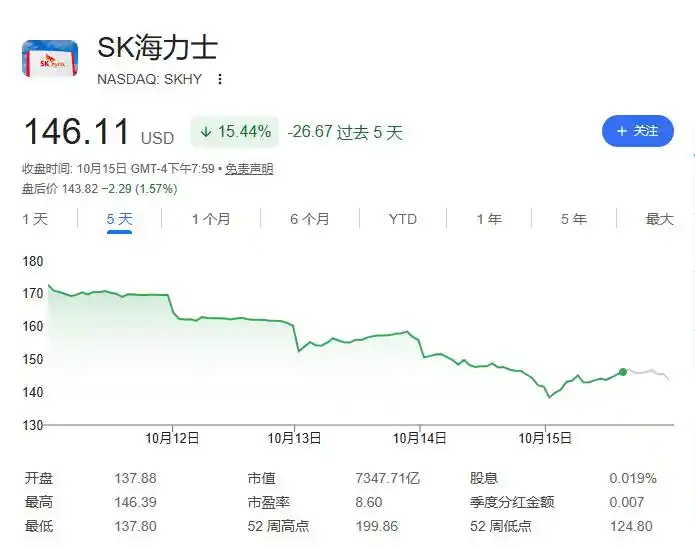
The sell-off continued in U.S. trading on Thursday. NVIDIA closed down 1.84%, AMD fell 1.5%, Intel lost about 2.8%, and Dell Technologies dropped 6.8%. Losses were sharper in Asia, where SK Hynix plunged more than 10% in a single session, Samsung Electronics fell 8.73%, and Japan’s SoftBank Group dropped 7.9%.
The iShares Semiconductor ETF (SOXX), which tracks the chip sector, fell for an eighth consecutive trading day on Thursday and is down about 12.7% over that span. Dow Jones Market Data said that is the ETF’s longest losing streak in 11 years.
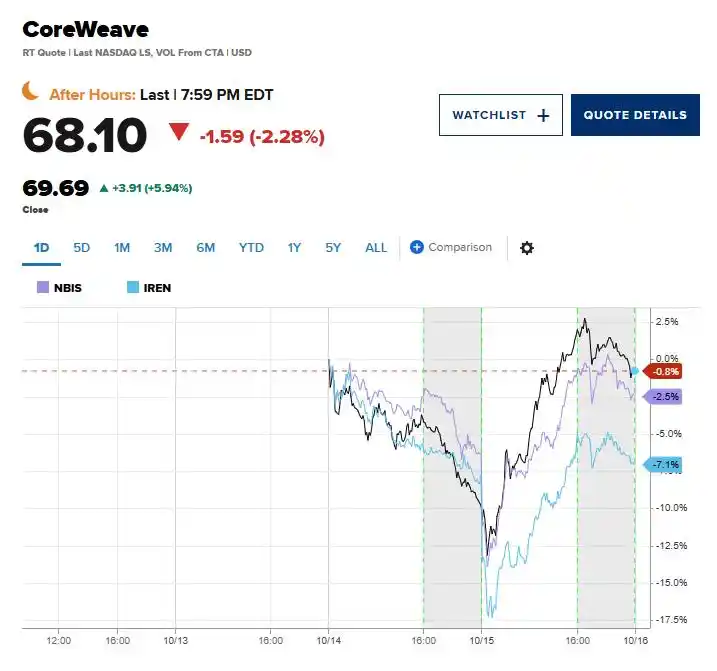
There was some separation within the group during the session. Speaking in Stockholm, NVIDIA CEO Jensen Huang told Bloomberg that he does not believe NVIDIA needs to stand behind CoreWeave, adding that 「their cost of capital is actually coming down」. His remarks helped neocloud names rebound intraday, with CoreWeave rising 5.94% and Nebius up 1.29%.
Inflation, funding pressure, and competition hit at the same time
The retreat was not driven by one headline alone. Several negative factors appeared together and reinforced one another.
Inflation data set the tone. The U.S. September consumer price index, released on Wednesday, came in above expectations, prompting markets to increase bets that the Federal Reserve could raise rates again. The Nasdaq Composite fell 1.88% on Wednesday to 26692.87, while the S&P 500 dropped 1.11% to 7718.94.
Anthropic’s latest figures added to the pressure. The Financial Times reported that the AI startup told investors at a private meeting on Wednesday that third-quarter revenue reached $16.8 billion, up about 50% from the prior quarter. That pace, however, was well below the roughly 145% quarter-on-quarter increase recorded in the second quarter.
D.A. Davidson analyst Gil Luria wrote in a client note: 「The market seems to be reading Anthropic’s update as a negative signal, and given how sensitive the market already is to the AI trade, that reaction is understandable.」
Luria himself took a more measured view. He said Anthropic generated positive cash flow in the third quarter, which suggests that Anthropic and OpenAI are 「not inherently unprofitable business models」. He also wrote that, at a broader industry level, 「overall AI usage (and AI spending) may not be slowing.」
Competition from China was also part of the backdrop. ChangXin Memory Technologies said over the weekend that it had made a breakthrough with a new architecture that can store more data in less space. Elon Musk then wrote on X that China will produce 「a lot of memory chips」 in 2028.
At the same time, the chief executives of Broadcom and Intel both warned on Monday that financing could become a major obstacle to AI expansion. Broadcom CEO Hock Tan said the challenge may even outweigh chip or power shortages.
Higher rates are hitting AI infrastructure returns
One of the central arguments behind the sell-off is that a high-rate environment directly weakens the economics of AI infrastructure investment.
James Vrachas, managing director at Post Oak Group, told MarketWatch that chip stocks have already 「priced in a lot of future growth expectations」. Against that backdrop, he said, 「even a small shift in sentiment or questions around spending can have a significant impact on share prices.」 He added: 「Believing in AI’s long-term potential is different from believing every company that benefits from that growth is fairly valued.」
Ross Mayfield, an investment strategist at Baird, told MarketWatch that rising Treasury yields are weighing on chip stocks, especially high-growth companies and firms on the more aggressive end of the 「AI risk spectrum」 that depend more heavily on outside capital. He said the CPI report could increase the urgency around further Fed tightening, 「putting enormous pressure on the front end of the curve and hitting borrowers with weaker financial foundations, or floating-rate debt tied to short-term rates, especially directly.」
Mayfield also said even hyperscalers are not fully insulated from higher rates. 「Even the biggest, most cash-rich companies have to reassess the return on investment on these projects,」 he said. 「And because much of the market’s momentum has been built on hyperscaler spending on hardware and data-center infrastructure, that casts a shadow over the whole supply chain.」
Asia and Europe fell harder than the U.S.
The weakness in U.S. tech stocks quickly spread to Asia and Europe, and in many cases the declines were deeper.
In South Korea on Thursday, SK Hynix fell more than 10%, Samsung Electronics dropped 8.73%, LG Innotek lost 8.95%, Seoul Semiconductor fell 9.28%, and Samsung SDI declined 6.26%. The Kospi approached its lowest closing level since April.
Japan also saw steep losses. SoftBank Group fell 7.9%, semiconductor test equipment maker Advantest sank nearly 14%, chip equipment supplier Tokyo Electron lost 6.45%, and Renesas Electronics fell 8%. TSMC dropped 1.81%.
In Europe, Dutch chip-equipment company ASML edged lower, Infineon fell 5%, and ASM International dropped 7%.
Analysts say demand signals matter more than rates
Even with sentiment weak, some analysts said the current sell-off has not yet shown a meaningful deterioration in AI demand.
Dan Ives, a technology analyst at Yorkville Ives, wrote in a report that the pullback reflects concern about funding costs rather than doubts about demand for AI compute. 「U.S. Treasury yields above 5% do raise financing costs for these infrastructure projects, and it is reasonable for investors to focus on balance sheets and contract structures, but rates are a financing issue, not a demand issue.」
Ives said he sees the move as a buying opportunity and argued that the AI infrastructure buildout is still in its early stages. He listed the signals that would change his view: hyperscalers cutting capital expenditure plans, contract cancellations, or lower GPU rental prices. 「What would really change our view is a demand signal, not an interest-rate signal.」
Hendi Susanto, a portfolio manager at Gabelli Funds, told MarketWatch that many chip and semiconductor equipment companies still have 「healthy balance sheets and strong free cash flow」. He expects most of them to 「finish the year in strong shape」, especially those where demand still exceeds supply. He also said the coming tech earnings season will show 「the extent to which investors have priced inflation worries in」.
The original article stated that it came from the WeChat account Huarjie Jianwen Max and was written by Long Yue. It also said the article does not constitute personal investment advice, does not represent the platform’s view, and that readers should make independent judgments and decisions.