
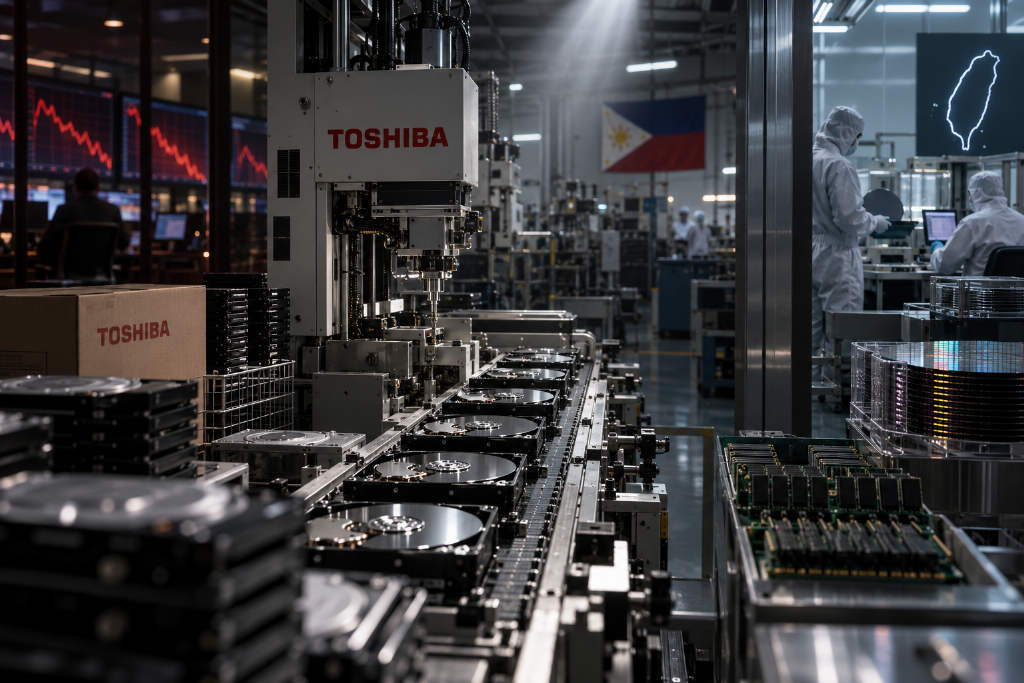
A Nikkei report that Toshiba plans to spend about JPY 60 billion to expand a factory in the Philippines and double hard disk drive, or HDD, output sent U.S. storage stocks sharply lower last Friday. Seagate and Western Digital both dropped hard, and the selling pressure spread through passive exchange-traded funds into other memory-related names.
Moore Investment analyst Lin Han-Wei said the sell-off was, at its core, an irrational spillover from expectations of higher HDD supply. He argued that Taiwan’s memory industry is concentrated in DRAM, niche ICs, modules, and packaging and testing, with very limited overlap with the HDD business, so investors should not overstate the negative read-through.
Toshiba expansion plan hit HDD leaders and spilled into ETFs
According to the Japanese media report, Toshiba wants to ease tight capacity in large-scale data storage driven by AI demand. The company is planning to invest roughly JPY 60 billion, or more than TWD 10 billion, to expand its Philippine plant and raise HDD output by 100%.
The news quickly fueled concerns about oversupply. Shares of Seagate (STX) and Western Digital (WDC), the two biggest HDD players globally, each fell more than 10% in one day. Because a number of global ETFs now bundle data storage and memory stocks together, the slide in STX and WDC also triggered program-driven rebalancing. That pressure pulled down SanDisk, which is tied to NAND Flash, and Micron as well, creating the impression of a broad collapse across the storage segment.
Taiwan suppliers are operationally detached from HDD, but near-term trading may stay soft
The analysis breaks the Taiwan impact into business exposure and capital flows, and says the two should be separated.
Little direct HDD risk for Taiwan companies
Taiwan semiconductor and electronic component makers are not major participants in heavy-asset HDD manufacturing such as heads and platters. Their core businesses are DRAM wafer production, Flash controller chips, memory modules, and advanced backend packaging and testing. On that basis, Toshiba’s Philippine expansion, which is aimed at traditional HDDs, does not directly damage the fundamentals of Taiwan memory names.
Short-term caution may still weigh on the group
Even without a fundamental hit, weakness in U.S. storage stocks could still affect sentiment. The report says Taiwan memory shares may face cautious buying interest at the open and a lack of immediate news catalysts. If the broader market is pushing toward new highs while AI leaders attract capital, memory stocks could lag in the short run.
Longer-term supply and demand trends are unchanged
Lin said the broader structural gap in memory and storage remains in place as international technology companies including Meta accelerate open-source AI Agent models. That trend is driving upgrades in edge computing, AI PCs, and high-end server hardware. In his view, a short-term pullback could instead create room for longer-term positioning.
Focus shifts back to HBM expansion and company guidance
Compared with what the report describes as a false negative signal from Toshiba’s HDD move, the more relevant issues for Taiwan names are Micron’s reported HBM expansion in Taiwan and upcoming September revenue releases and earnings call outlooks.
First group to watch: Micron-linked HBM and advanced packaging names
Micron is said to be expanding high-end HBM, or high-bandwidth memory, capacity across four sites in Taiwan. That would directly support demand for advanced packaging and memory testing. The report points to Powertech Technology (6239) and ChipMOS (8150), both tied to Micron and advanced packaging and testing, as well as Powerchip Semiconductor Manufacturing (6770) and HBM IP company AP Memory (6531), as names with operating momentum.
IC design names with stronger fundamentals
ESMT (3006) reported September revenue of TWD 7.46 billion, up 470% from a year earlier and the second-highest level in its history, with steady profit performance through the first three quarters. The analysis says that if the stock group opens lower with the broader market and retests monthly or five-day moving averages, revenue strength could still offer support.
Standard DRAM makers remain supported by tight supply
Nanya Technology (2408) and Winbond (2344) are still benefiting from a squeeze effect as Samsung, SK hynix, and Micron shift capacity toward higher-margin HBM4. That has kept supply of standard memory relatively tight. The report says investors are watching monthly moving-average support for Nanya, while Winbond may need to wait for institutional selling pressure to ease and positions to settle before a catch-up move becomes more likely.
Analyst says HDD and semiconductor memory should not be conflated
Lin said the market often mixes up HDDs with semiconductor memory such as DRAM and Flash. In this case, Toshiba’s expansion is an internal capacity adjustment within the HDD segment, while the broader selling pressure mainly came from ETF basket trading. For Taiwan memory stocks, he said, the more relevant framework is still revenue, earnings, and the structural support created by global manufacturers shifting capacity toward HBM.