
Walden Robotics, a company spun out of Toyota Research Institute, came out of stealth on July 15 and disclosed a $300 million seed round alongside an $1.1 billion valuation.
The round was co-led by Toyota and Deviation Capital. NVIDIA, Boeing, Samsung Ventures, Prologis Ventures and CoreWeave Ventures also participated. Walden reached unicorn status roughly six months after it was formed.
A new unicorn spun out of Toyota Research Institute
Walden Robotics was spun out of Toyota Research Institute, or TRI, in January. Before announcing the financing, the company had stayed out of public view.
The name Walden was inspired by Henry David Thoreau’s Walden. The company links that reference to its own question: how robots might help people find more meaning in work and life.
Co-founder and CEO Russ Tedrake has argued that general-purpose robots powered by physical AI are a disruptive technology at a key inflection point. He has also said robotics companies still need to prove unit economics and work closely with customers if they want to succeed commercially.
As a standalone company, Walden is positioning itself to commercialize robotics work developed inside TRI and move it from the lab into production settings. The company said it wants to keep validating its products in real-world environments through partnerships with large manufacturers and logistics operators, with the goal of fitting into actual workflows and delivering clear cost savings and efficiency gains.
Tedrake is a professor at the Massachusetts Institute of Technology and previously led TRI’s robotics and machine learning team for nearly a decade. That group contributed to research including Diffusion Policy, Universal Manipulation Interface, Large Behavior Models, OpenVLA and the open-source simulator Drake.
Walden’s founding team also includes CTO Ben Burchfiel, COO Kerri Fetzer-Borelli, Chief Product Officer Dave Johnson, Chief Strategy Officer Adrien Gaidon, Chief Architect Siyuan Feng and AI lead Rares Ambrus. Several of them also led TRI’s Large Behavior Models research program and worked on model architecture, training, simulation and evaluation.
Compared with a typical startup, Walden begins from a different position. It inherits decades of robotics research from TRI, while Toyota serves not only as a key investor but also as its earliest industrial partner, supplying initial production environments for deployment.
Toyota’s manufacturing system shortens the path to commercial validation
A common problem for embodied AI companies is the gap between technical development and commercial deployment.
Robots need high-quality data from real environments, yet early products often struggle to convince enterprise customers because of reliability and economic questions. Without deployment settings and data, models have a harder time covering edge cases in the physical world, and product performance becomes harder to improve over time.
Walden starts with access to Toyota’s production system, which may shorten that validation cycle. Toyota is the incubation source, a core investor and a provider of the first deployment environments. That means Walden does not have to find industrial customers from scratch or build a separate mock factory for testing. It can enter existing workflows directly, define tasks with manufacturing teams, adjust equipment and measure return on investment in place.
The value of that industrial backdrop goes beyond giving robots a place to “train.” Whether an industrial robot creates economic value depends on factors such as task frequency, equipment utilization and safety requirements. Tasks that look strong in a lab do not necessarily make sense once they are moved into a factory.
Toyota’s long experience in manufacturing and automation can help Walden prioritize processes that fit current technical capabilities while also offering a clear commercial payoff. That lowers the risk of building products that do not match customer demand.
Walden’s investor base also opens possible channels into external deployment settings. Beyond Toyota, Boeing, Samsung Ventures and Prologis Ventures connect the company to aerospace manufacturing, electronics and logistics infrastructure. NVIDIA and CoreWeave add links to robotics compute and AI training resources.
Those backers could become collaboration resources over time. After Toyota helps solve the early-stage problem of access to data and operating environments, Walden’s longer-term value may depend on whether its technology and operating system can move beyond Toyota and become a standardized product for a wider set of manufacturers.
Large Behavior Models sit at the center of the product strategy
Walden’s technical system is built around Large Behavior Models, or LBM, a line of research inherited from TRI.
Unlike large language models for text generation, LBM must process visual input, robot state, tactile or other sensor data, and task instructions at the same time, then produce continuous actions. The aim is not to write a separate program for every job. It is to train one model on multitask data so that skills can be learned once and transferred across tasks.
That approach draws on years of robotics learning research at TRI. Diffusion Policy is one of the better-known foundations. Traditional industrial robots usually depend on preset trajectories and workstation conditions. If part locations, equipment layouts or production workflows change, engineers often have to reprogram and retune the system. Diffusion Policy learns action distributions from human demonstrations, extracting patterns from vision, action and robot-state data before attempting to reproduce them autonomously.
LBM extends that logic by putting multiple tasks into a single pretraining framework. TRI previously disclosed research that used nearly 1,700 hours of robot data, 1,800 real-world tests and more than 47,000 simulation tests. According to those results, a multitask pretrained model needed markedly less data than a single-task model trained from scratch when learning some new tasks.
That research underpins Walden’s product thesis: robots should not depend on engineering teams to program each workflow one by one, but should be able to adapt to new operations from a small number of demonstrations. For industrial customers, that kind of system is aimed at manufacturing environments with many product types and frequently changing tasks. Compared with conventional automation that repeats fixed motions, a learning-based robot could switch processes and tasks with lower retrofit costs.
At the moment, Walden is combining autonomous operation with remote human assistance. The robot handles routine tasks it already knows how to do on its own. When it encounters unusual objects, environmental changes or conditions outside the model’s capability range, a remote operator steps in.
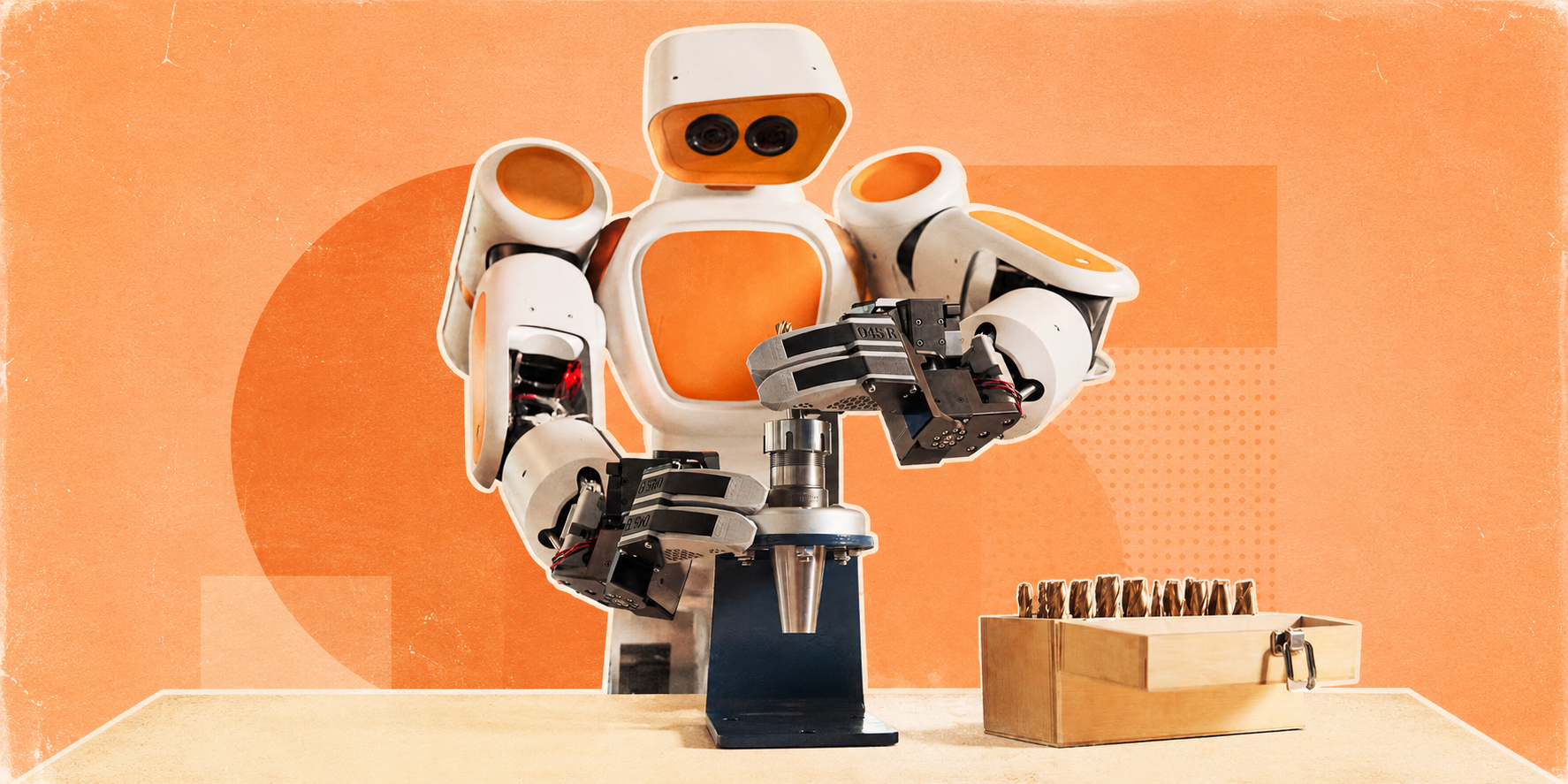
For hardware, Walden uses a form factor that combines a humanoid-style dual-arm upper body with a wheeled mobile base. The company is focusing on dual-arm manipulation, task learning and adaptation to changing environments.
Wheeled mobile robots are already common in industrial and warehouse settings where floors are even and workstations are clearly defined. Their main advantages are stability, payload and system complexity that stays relatively manageable. A humanoid upper body helps the robot use tools and workspaces originally designed for people. In Walden’s design, “generality” comes less from humanlike appearance than from the model’s ability to learn many tasks and from the dual-arm system’s ability to handle different objects and equipment.
Even with those advantages and a head start in the field, Tedrake kept the public message restrained when Walden was introduced. “The team is strong enough, and the progress is fast enough, that we don’t need to exaggerate it,” he said.
He also added: “We’re just at the beginning of this journey.”