
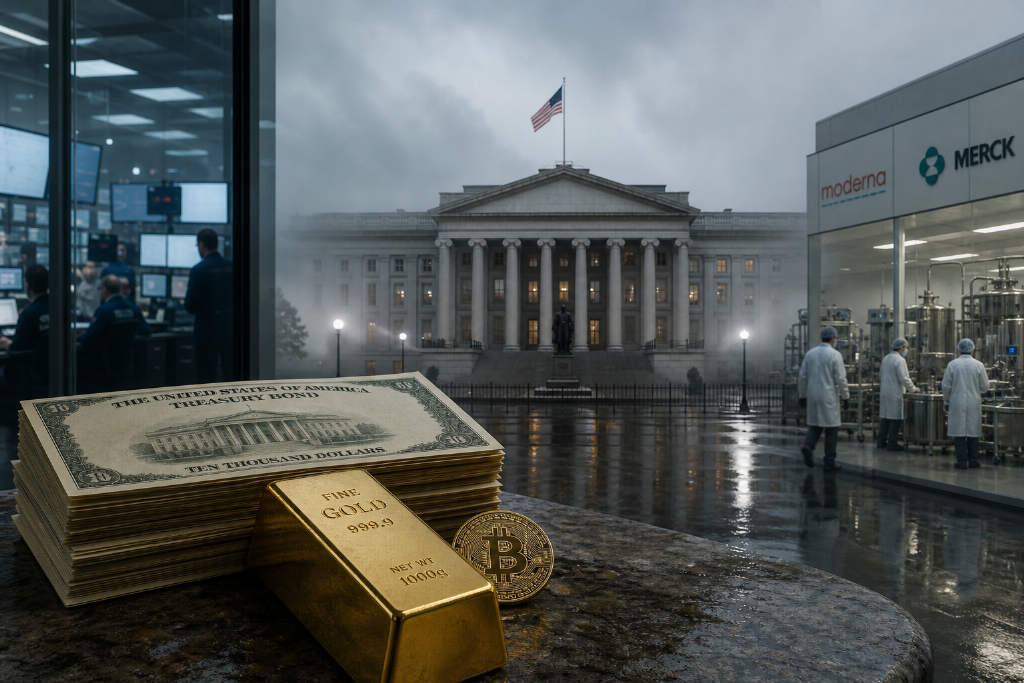
U.S. stocks ended a three-session slide on Wednesday, though the recovery was far from smooth. A Treasury decision to raise the cap on long-dated bond buybacks helped push the 30-year Treasury yield lower by about 10 basis points at one point, giving support to stocks, bonds, gold and crypto. At the same time, minutes from the Federal Reserve’s July meeting carried a hawkish tone and showed support for higher rates ran deeper than the formal vote suggested.
Trading underlined a split market. Progress in an mRNA cancer vaccine trial lifted healthcare shares sharply, with Moderna jumping nearly 180% and Merck rising nearly 13%. Semiconductor stocks, however, remained under pressure. The Philadelphia Semiconductor Index fell more than 2%, Broadcom lost 4.6%, and Nvidia was one of the few members of the so-called Magnificent Seven to finish lower. Long-end rate pressure eased for now, but stress across the AI hardware chain has not fully cleared.
Treasury raises long-bond buyback ceiling
The day’s key policy move came from the U.S. Treasury. It said the cap on long-dated bond buybacks would be increased by at least twofold, with the ceiling for a single operation lifted to $4 billion. After the announcement, the 30-year Treasury yield briefly dropped by about 10 basis points, easing pressure at the long end of the curve.
By the bond market close, the 10-year Treasury yield was around 4.64%, up about 6 basis points on the day. The 2-year yield was near 4.16% and was little changed. The 30-year yield was around 5.19%, down about 9 basis points. The move was concentrated in the long end, while the front end and the 10-year did not see a comparable decline.
The article said Wall Street read the step as another instance of the “Trump put,” with the Treasury stepping in as long-bond yields approached what investors saw as dangerous levels. It also noted that U.S. federal government debt officially crossed $40 trillion on Wednesday, more than doubling over the past decade.
In currencies, the dollar index weakened alongside the drop in long-dated yields and fell to its lowest level since late May. The yen rebounded nearly 1% intraday, while the offshore yuan broke above 6.73 during trading for the first time in more than three years.
Fed minutes show broader backing for hikes
Minutes from the Fed’s July meeting were released the same day and pointed to a hawkish internal discussion. The record showed that more than three members supported a rate hike at that meeting, and several participants said action would be needed if inflation did not continue to cool. Some officials argued that AI could add to inflation pressure, while staff saw upside risks to inflation expectations.
The minutes also showed that Waller proposed cutting the number of Federal Open Market Committee meetings from eight per year to six.
The article cited the “new Fedwire” interpretation as even more direct: support for a rate hike had become “more broad-based.” In practical terms, that leaves the September meeting with more uncertainty than markets had previously priced in. Even after cooler July CPI and PPI readings, inflation concerns inside the Fed have not faded.
That left markets facing a policy offset. The Treasury moved to cap pressure on long-end yields, while the Fed signaled it could still lean toward tighter policy. Investors first traded the near-term relief from the Treasury action, but the shadow cast by the hawkish minutes remained in place.
Healthcare leads after Moderna and Merck announcement
Moderna was the standout name of the session. The company and Merck said their personalized mRNA cancer vaccine succeeded in a phase 3 melanoma trial. Moderna closed up nearly 180%, while Merck gained nearly 13% and led the Dow.
The S&P 500 healthcare sector rose 3.2%, its biggest one-day gain since April 2025. The article said mRNA technology had gone through a period of valuation compression and policy controversy after the COVID vaccine boom. The phase 3 cancer result prompted investors to reassess the commercial scope of the platform, lifting biotech, pharmaceutical and healthcare ETFs.
Retail earnings also offered support. Target beat expectations and raised its full-year outlook, while Estee Lauder rallied on the back of revenue growth in China. Consumer-facing results did not point to a broad recession signal, and that was one reason major indexes avoided another leg lower.
Semiconductor weakness remains a problem
Even with the broader market rebounding, the Philadelphia Semiconductor Index fell more than 2%. Broadcom led the decline with a 4.6% drop, while Marvell Technology rose nearly 10% after a report tied the move to news of custom chip cooperation with Google. Among the Magnificent Seven, Nvidia alone fell about 1%, while Tesla rebounded more than 4%.
The article pointed to two pressures on chip stocks. First, the Fed minutes said some officials saw AI as a possible driver of inflation. If AI investment itself starts to look inflationary, then one of the rate-related supports behind the AI trade weakens. Second, financing concerns around AI remain in focus. OpenAI’s second-quarter revenue growth slowed and its operating loss widened, raising questions about whether application-layer cash flow can support higher capital spending.
That split helps explain the market’s growing distinction between two types of tech assets. One group includes mega-cap and software names that benefit from easing rate pressure. The other includes hardware-linked companies that have already rallied hard, are more crowded, and are tightly tied to AI capital expenditure. Lower long-bond yields can ease valuation pressure, but they do not automatically fix positioning or expectations inside semiconductors.
The article added that the Philadelphia Semiconductor Index says more than the Nasdaq at this stage. The Nasdaq can still be supported by the largest tech names and software stocks, but the chip index offers a clearer read on confidence in the AI hardware cycle. As long as semis continue to lag the broader market, it is hard to argue that the tech rebound is complete.
Commodities and crypto move higher together
Commodities continued to reflect geopolitical risk pricing. WTI crude futures rose 1.05% to $85.83 a barrel, while Brent crude gained 0.66% to $91.62 a barrel. The article said U.S.-Iran talks remained deadlocked, and that Trump, a day after his earlier stance, said perhaps talks would resume “at some point,” leaving Iran-related risk as continued support for oil prices.
Gold also rebounded strongly. COMEX gold futures rose 2.83% to $4,489.4 an ounce and briefly traded above $4,500 intraday. A weaker dollar and lower long-end yields combined to lift precious metals, while silver rose 2.8%.
Cryptoassets climbed in tandem. Bitcoin rose above $69,000 during the session, up more than 8% from the day’s low, while Ether at one point gained 10%. The article’s reading was straightforward: once long-dated Treasury yields stop moving out of control, investors quickly move back into higher-beta assets.
Three things the market is watching next
The article said Thursday’s focus falls into three areas.
- First, whether long-end Treasury yields can hold steady. If Treasury buybacks continue to keep a lid on the 30-year yield, the equity rebound may extend beyond a technical bounce into a steadier return of flows.
- Second, U.S. initial jobless claims and the Philadelphia Fed manufacturing index. After the hawkish Fed minutes, markets are likely to react more sharply to each growth and labor-market data point. If the numbers remain strong, rate pressure could return quickly. If the data soften, the repair trade in tech will still depend on whether semiconductors can stop falling.
- Third, the market response to SK Hynix’s buyback plan. SK Hynix said it plans to repurchase and retire KRW 40 trillion in shares and pledged to return at least 50% of cash flow to shareholders. After SanDisk rose 35% in a week, memory stock valuations are already elevated, and the article said the impact of this news on sentiment in the segment is worth watching.
