
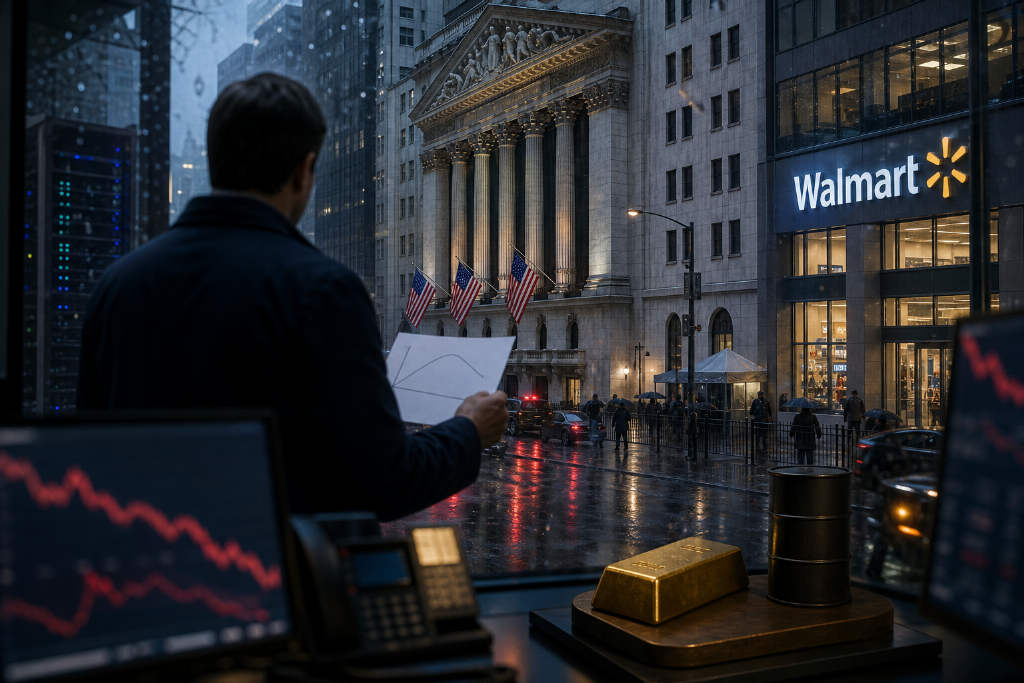
The Treasury’s effort to calm the long end of the U.S. bond market lasted less than a day. By Thursday, yields had pushed back up, equities turned lower, and investors were again focused on deficits, inflation and supply rather than buyback support.
The S&P 500 fell 0.87%, the Nasdaq Composite lost 1.00%, and the Dow Jones Industrial Average dropped 1.32%. The VIX climbed 7.52% to 16.01, and only about one-third of S&P constituents advanced.
Buyback support fades as long-end yields rebound
The market initially welcomed the Treasury’s decision to expand long-dated bond buybacks, but the move did not hold. The 10-year Treasury yield returned to about 4.70%, while the 30-year yield moved back near 5.25%, erasing most of the prior move tied to the buyback announcement.
On Wednesday, the Treasury said the size of long-end Treasury buybacks would at least double, and the 30-year yield fell noticeably that day. On Thursday, Bessent added to the message on CNBC, saying a single buyback operation could exceed $4 billion. He said, 「we have a large toolbox」 and also said a fiscal consolidation plan could be released this weekend or early next week.
That was not enough to keep the relief trade alive. Investors quickly moved back to a more basic conclusion: buybacks can improve liquidity, but they do not solve the deficit, inflation pressure, or bond supply.
JPMorgan strategists Jay Barry and Jason Hunter said the Treasury’s market operations address symptoms rather than the core issue. In an economy close to full employment, the U.S. is still running a fiscal deficit near 6%, and without real fiscal consolidation, any technical buyback risks being seen as lacking credibility or even as a 「desperate attempt to lower yields」. Evercore ISI’s Sarah Bianchi made a similar point, saying it would be difficult for the government to deliver meaningful deficit-cutting measures in the near term, which leaves any market lift from buybacks short-lived.
Trump signals economic campaign on Iran, oil extends rally
Trump said the U.S. would launch an 「economic D-Day」 and an 「economic war on a scale never seen before」 against Iran. Bessent said a press conference would be held on Aug. 24 to outline the plan, warning of the 「harshest sanctions in history」 and 「economic isolation on a scale never seen before」. He also told allies they must either stand together or be treated as opponents.
Bessent suggested that maximum economic pressure could reduce the odds of military conflict. He also said he did 「not understand」 Thursday’s jump in oil prices and argued that the coming measures would push crude lower.
Oil moved the other way. The energy market logged a fifth straight gain, with WTI crude for October up about 2.5% at $86.83 and Brent up 2.4% at $93.78. Both contracts touched their highest levels in about a month.
UBS analyst Giovanni Staunovo said tensions in the Middle East remain elevated and that room for supply disruption is still present.
Gold holds firm as traders price in a “bad 4.70%”
Precious metals also advanced. COMEX gold futures settled up 0.71% at about $4,577 per ounce. Spot gold rose above $4,550 during the session and reached its 200-day moving average, which some technical traders viewed as a strong bullish signal. Silver futures jumped 3.56% to about $68.
From a trading perspective, gold’s resilience stood out because it did not continue falling even after the 10-year yield moved back toward 4.70%. The market is increasingly treating this as a 「bad yield rise」 rather than one tied to growth. In that view, the term premium is being pushed higher by oil, inflation risk, $40 trillion in debt, and funding demands linked to AI, not by a healthier macro backdrop. In that setup, gold’s real rival becomes Treasuries themselves.
The U.S. dollar index edged up 0.07% to about 98.869 after falling during Bessent’s remarks and then reversing sharply. Bessent reiterated support for a strong-dollar policy and said the greenback is returning to where it was two months ago. Citi, though, cut its three-month DXY forecast to 98.34 from 102.12, citing a market repricing toward a more dovish Federal Reserve and uncertainty around fiscal intervention.
Walmart leads the downside and hits consumer shares
Walmart was the clearest immediate trigger behind the Dow’s weakness. The company, often treated as a read on U.S. consumers, reported 2.6% growth in U.S. same-store sales, below the 3.8% expected by the market. That was the slowest pace in more than six years and marked a second straight quarter of deceleration.
Revenue and adjusted EPS beat expectations, and Walmart raised part of its full-year guidance. Even so, its full-year EPS outlook came in below market expectations. The stock fell 9.15%, its worst single-day performance since May 2022. Consumer staples dropped 1.93% and consumer discretionary lost 1.77%. Lower spending per transaction with stable transaction counts pointed to clear downtrading by consumers.
Large technology names were mostly weaker as well. Apple fell 1.75%, Amazon lost 2.16%, Tesla dropped 1.71%, Google fell 1.02%, Microsoft slipped 0.47%, and NVIDIA eased 0.33%. The Magnificent Seven index lost more than 1%.
AI financing grows larger as credit markets absorb more pressure
The session also highlighted how far AI spending has expanded into credit markets. Broadcom is reportedly in talks with Blackstone and Apollo on a debt financing package worth more than $60 billion, with total size potentially reaching $100 billion, to provide chips and infrastructure for companies including Anthropic. The arrangement would continue the earlier AI XPV framework.
The message from that financing effort is two-sided. AI buildout is still accelerating, but AI companies may also need to borrow more heavily, which means credit markets are taking on more of the strain.
Anthropic could publicly file for an IPO as soon as the end of this month, according to the report, and the fundraising could match or exceed SpaceX’s earlier $75 billion record. The company posted preliminary second-quarter revenue of more than $11.5 billion, with an annualized run rate around $65 billion, though full-year net losses remain large.
Storage and optical names outperform despite broader weakness
Even with the wider market under pressure, storage and optical communication stocks moved higher. Micron rose 3.97%, Lumentum gained 6.24%, and Marvell added about 5.8%.
Micron CEO Sanjay Mehrotra said AI has changed memory from a cyclical commodity into strategic infrastructure, adding that 「without memory, there is no AI」. He said demand from data center customers is about 50% above the supply the company can commit, and that procurement is shifting from price comparison to co-design. Micron also said it will invest $10 billion over the next decade to build research laboratories and lock in long-term demand.
Across the storage group, SanDisk rose about 2%, SK hynix gained 4.43%, Silicon Motion advanced 2.82%, Seagate climbed 2.12%, Western Digital rose 1.51%, and Rambus added 1.43%.
Lumentum’s gain came after SK hynix released a next-generation CPO roadmap that aims to extend optical interconnects to memory interfaces. That reinforced the market’s focus on bandwidth constraints inside AI clusters. In optical names, Marvell gained about 5.8%, AAOI rose 5.66%, Coherent added 0.89%, and Astera Labs gained 0.52%.
Broadcom, SpaceX, Moderna and Chinese ADRs show mixed moves
Broadcom rose 0.43%. The report said the company is discussing a debt financing plan of as much as $100 billion with Blackstone and Apollo, using an SPV to buy chips and infrastructure for AI companies such as Anthropic. The move would help Broadcom accelerate its challenge to NVIDIA in AI chips. Related names moved lower, with Blackstone down 2.58%, Apollo off 2.73%, and NVIDIA down 0.33%.
SpaceX fell 4.05% and dropped below its IPO price. The main reason was a second lockup expiration wave, with as many as 319 million insider-held shares becoming tradable. That amounts to 7% of holdings owned by early investors and employees, and the added supply weighed on the stock. Commercial space shares also retreated, with AST SpaceMobile down 2.06% and Rocket Lab off 3.81%.
Moderna plunged 23.55%, giving back a large share of the previous day’s 176% rally tied to its cancer vaccine news. The move weighed on biotech more broadly, and the Nasdaq Biotechnology Index fell 2.92%.
Among Chinese ADRs, most names were lower, but Alibaba rose 1.26%. The company reported 45% year-over-year growth in AI cloud revenue, and adjusted EBITDA margin for AI cloud and computing services improved to 12%. Its internally developed Zhenwu M890 chip now serves more than 650 customers. Elsewhere, PDD fell 0.75%, NetEase lost 5.85%, Baidu dropped 0.97%, JD.com rose 0.20%, and Li Auto gained 1.65%.
Microsoft slipped about 0.47% and Meta was down 0.04%. Meta is said to spend hundreds of millions of dollars a year accessing AI models through Microsoft Azure, using trillions of tokens each week. Microsoft’s Foundry model marketplace has reached 100,000 customers, but people familiar with the matter said its biggest AI customers are still concentrated in tech, including Meta, Adobe, Perplexity and Sierra. That added to concern that AI demand remains highly self-referential inside the sector.
Elsewhere among megacaps, Apple fell 1.75% under pressure from higher long-end yields and weaker sentiment in tech. Amazon lost 2.16% even after saying Prime Air drone delivery will reach nearly 500 U.S. towns by year-end, as discretionary spending concerns outweighed the announcement. Tesla dropped 1.71% as rich valuation and weaker risk appetite remained in focus.
What markets are watching next
On Aug. 21, the Seoul AI Summit runs through the day, with participants including Google DeepMind, Google Cloud, Microsoft Research, NVIDIA, LG AI Research and Hyundai Motor. The market is watching for signals on large models, AI cloud, autonomous driving, AI chips and enterprise applications.
The World Robot Conference is being held in Beijing from Aug. 19 to Aug. 23, where Unitree, UBTech, Siasun, Galaxy General and Tiangong are set to showcase humanoid and industrial robot solutions. Investors are watching manufacturing progress, orders and cost trends.
The NYMEX September crude contract is also rolling. With Hormuz risk and expectations for U.S. sanctions on Iran in focus, the roll may amplify front-month volatility. A wider spot premium would point to tighter physical supply, while a narrowing spread could indicate weaker upside momentum in oil.
Earnings are due from ZTE, Zijin Mining, Zhongji Innolight, Yangtze Optical Fibre, Beike and Sinopec. Zhongji Innolight and Yangtze Optical Fibre are being watched for AI optical module and fiber demand. ZTE is seen as a read on computing-network buildout and carrier capex. Zijin Mining is tied to gold and copper prices, Beike to China’s property transaction recovery, and Sinopec directly to crude prices and refining spreads.
From Aug. 22 to Aug. 26, the second World Humanoid Robot Games will take place, adding events such as robot tug-of-war, pitch-pot and weightlifting. The market will be watching motion control, stability, endurance and adaptability in real-world scenarios.