
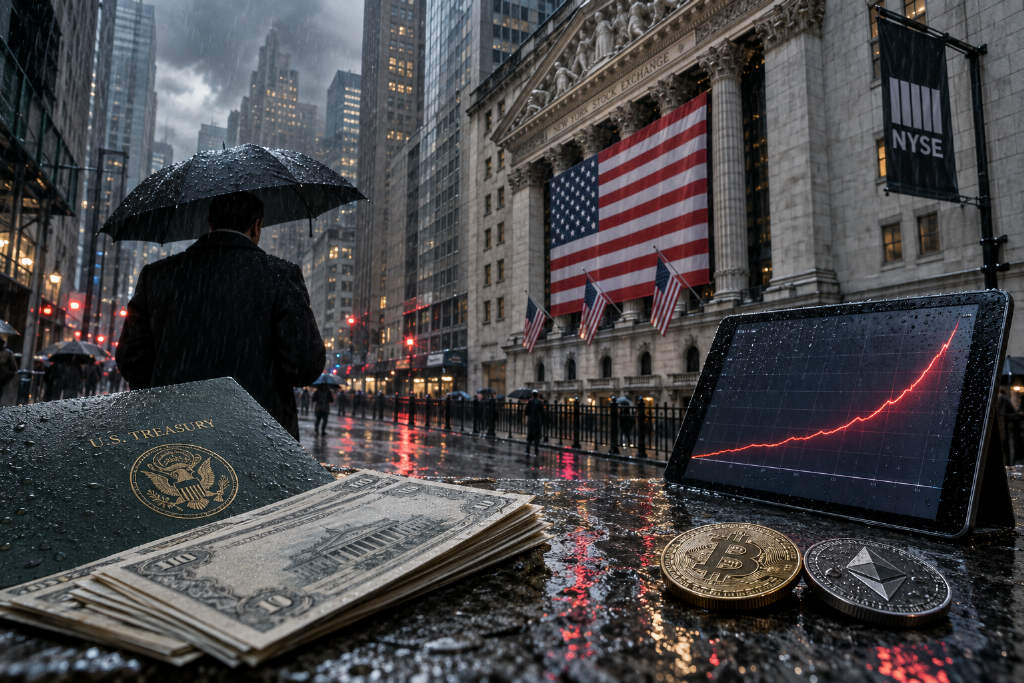
U.S. stocks finished lower on Wednesday, ending a five-day winning streak as higher long-term Treasury yields weighed on risk assets. The Dow Jones Industrial Average fell 0.66% to 51,179.87, the S&P 500 lost 0.22% to 7,801.77, and the Nasdaq slipped 0.22% to 27,538.69. The VIX closed at 15.07.

The bond market was the main source of pressure. The 10-year Treasury yield rose above 5.36% intraday, its highest level since 2002, while the 30-year yield climbed to about 5.73%, also reaching a 2002 high. Higher long-end rates weighed on richly valued assets.
Strong 10-year auction briefly eased the selloff in long bonds
Later in the session, a $39 billion 10-year Treasury auction came in stronger than expected. The high yield was 5.3%, the bid-to-cover ratio reached 2.77, the highest since 2016, and the share awarded to non-dealer investors rose to 97.5%, a record high. Selling pressure in long-dated Treasuries eased for a time after the auction, and the 10-year yield briefly turned lower.
The 2-year Treasury yield closed at 4.76%, down about 3 basis points on the day.
In foreign exchange, the dollar index rebounded toward an 18-month high, while the euro moved near a 17-month low. Crypto assets also came under pressure. Bitcoin fell below $84,000 intraday and touched roughly $82,922 at its low, while Ether dropped below $2,600.
Chip stocks diverged, with Micron up 4.06%
Semiconductor names moved in different directions. Micron Technology rose 4.06% to $1,088.00, Super Micro Computer gained more than 3%, and Nvidia posted a modest gain. The Philadelphia Semiconductor Index closed down more than 1%.
Meta, SpaceX AI, Qualcomm, and SK Hynix each fell more than 2%. CrowdStrike dropped 4.81% to $265.44.
Among megacap technology stocks, moves were mixed. Microsoft introduced the Surface Laptop Ultra powered by Nvidia RTX Spark and demonstrated Windows running AI models and agents locally. Microsoft said response times for some local AI tasks could be as much as 2.1 times faster than Apple’s MacBook Pro M5 Pro.
Amazon rose 1.42%, Google gained 0.81%, Apple added 0.91%, and Microsoft edged up 0.09%. Nvidia fell 0.74%, Tesla lost 0.75%, and Meta dropped 2.38%.
The Nasdaq Golden Dragon China Index was little changed, up about 0.1%. GDS rose 2.2%, while NIO, JD.com, and Li Auto each gained at least 1%. In Hong Kong, chip stocks and large-model names both declined, with HG Semiconductor down 5% and MINIMAX down 4%.
Fed minutes pointed to another possible hike this year, but not urgency for October
Minutes from the Federal Reserve’s September meeting showed officials unanimously supported raising the federal funds rate by 25 basis points to 3.75%-4%. Most participants said another increase before year-end could be appropriate, but the minutes did not signal that a run of back-to-back hikes had begun.
The report said the “Fed whisperer” viewed the minutes as lacking any push for multiple consecutive rate increases. Nearly all officials said inflation remained elevated and the labor market was close to full employment. Some officials said AI could expand investment and lift productivity, but could also add to inflation pressure.
A New York Fed consumer expectations survey released the same day showed median one-year inflation expectations rose to 3.9% in September from 3.6% in August, the highest since May 2023. Three-year inflation expectations rose to 3.3% from 3.2%. Consumers also reported a better view of the labor market and saw a lower probability of losing their jobs.
Iran comments and reserve-release plans moved energy markets
On geopolitics, a senior Iranian official said Wednesday that Washington must first meet Tehran’s conditions before any discussion of nuclear issues, adding that there were “no negotiations” between the two sides. Iran also repeated that it would soon block what it called the “illegal” shipping route through the Strait of Hormuz until its demands were met.
Donald Trump said Tuesday that military action against Iran “must be wrapped up,” and that the only question was whether it would be wrapped up in a soft or hard way.
The International Energy Agency said member states supported accelerating the reserve-release plan announced in a joint March action, with diesel reserves taking priority. The European Union said the release mainly reflected previously announced commitments rather than a new allocation.
Oil prices reversed lower during the session. WTI for November delivery fell 1.30% to $88.28 a barrel, the lowest in more than a month. Brent for December delivery slipped 0.38% to $100.20 a barrel after rising above $102 intraday.
Gold fell more than 2%. COMEX December gold futures dropped about 1.1% to $4,140.7 an ounce, the lowest in two months. COMEX December silver futures fell about 2.1% to $60.29 an ounce.
Anthropic and OpenAI both rolled out new models
Anthropic introduced Claude Haiku 5.5 and said average operating costs were about 75% lower than the previous generation. For requests of up to 100,000 tokens, both input and output pricing was cut by 90% from the prior version. For usage above 100,000 tokens, pricing was reduced by 50%. The company said the model can work with Opus 5.5 and Sonnet 5.5 as a “sub-agent.”
At the same time, people familiar with the matter said Anthropic could formally begin its IPO roadshow as early as the week of Nov. 9, with trading potentially starting before Thanksgiving on Nov. 26.
OpenAI rolled out GPT-6 to its global base of 1.2 billion ChatGPT users. Paid users receive GPT-6 Sol, while free users get GPT-6 Luna. Both models were classified as “high capability” in cybersecurity and biosecurity, and OpenAI said alignment evaluations were better across the board than GPT-5.6.
OpenAI also launched an interactive visualization feature called Smart UI, allowing responses to include graphics, clickable buttons, forms, and charts. The company further released a large body of mathematical research generated by an undisclosed internal frontier model, including work involving zeros of the Riemann zeta function, and published part of the Lean formal verification code.
On chip financing, a report said SpaceX is discussing roughly $40 billion in financing to buy Nvidia AI chips. About $10 billion would be raised through bank loans, while another $30 billion would come from investment-grade bond issuance. Apollo is expected to lead the financing arrangement.
Oracle data center project faces another power-related delay risk
Oracle’s Project Lighthouse data center in Wisconsin is facing delay risk after transmission approval was restarted. The project’s total power demand is about 1.3 GW. Aterio said full power delivery could be delayed until October 2028 in its base case, and to 2029 if approvals take longer.
After Project Jupiter in New Mexico issued a force majeure notice over power supply issues, this is Oracle’s second large AI data center project in a short period to run into obstacles. Competition in AI computing is extending beyond chips to power infrastructure, with transmission approvals and grid capacity emerging as new bottlenecks.
Markets now turn to jobless claims and a 30-year Treasury auction
Two items are next on the market calendar. The first is U.S. initial jobless claims, due at 20:30 Beijing time. The source article said the Fed minutes showed most officials still expected one more rate hike this year, while also suggesting there was no rush for October. If labor data remains firm, expectations for another hike this year could strengthen, and whether the 10-year yield can hold above 5.3% will be a key variable.
The second is a $22 billion 30-year Treasury auction scheduled for 1:00 a.m. Beijing time on Thursday. Demand at Wednesday’s 10-year auction was notably strong, with the allocation to non-dealer investors reaching a record. Thursday’s 30-year sale will offer another test of demand for long-dated Treasuries and will directly affect the path of long-end yields and the valuation backdrop for high-multiple technology stocks.