

Two prediction-market projects announced closures on Aug. 10 from opposite ends of the stack: Trepa, a Solana app built around numerical precision, and Fireplace, a professional trading terminal layered on top of Polymarket.
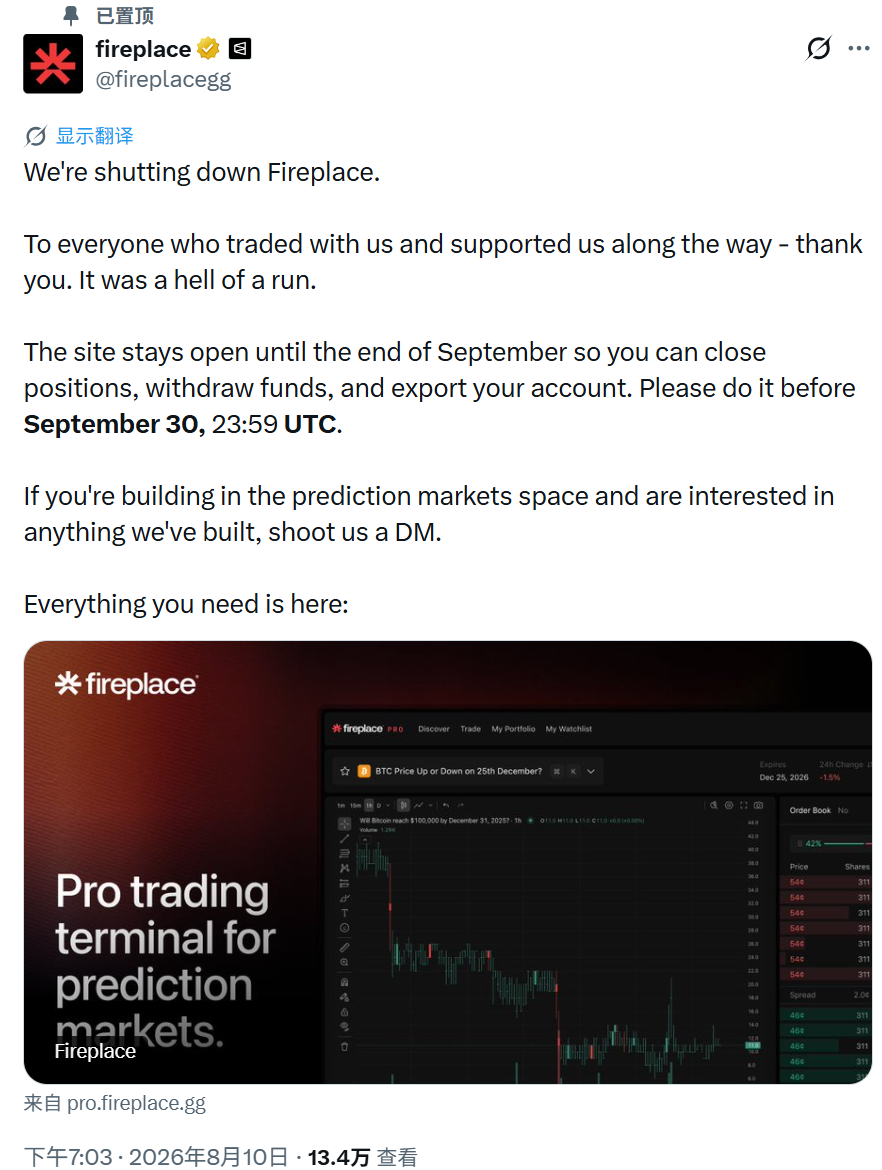
Trepa said its final playable market will end on Aug. 12, 2026, and no new rounds will be opened after that. The app will remain accessible until Sept. 30 for withdrawals, then become unavailable. Fireplace said trading will stop on Aug. 15, and the website will shut down at 23:59 UTC on Sept. 30.
Seen in isolation, the two closures look unrelated. Put together, they point to the same pressure: prediction markets are becoming more concentrated, and that leaves less room for smaller projects trying to win through novel mechanics or better interfaces.
Trepa’s bet on precision did not become a business
Trepa launched on the Solana mainnet on Dec. 8, 2025. Its core idea was straightforward but unusual. Users were not asked to choose Yes or No, or up versus down. They were asked to predict a specific number, whether that meant the price of BTC, a macroeconomic data point, or a sports statistic.
The system distributed rewards through a pooled model weighted by accuracy. The closer a user’s prediction was to the final result, the larger that user’s share of the prize pool. The team described the format as “precision predictions” and positioned it as a third path beyond binary prediction markets.
Trepa’s roots go back to the Bybit × DMCC hackathon in November 2024. It started as a Telegram mini-app on TON for predicting polling results, then moved through a run of hackathons and programs, including Sonic SVM, Superteam Korea, Colosseum Breakout, and Balaji Srinivasan’s Network School.
In August 2025, Trepa raised a $420,000 pre-seed round led by Colosseum, with Ignite Capital, The Balaji Fund, and Balaji himself among the participants.
In the shutdown statement, co-founders Jong-Chan Chung, the CEO, and Leon Meka, the CTO, were unusually direct. They said the company had bet on the idea that people would pay for precision rather than simply pay to be right on direction.
They also said they had chosen a pooled structure while fully aware of its trade-offs: users could not know the odds in advance, and once a position was entered it could not be exited. The team believed that design was the only way to reward numerical accuracy fairly while keeping the product understandable for mainstream users.
What Trepa said went wrong
Trepa’s post-mortem identified several failure points. The first was demand. Heavy participation in binary markets, the team wrote, did not mean users would also want to enter a contest built around being more precise than everyone else. The cognitive burden was higher, especially when users were expected to think in exact figures rather than broad directional calls. Trepa’s conclusion was blunt: in consumer prediction products, simplicity may be the whole product.
The second problem was concurrency. A pooled market only works if enough people participate during the same time window. Without that, the prize pool gets too thin and the user experience deteriorates quickly. Trepa eventually narrowed activity into a one-hour window each day from 1 to 2 UTC, which meant users had to organize their schedules around the product. That made retention harder.
Growth created another conflict. To expand its audience, Trepa would have needed to add more assets and more time windows. But doing so would have diluted concurrency and weakened the mechanism it depended on. By the time the team fully recognized that contradiction, it said, it was too late.
Trepa also said it had overestimated the size of its potential user base. Referral mechanisms did little, paid KOL promotions produced almost no result, and geographic limits combined with funding friction reduced the active crypto audience more than public data suggested. The team’s judgment was that the real active audience suitable for this kind of product was in the hundreds of thousands, not the millions.
Even in closing, Trepa did not walk away from the thesis itself. The team said it still believed there was value in the idea that people would pay to be measured precisely. What it had not found was a way to turn that thesis into a sustainable business.
Fireplace’s shorter experiment as a professional terminal
Fireplace was aimed at a different layer of the market. It did not run a prediction market itself. Instead, it sat on top of Polymarket and offered a more advanced trading terminal, with professional charting, position management, wallet and whale tracking, market discovery, and execution tools. Its pitch was a “Bloomberg Terminal” for prediction markets.
Fireplace launched on Jan. 27, 2026. In February, it raised a $1.5 million pre-seed round led by Frachtis, with White Star Capital and others participating. Founder and CEO Sumer Malhotra and CTO Akshay Rajagopal had previously argued that prediction markets lacked professional-grade infrastructure and execution tooling.
Less than half a year later, the project said it would shut down. Unlike Trepa, Fireplace did not publish a detailed retrospective. Its public communication was much shorter.
One complaint, however, surfaced repeatedly in market feedback: fees. Some users said a trading fee of around 1% was unattractive for larger capital and too expensive relative to trading directly on Polymarket. For a third-party terminal operating in a market where traffic and liquidity already sit with dominant platforms, that premium was hard to justify.
There was also a structural issue. If Polymarket keeps improving its own user experience, the room for third-party differentiation shrinks quickly. In prediction markets, the central moat is liquidity and trading volume, not interface design. An interface can be copied. Liquidity cannot.

A more concentrated market leaves less room for the tail
The broader backdrop makes the fate of both projects easier to understand. According to data cited for June 21, trading volume in prediction markets has become highly concentrated, with Kalshi and Polymarket far ahead of every other competitor. The same article said Kalshi’s growth rate had already surpassed Polymarket’s.
Valuation trends tell a similar story. In May this year, Kalshi completed a $1 billion financing led by Coatue Management, lifting the company’s valuation to $22 billion. At the end of June, the Financial Times, citing people familiar with the matter, reported that Kalshi was in talks for another funding round at roughly a $40 billion valuation, with a deal possibly arriving as early as the third quarter of this year.
Polymarket has also been tied to fresh fundraising. On Aug. 4, Bloomberg, citing people familiar with the matter, reported that Polymarket planned to raise about $1 billion at a valuation above $20 billion. The report said the company was in early talks with potential investors.
Kalshi and Polymarket occupy different lanes, but both squeeze smaller players
The article also drew a distinction between the two leaders. Kalshi is a US platform regulated by the Commodity Futures Trading Commission, or CFTC. It focuses on sports and event contracts, and its regulated setup gives it smoother access to institutional capital, compliant distribution channels, and retail partnerships, including work with brokerages. Sports contracts account for most of its trading volume.
Polymarket, by contrast, is more crypto-native and more global in its user base. Political, geopolitical, and crypto-related contracts make up a larger share of activity there. It has deeper liquidity and stronger brand recognition inside crypto, but it also faces heavier constraints tied to regulation and geography.
That market structure leaves little room for independent growth at the edge. Trepa’s precision-pool model needed a large enough concurrent user base to make the pools meaningful. Fireplace’s terminal needed enough order flow to cover operating and user acquisition costs. If more than 80% of volume is already captured by two giants, the remaining long-tail market may simply be too small to support many venture-backed startups.
The signal is not the end of prediction markets, but the end of easy entry
Trepa left behind a line that captures the moment well: the team still believes people are willing to pay to be measured precisely; it just did not find a path to making that belief into a business. Fireplace chose a quieter exit, opening its technical work to later builders and leaving a migration window before closing down.
The article’s conclusion is not that prediction markets have peaked. Kalshi and Polymarket are still operating at high volume. The sharper signal is that the sector is moving quickly from a phase of many experiments into one dominated by a small number of heavyweight platforms. For new entrants, the bar is now much higher. They either need differentiation that is hard to copy, or they need to build something complementary on top of the leaders before the window closes.