

BIS Warning: Unsustainability of Trillion-Dollar Capex
The Bank for International Settlements (BIS) stated in its annual report that the ongoing AI investment boom raises questions about the sustainability of current economic expansion. The five hyperscalers plan to spend over $1 trillion on AI-related capital expenditure between 2025 and 2026, commitments that exceed these companies' profits and free cash flow, forcing some to issue debt. The BIS warned that disappointing returns could trigger a sudden withdrawal of financing, turning the capex boom into a long-term investment depression with ripple effects on financial conditions. If hyperscalers slow or halt aggressive deployment, many borrowers in the supply chain may struggle to replace lost revenue and repay debts.
Systemic Risk: OpenAI's Failure Could Trigger a Chain Collapse
OpenAI's tentacles have reached into many corners of tech: agreements with Google, Amazon, Cerebras, Broadcom, and SoftBank's massive commitments. But systemic risk remains omnipresent. If OpenAI fails, NVIDIA, Oracle, Microsoft, and new cloud providers like CoreWeave would suffer sequentially. Oracle, a traditional database giant, has levered up heavily to offer AI compute: as of FY2026, free cash flow was -$23.7 billion, total debt reached $129.5 billion, plus $38 billion in lease commitments and an additional $260 billion in signed but not yet started leases. Oracle's existence—and Larry Ellison's personal fortune—depends entirely on OpenAI's ability to honor its $300 billion compute spending commitment.
Real Returns on Capex: A Loop of Compute Spending
Hyperscalers' returns on AI investment are so poor that they never disclose actual revenue breakdowns, only vague 'annualized revenue' figures. Microsoft boasted $37 billion in AI annualized revenue in 2025, but that equates to about $3.08 billion per month, less than one-tenth of its quarterly capex ($31.9 billion). Crucially, OpenAI spent $17.2 billion on Microsoft Azure in 2025, while generating just $13.04 billion in revenue and losing $20.9 billion. OpenAI likely accounts for up to 70% of Microsoft's AI revenue. A similar structure applies to Amazon and Google with Anthropic. The only real outcome of all this capex is supporting two deeply unprofitable companies and recovering a fraction of it as compute spending, which itself is subsidized by hundreds of billions in venture capital.

The Exponential View Report: Industry Marketing Disguised as Research
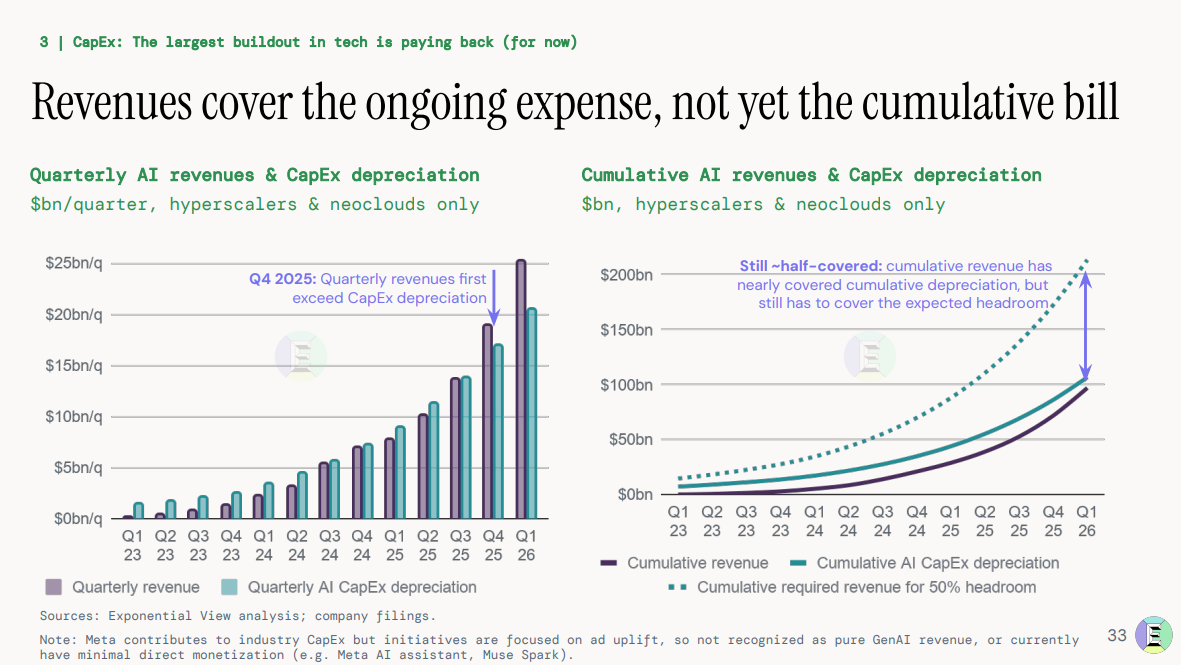
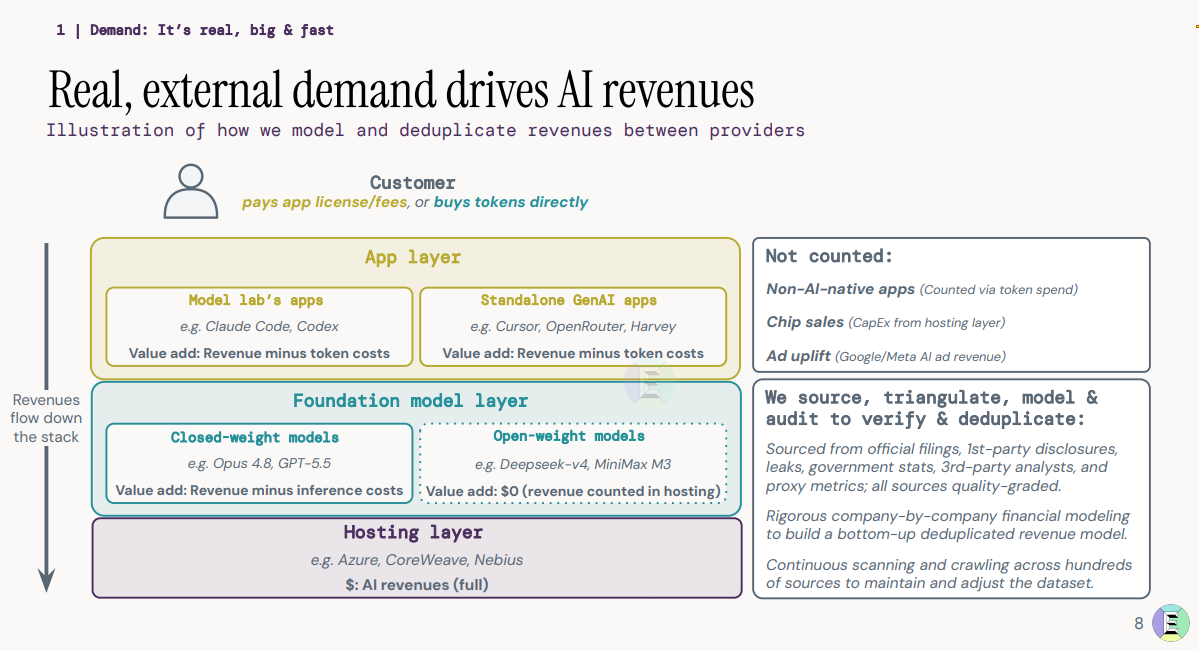
Research firm Exponential View published a report claiming AI revenue of $110 billion over the past 12 months, attempting to suggest sustainability. However, deep analysis reveals the report piles customer spending and compute spending from OpenAI and Anthropic together, claiming 'de-duplication' but refusing to explain methodology. According to The Information and the author's own research, just OpenAI and Anthropic account for at least 68% of that total (OpenAI ~$44 billion, Anthropic ~$20.25 billion, combined ~$64.25 billion). The report also uses 'annualized run rate' to inflate numbers and applies its own proprietary depreciation model to make AI capex look smaller. Bloomberg reported this as AI revenue reaching a 'critical point,' but the analysis has been widely criticized as misleading.
Struggles of the Big Four: A Loser-Driven Industry
The CEOs of Microsoft, Google, Amazon, and Meta—Satya Nadella, Sundar Pichai, Andy Jassy, Mark Zuckerberg—exhibit classic 'loser' patterns in the AI wave: their products (Microsoft 365 Copilot, GitHub Copilot, Google AI Overviews, Amazon Rufus, Alexa+) are widely disliked, generate little real revenue, yet consume enormous capital. Meta has no independent AI story; its massive GPU investments fail to drive meaningful ad revenue growth. The only significant AI revenue for these four comes from subsidized compute spending for OpenAI and Anthropic, creating a 'loser supporting loser' loop.
Data Center Demand: Monuments Built for Nobody
The hundreds of billions of dollars in new data centers are almost entirely being built to serve the demands of OpenAI and Anthropic. There are virtually no other large-scale AI compute consumers. CoreWeave gets 65% of its revenue from Microsoft (for OpenAI) and NVIDIA, with the rest from Google (for OpenAI), Anthropic, Meta, and OpenAI itself. Beyond these two unprofitable model labs, no other clients can afford AI compute. If NVIDIA CEO Jensen Huang's prediction of $1 trillion in Blackwell and Vera Rubin sales becomes reality, it would require about 40 GW of data center capacity, but the corresponding annualized compute demand would only be around $435 billion—and the only entities capable of paying such amounts are hyperscalers or their subsidized AI companies.

SoftBank and Masayoshi Son's Gamble: IPO Delay and Confidence Crisis
SoftBank has invested $64 billion into OpenAI, tying its fate to Sam Altman's ability to turn a company that lost $20.9 billion in 2025 into one with $284 billion in annual revenue by 2030. But OpenAI has postponed its IPO to 2027, with bankers believing it cannot achieve a trillion-dollar valuation. SoftBank cannot even secure a $6 billion margin loan using its OpenAI shares (book value over $100 billion), indicating banker lack of confidence. Son called SoftBank a 'golden egg machine' at the annual general meeting, but the reality is his wager depends on AI data center capex not collapsing.

Limitations of Open-Source Models and Industry Future
The AI industry's best hope is open-source models, but they may only improve by distilling US models. Once Anthropic or OpenAI slow or stop model training due to prohibitive costs, open-source progress will also stall. Both labs rely on continuous funding to sustain training, and if open-source models compete for market share meaningfully, that funding will become harder. US government demands for regulation on model releases, combined with cost pressures, could push the entire industry into a deceleration phase.
Conclusion: Losers Cannot Win by Telling the Truth
The AI industry sustains its bubble through manipulation, deception, and forward-looking statements. No product currently justifies its cost. Every pro-AI argument requires using future tense, ignoring real losses and mediocre products. Once hyperscalers decide to stop spending $30 billion per quarter on GPUs, the entire supply chain will collapse. This capital-driven frenzy will ultimately result in financial carnage and chaos, while genuine innovation is distorted into a compute loop serving two unprofitable companies.