
TRON’s weekly report for July 6 to July 12, 2026, said crypto market attention remained fixed on institutional-grade infrastructure, AI, real-world assets and stablecoin yield, while macro trading was driven by Federal Reserve policy expectations and the pace of Europe’s recovery.
Macro backdrop stays focused on Fed policy and European data
The report said minutes from the June FOMC meeting showed Federal Reserve officials still see inflation running above the 2% target. Rates were left unchanged, but most officials still leaned toward additional tightening later this year, leaving markets focused on inflation and labor data for clues on the policy path ahead.
Weaker nonfarm payroll data and lower energy prices had cooled expectations for an immediate July rate hike, which helped risk assets. In Europe, German industrial orders and industrial production pointed to continued weakness in manufacturing, while broader euro area inflation pressures kept easing. The European Central Bank was described as staying cautious, and markets were said to expect stable policy in the near term.
Looking ahead to July 13 to July 19, TRON identified U.S. June CPI, PPI, retail sales, the Federal Reserve Beige Book, and Federal Reserve Chair Kevin Warsh’s first congressional testimony as the most important pricing inputs for global markets. A softer CPI print, the report said, would strengthen expectations for rate cuts later this year or a delayed hike path; a hotter reading could push the dollar and Treasury yields higher and weigh on risk assets.
Crypto market recap: BTC fell after Strategy sale disclosure, then recovered
TRON said the crypto market moved through a volatile recovery phase during the week. On July 6, Bitcoin briefly dropped to around $61,300 after Strategy, formerly MicroStrategy, disclosed the sale of about 3,588 BTC valued at roughly $216 million.
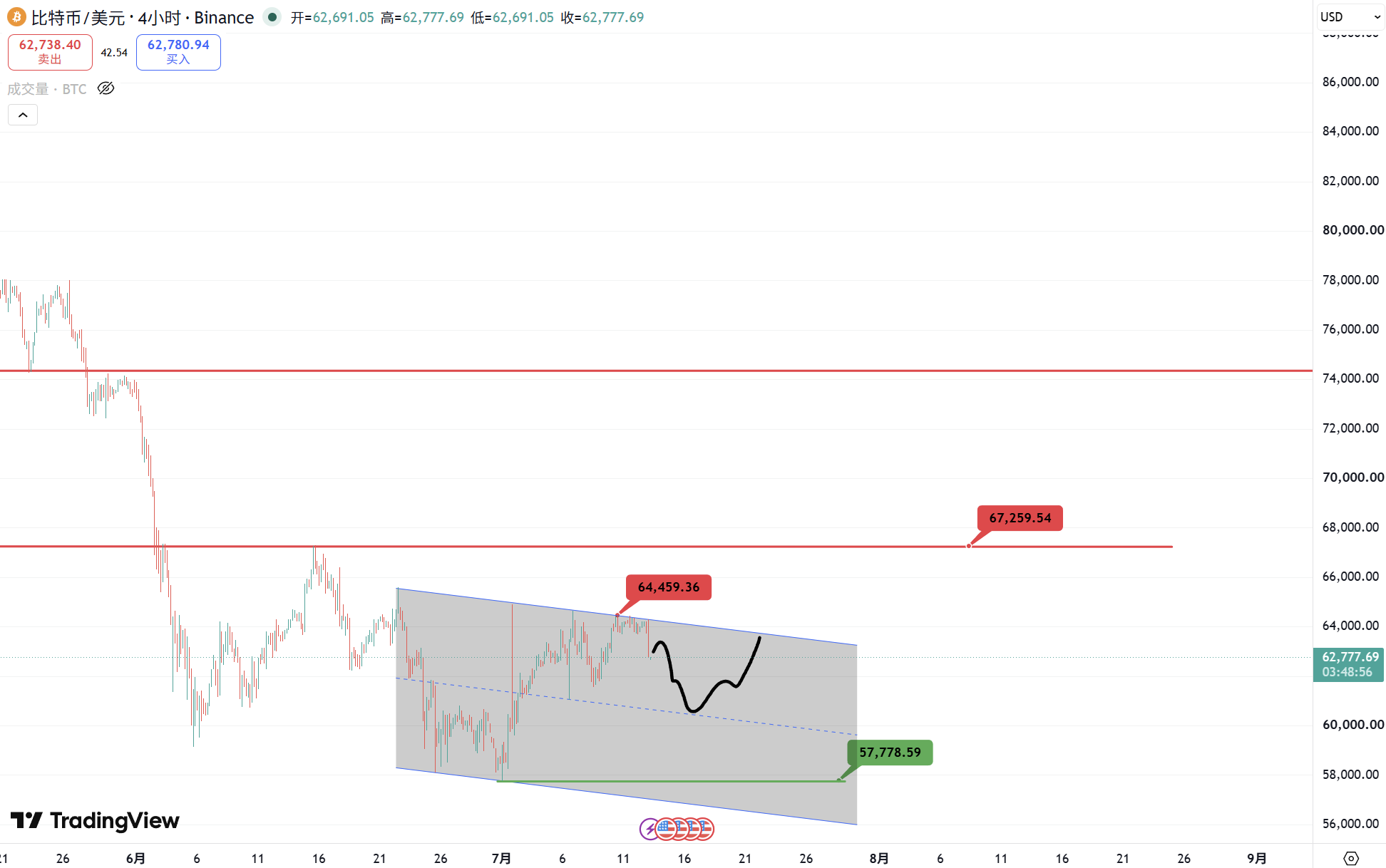
Prices then rebounded as spot ETF inflows resumed and buying improved. BTC rose to $63,163 on July 7, slipped back to $62,247 on July 8, closed at $63,795 on July 11, and traded around $63,600 on July 12.
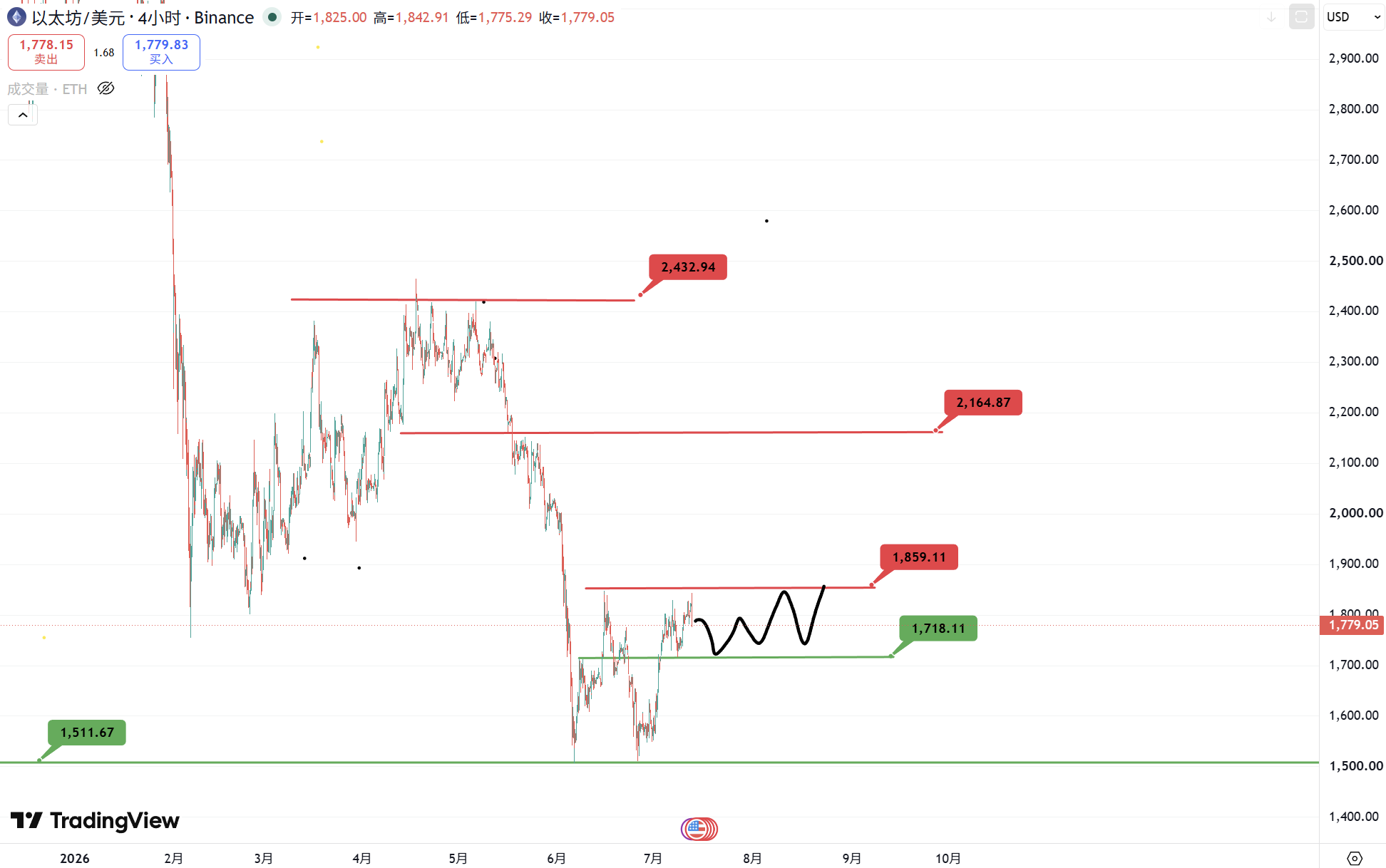
Ether held up better, staying in a $1,760 to $1,800 range during the week and last trading around $1,790. The report said market interest remained concentrated in AI, RWA, stablecoin infrastructure and institutional DeFi yield protocols. Risk appetite improved from the previous week, though trading volume stayed cautious.
For the coming week, TRON said macro data, ETF flows and institutional capital movements would remain the main market drivers. Its range view was straightforward:
- If BTC holds above $64,000, it may test resistance in the $65,000 to $66,000 area.
- If BTC falls back below $62,000, it may revisit support between $60,000 and $61,000.
- ETH is expected to trade in a $1,750 to $1,850 range, with direction still led by BTC.
The report added that RWA, stablecoins, AI agents, on-chain yield and institutional infrastructure could stay in focus, while warning that macro events and large institutional flows may still drive swings in price.
Sector themes: compliance, IP infrastructure and tokenized assets drew funding
TRON said the week’s industry discussion continued to cluster around institutional infrastructure, AI, RWA and stablecoin yield.
On the funding side, Elliptic completed a $125 million strategic financing, KOR Protocol raised $7.5 million in a Series A round, and Mercado Bitcoin received a $20 million strategic investment. The report linked those deals to on-chain compliance and blockchain analytics, digital content and IP infrastructure, and tokenized institutional assets tied to the RWA push.
It also said that institutional yield infrastructure, RWA yield products, cross-chain liquidity and AI-driven financial automation remained central technical themes. More teams are trying to connect traditional financial capital with on-chain yield markets through APIs, modular architecture and automated allocation, according to the report.
Jia: an on-chain credit network tied to real yield in emerging markets
In its project review, TRON first covered Jia, which it said has raised $7.3 million from Coinbase and TCG as lead investors, with Strobe, Hashed Emergent and SAISON participating.
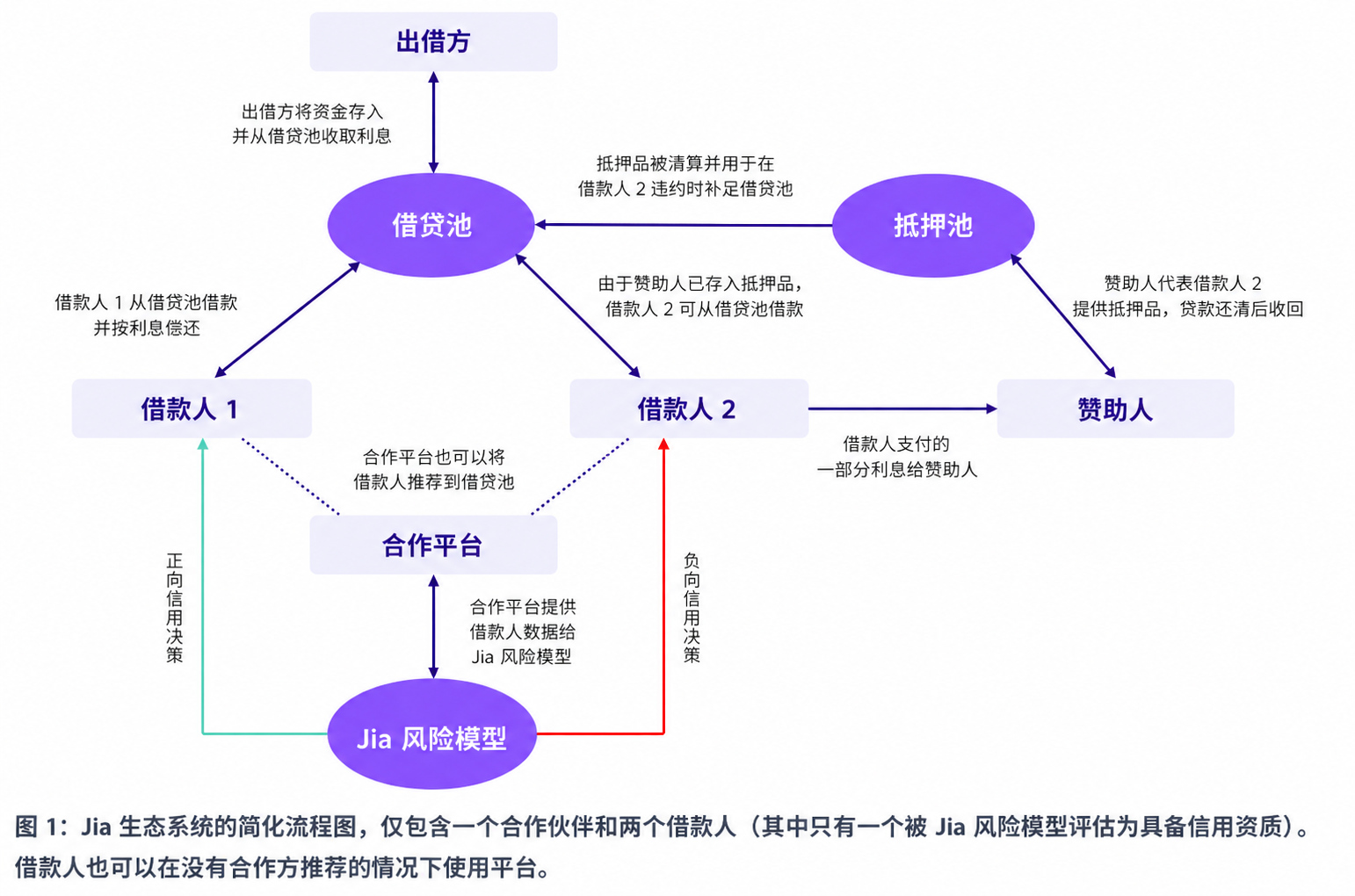
Jia was described as a decentralized lending protocol and fintech platform built to connect capital with micro and small businesses in emerging markets that can generate real yield. The project aims to address gaps in financial access by offering short-term funding to businesses that traditional finance has often overlooked.
TRON said Jia works with high-quality data providers and uses a token reward design to offer investors a recurring source of yield while helping businesses in underserved markets secure growth capital.
How Jia is structured
The report grouped Jia’s core participants into four categories:
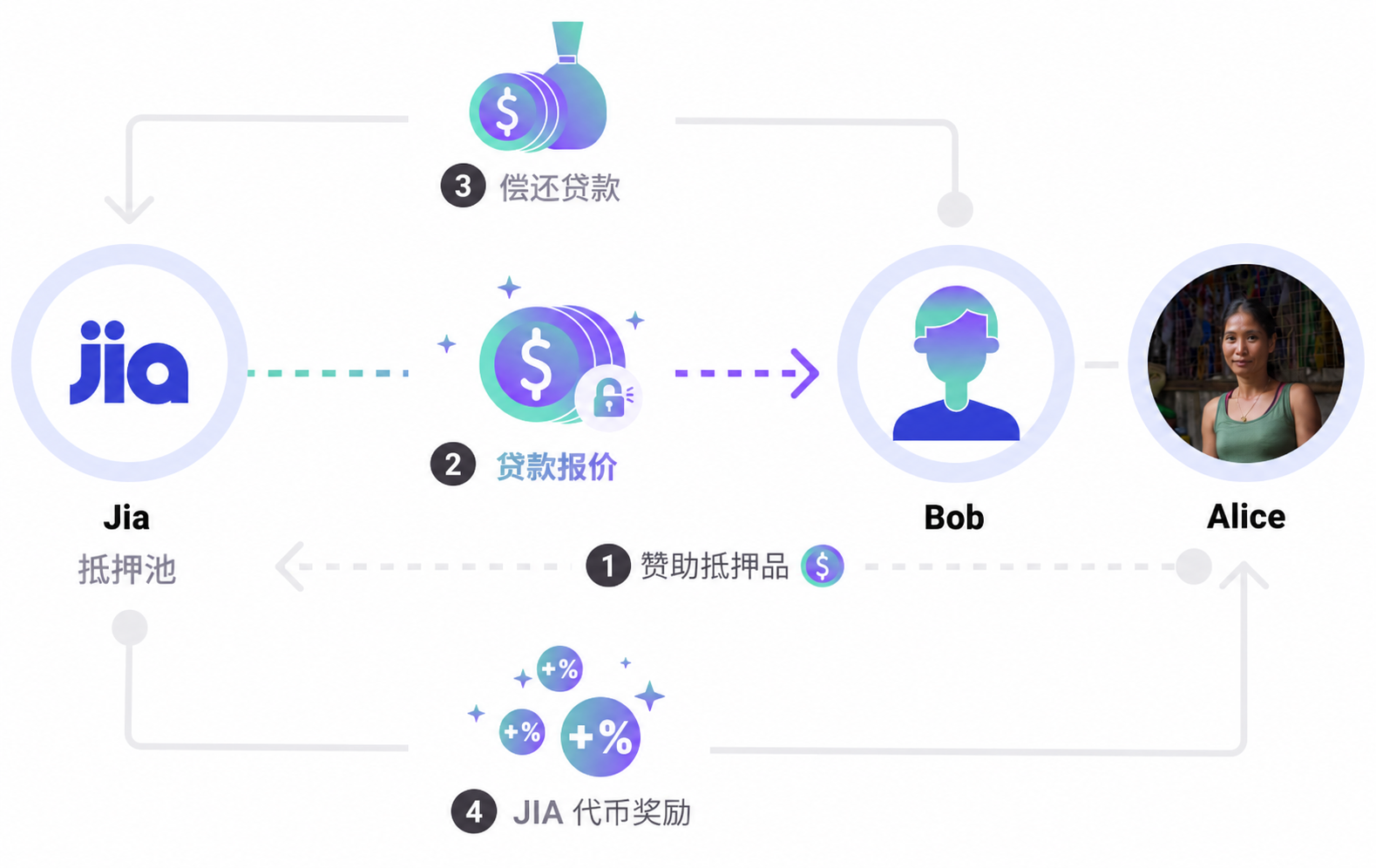
- Borrowers: mainly micro and small businesses in emerging markets that borrow through Jia’s lending pools. They can be introduced by partners or apply directly, and may post collateral to obtain better terms. Borrowers use a mobile app, while the blockchain layer stays abstracted away.
- Lenders: investors who supply capital to the pools and earn interest from borrower repayments, sharing in what the report called real yield from local economic activity.
- Sponsors: parties that hold on-chain assets and use them as guarantees, giving additional credit support to borrowers with thin files or higher risk profiles.
- Partners: platforms or ecosystem participants that serve borrowers and provide borrower referrals, operating data and support for underwriting and credit assessment.
Jia’s standard lending product is aimed at working capital needs. TRON listed the usual terms as loan sizes of $100 to $5,000, durations of 30 to 90 days, and monthly interest rates of 2% to 7%.
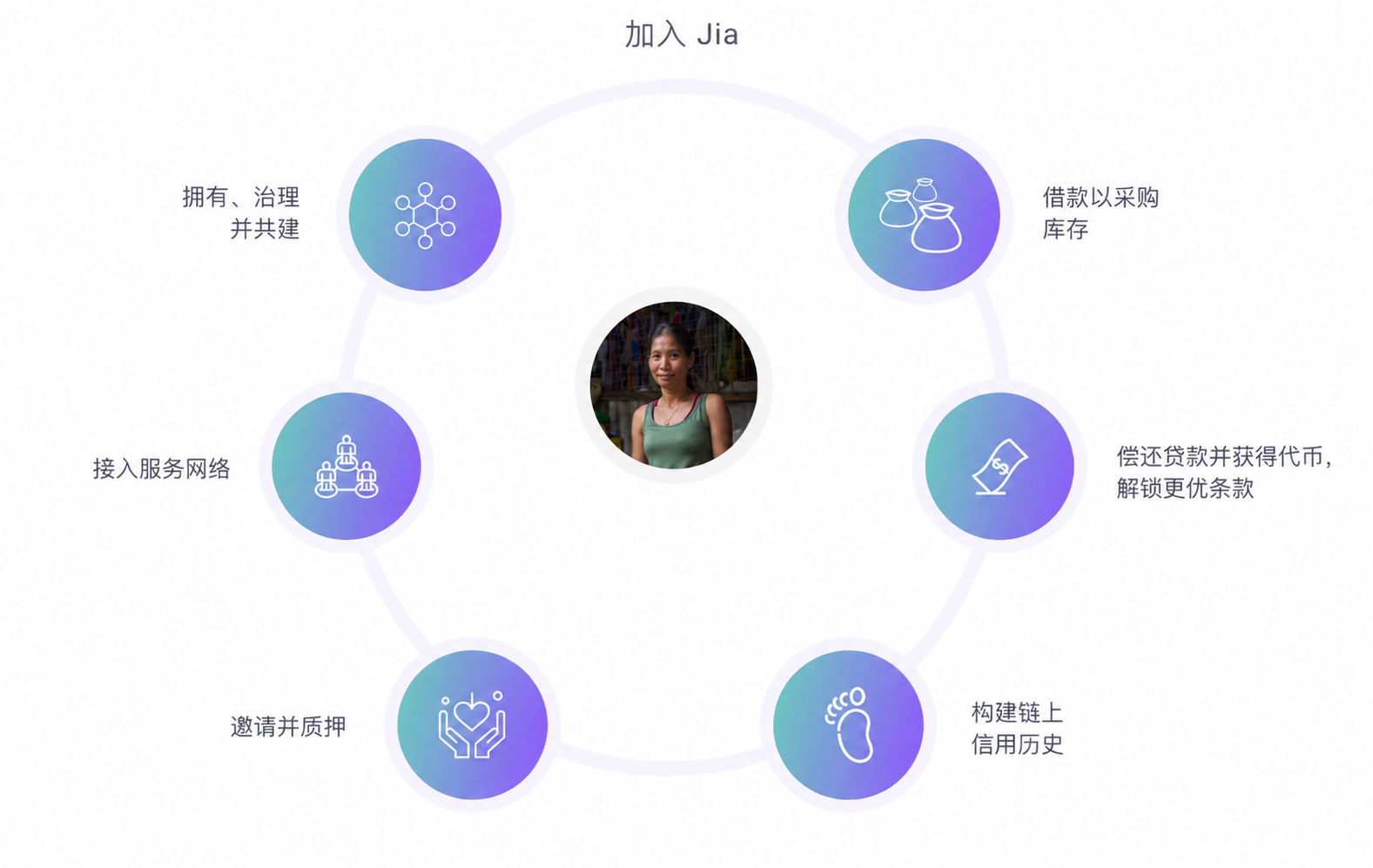
The final terms are adjusted based on the borrower’s credit profile, business condition and funding demand, and the report said those terms can improve as repayment history builds over time.
Credit underwriting and token incentives
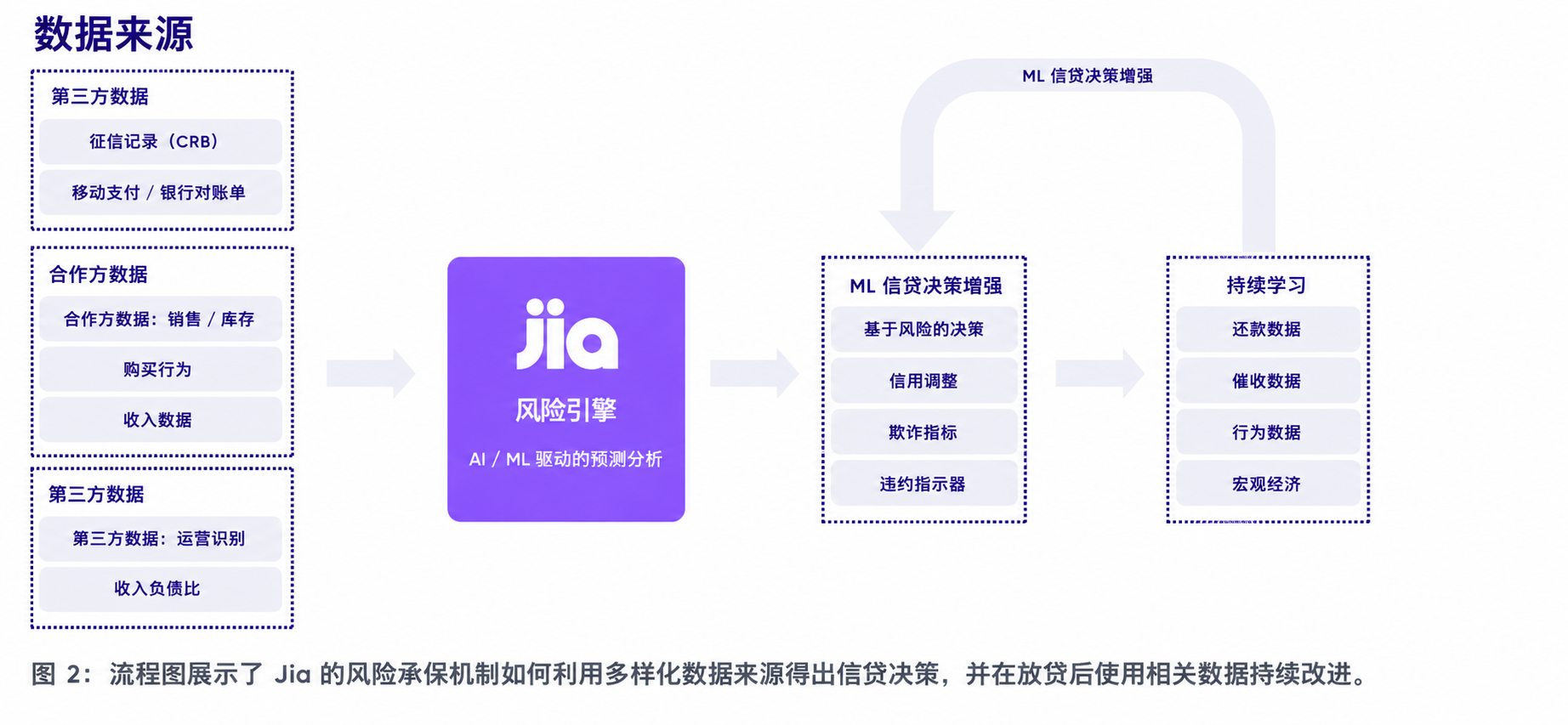
TRON said Jia’s core difference from many DeFi lending systems is its support for unsecured or lightly collateralized credit. Instead of relying on overcollateralization, it evaluates borrowers using partner data, loan application data and third-party financial information.
That includes sales, inventory, revenue, operating behavior, income, expenses, use of funds, and records from local credit bureaus, banks and financial service platforms. The report said Jia uses those inputs to build a machine-learning credit model that examines business strength, income stability, repayment history, cash flow and credit records before setting exposure and loan terms.
Jia also uses a JIA token incentive model. TRON used an example of a borrower named Alice to explain the design, saying that under a traditional system she might only have a one-way relationship with a lender and no way to share in platform growth. In Jia’s system, long-term positive borrowing activity can earn JIA rewards. Token holders can then participate in governance, vote on future development and share in the platform’s long-term value.
TRON’s assessment was that Jia’s strength lies in combining DeFi capital with real economic demand in emerging markets and generating yield from real commercial activity, while helping businesses that have long faced limited access to funding.
It also flagged several risks: borrower default, data quality issues, failure of risk models, macro volatility in emerging markets, heavy reliance on local partners for operating data, and higher compliance and operational complexity than overcollateralized DeFi lending protocols.
Manadia: a verifiable collaboration network built around AI and privacy computing
TRON’s second deep dive focused on Manadia. The report said the project’s total financing has not been disclosed and that AurumX led the round.
Manadia was presented as a Web3 infrastructure platform that combines AI collaboration with privacy computing to support verifiable data settlement, privacy-enhanced value transfer and cross-system coordination. Its goal is to break trust barriers between on-chain and off-chain systems without relying on a single trusted third party.
VERITAS handles external data injection and adjudication
The report said VERITAS is the core protocol used by Manadia to process external inputs and create on-chain signals that are resistant to manipulation and open to challenge.
For high-frequency price feeds, VERITAS uses a weighted median aggregation method. It collects signed data from multiple nodes and applies a deviation check based on Z-scores, removing outliers above a threshold of 3 before producing a consensus price.
The economic model uses staking and slashing. Nodes must lock MA tokens as collateral, and if their reported data deviates by more than 5%, slashing is triggered automatically. The penalty ratio is based on historical reputation and an exponential decay model. TRON said this design is more robust than simple voting and can use time-lock delayed confirmation to resist flash-loan attacks.
In the report’s example, VERITAS can push ETH/USD prices every five seconds in DeFi liquidation scenarios and support sub-millisecond derivatives pricing.
For more complex events, VERITAS combines AI-generated proposals with human challenge processes. Large language models parse news APIs or off-chain signals and generate structured event assertions. A fixed challenge window then opens, such as 24 hours, during which any token holder can submit contrary evidence and stake an equal amount of MA tokens. If the challenge succeeds, the challenger receives slashed assets as a reward.
Final resolution comes either from more than 66% node signatures reaching threshold consensus or from an arbitration DAO. The report said this gives the result finality and irreversibility.
TRON also said that compared with a fully market-driven approach such as Pyth, VERITAS can reduce human bias through AI-generated proposals and support non-binary outcomes, including probability distributions for election results and verification of complex real-world state changes. In RWA settings, the mechanism can verify changes in real estate status without relying on a single custodian.
Outside price and financial events, VERITAS can also be used for lower-frequency but high-value state verification, such as whether a participation relationship is ongoing, whether a behavior pattern has materially broken, or whether signals across platforms show coordinated manipulation.
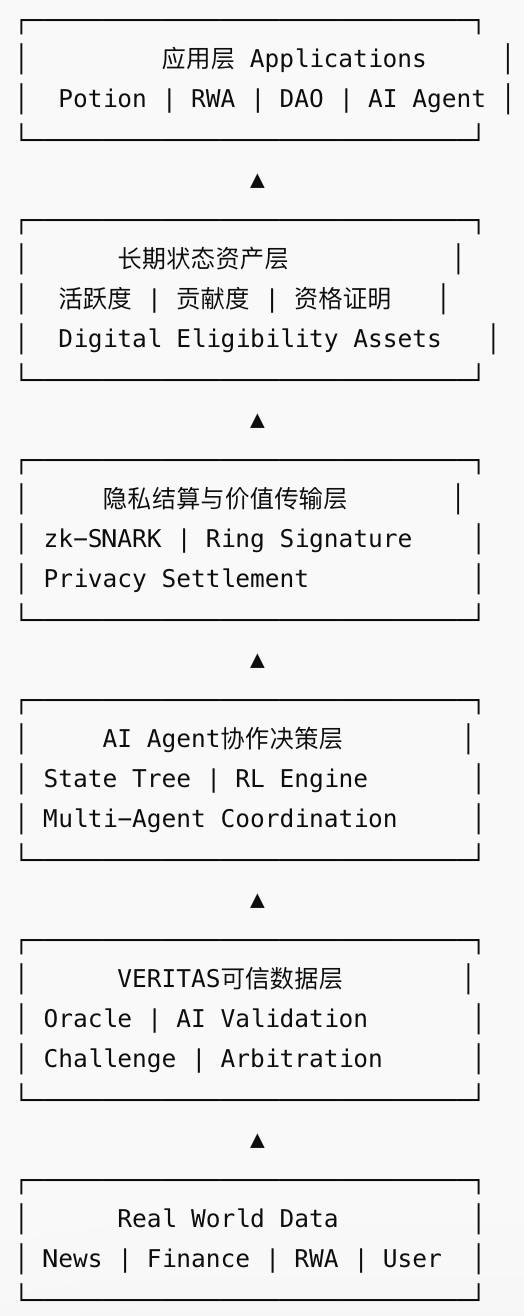
In the Potion use case described by TRON, VERITAS verifies external participation signals through multiple sources and filters out deviations so that labels such as active, continuously participating and eligible remain challengeable and final.
The security model is based on an improved Byzantine fault tolerance framework. Node selection uses VRF random sampling to reduce Sybil attack risk, and the system targets throughput of 1000 TPS while using rollup-like batch proofs to optimize gas use.
Stateful AI agents, long-term coordination and eligibility proofs
TRON said Manadia is not built for high-frequency trading or one-off interactions. Instead, it is meant for long-duration, cross-platform relationships that can be interrupted and resumed. In Potion, that means participation links between users and content, platforms or ecosystems that can last for months or even years.
The main protocol problem, in TRON’s framing, is not raw throughput. It is continuity, resistance to manipulation and verifiable evolution. Manadia addresses that with state trees, persistent agent execution and eligibility proofs, so the question of whether a long-term condition has been satisfied becomes a settlement object in itself.
AI agents in this framework are treated as autonomous economic entities. Each one maintains an IPFS-anchored Merkle Patricia Trie state tree that records decision history, credit scoring and behavioral traces. State updates use an incremental hash-chain model, generating a new root hash after each interaction and broadcasting only differential proofs.
On the decision side, each agent runs a lightweight Actor-Critic model based on Torch. Inputs include VERITAS signals, historical state and external task queues, and outputs include release speed for rights and scheduling parameters.
TRON’s example was a liquidation scenario where an agent pauses execution if price volatility exceeds 10%. It also said Q-Learning is used to improve long-term returns.
Cross-agent coordination follows an A2A-style standard. Tasks are split into sub-commitments, validated with ECDSA signatures, and subject to slashing if execution fails. Consensus uses Optimistic Rollup, while disputes move on-chain for arbitration.
Authority is controlled through token-bound permissions. Agents hold ERC-721-like agency warrants that allow limited value transfer and cap risk exposure. The system also uses differential privacy noise injection at ε=0.5 and on-chain audit hooks so agent decisions remain traceable.
Privacy-preserving settlement and reusable long-term participation data
On settlement, TRON said Manadia uses zero-knowledge proof circuits and conditional contracts to prove claims without revealing the underlying details. The core proving system is zk-SNARK using Groth16. Users can generate proofs such as whether a position exceeds a threshold, while verifiers only need to check a Groth proof of roughly 200 bytes.
The system also uses ring signatures for anonymous transfers between multiple parties. Automated settlement runs through state channels, with pre-signed transaction trees, off-chain settlement triggered by VERITAS and on-chain dispute handling.
For compliance, Manadia integrates a Verite-like verifiable credentials module. Users can bind KYC proofs and verifiable credentials, while the system checks only AML blacklist status instead of exposing a full transaction graph. In the cross-border payment example cited by TRON, Manadia can prove that funds come from a lawful source while hiding the transfer amount and transaction details.
Performance optimizations include recursive SNARK batch proofs, and gas consumption is described as below 100k per transaction. Security auditing focuses on constant-time computation and side-channel attack protection.
TRON emphasized that the system’s zero-knowledge settlement model is not limited to proving balances or positions. It is also designed for eligibility proofs, allowing users to prove they satisfy a long-term participation condition without exposing raw behavioral data, source platforms or time-series details.
The report said Manadia’s data model is built around the accumulation of long-term participation relationships rather than a single app. Once those behavioral traces are confirmed and written into the state tree, they become reusable long-term state assets.
In the Potion example, those states initially support automated membership benefits and eligibility settlement. But the same long-term participation record can later be verified again across different times and applications without recollecting original behavior data. TRON said that gives reusable structure to concepts such as long-term activity, stable contribution and continuous support.
Its conclusion on Manadia was two-sided. The project’s strength, TRON said, lies in unifying verifiable data validation, AI agent coordination, zero-knowledge private settlement and long-term state assetization into a single infrastructure stack. At the same time, the architecture is complex, touching AI, TEE, ZK, oracles and state management, with high implementation and operating costs. The report added that the project’s value depends heavily on real adoption and ecosystem scale, meaning the network effects around long-term state assets and AI agents may take time to form.
Economic calendar and regulatory updates
TRON said U.S. June ISM services PMI moved back into expansion territory, suggesting services consumption remained resilient and easing concerns about a rapid slowdown. The June Fed minutes again stressed that future rate decisions would depend on incoming data, leaving markets cautious on rate-cut expectations for this year.
U.S. equities posted gains over the week, and the report said market focus is gradually shifting from macro data toward the upcoming second-quarter earnings season.
For July 13 to July 17, TRON listed these key releases:
- July 14: U.S. June CPI and core CPI.
- July 15: U.S. June PPI, New York Fed manufacturing index and the Beige Book.
- July 16: U.S. June retail sales, initial jobless claims and housing-related data.
- July 17: U.S. June industrial production, housing starts, preliminary July University of Michigan consumer sentiment; China’s second-quarter GDP, June industrial output and retail sales data.
On regulation, the report said the U.S. continued work on market structure and stablecoin legislation, with reserve requirements, issuer access and the division of responsibilities between the SEC and CFTC still central. The EU was described as moving into full MiCA enforcement, pushing platforms without CASP licenses out of the market faster.
TRON also noted continued policy work in the UK around the digital pound and crypto oversight, stablecoin licensing preparation in Hong Kong, tighter licensing and AML rules for digital payment token service providers in Singapore, ongoing reforms in Japan around digital asset financial products and tax policy, and further work by Dubai’s VARA on VASP licensing and compliance.
The report ended with a reminder that markets carry risk and that the document does not constitute investment advice.