

By Sebastien Davies
Translated by TechFlow
Sebastien Davies uses his experience with TrueFi and the buildout of Elara to make a broader point about where on-chain finance is heading. The industry, he argues, has moved beyond a stage where narrative could dominate product design and capital formation. The question now is less about who launched first and more about which systems can keep operating in real market conditions.
Finance is shaped by friction, not just speed
Davies frames the problem through the idea of viscosity. In fluid dynamics, viscosity measures resistance to flow. In financial systems, he uses the term to describe institutional inertia, compliance demands and embedded operating behavior. One of crypto's earliest mistakes, in his view, was assuming technical superiority would force adoption on its own.
Financial systems do not evolve simply because a new design is cleaner or more elegant. They evolve when new rails fit existing workflows. In traditional finance, much of the friction outsiders criticize is deliberate. Layered controls, capital standards and operating committees are there to keep critical functions running under stress and to protect client assets and institutional credibility.
That design bias favors stability. Product development moves through gated processes, and functionality is constrained by custody rules and reporting standards. Execution slows down, but durability is built in from the start. When failures appear, they often show up as delays in integration or weak responsiveness to change rather than sudden collapse.
Crypto-native markets were built on a different set of assumptions. Friction was reduced to speed up experimentation, deployment and global expansion. Permissionless launches and token incentives allowed capital to move quickly, often without the same operational safeguards. Products could find demand fast, but users frequently became the first live testers of code and incentive systems.
Davies does not present this as a neat binary. Traditional finance trades speed for predictability. Crypto accepts breakage because iteration is a core competitive edge. But in low-viscosity markets, liquidity can unwind as quickly as it accumulates. Under stress, that reflexivity can produce rapid contagion.
As the sector matures, expectations have changed. Crypto-native capital now wants traits associated with institutional systems: transparency, risk management and more disciplined treasury oversight. A middle ground is starting to form, where participants operate on blockchain rails but expect stronger operating discipline.
A selective hybrid is taking shape
Davies says the two systems are converging in practical ways. Crypto infrastructure is becoming more viscous where institutional scale requires it, especially in custody, compliance and risk management. Traditional institutions, meanwhile, are modernizing delivery through APIs and programmable settlement systems to reduce integration friction.
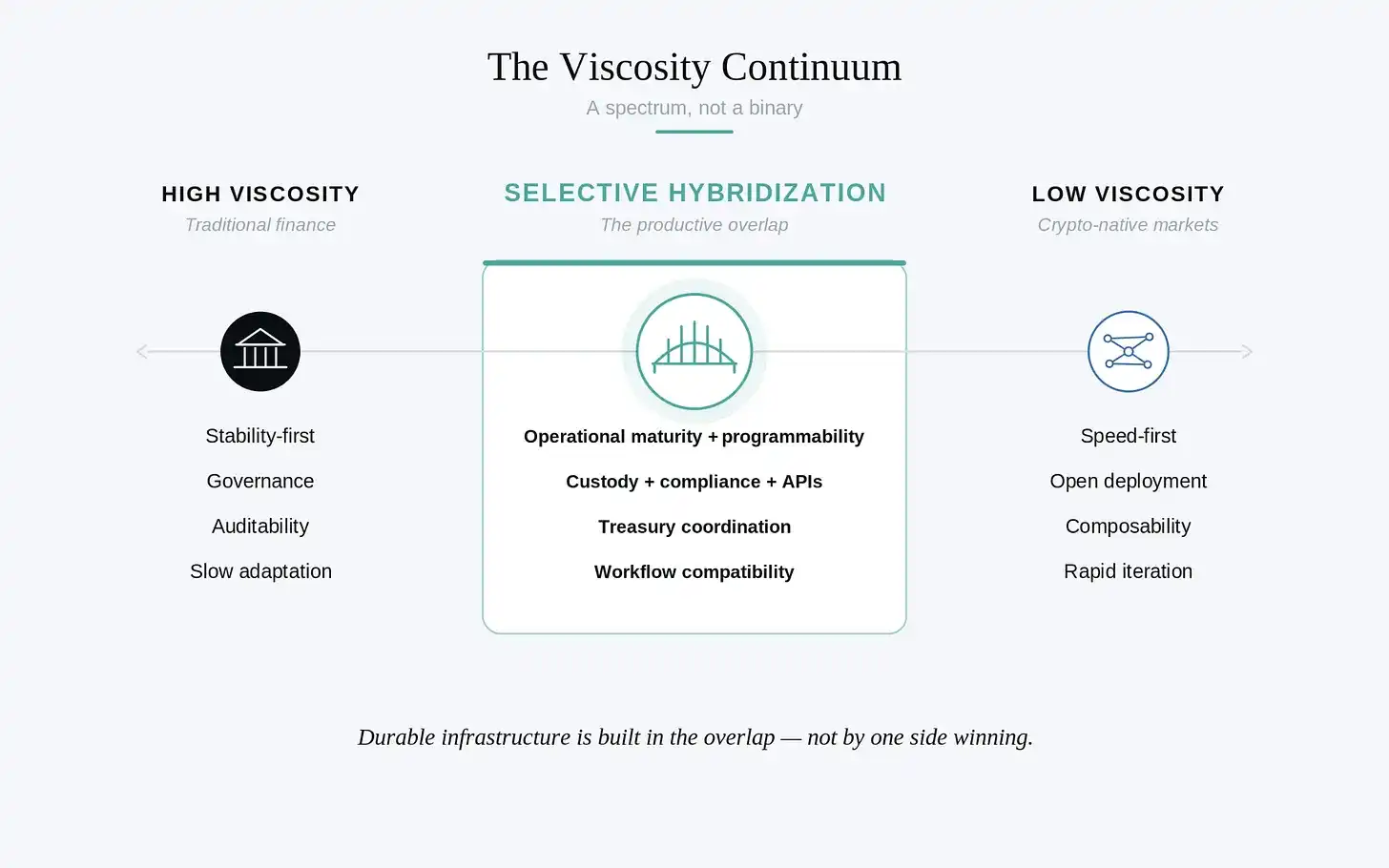
The infrastructure that lasts, he argues, will combine the speed of digital asset iteration with the control architecture traditional finance spent decades refining. For institutions, the main obstacle is rarely awareness. It is integration. Replacing treasury systems and reporting structures creates large organizational friction, so continuity still ranks above optimization. The likely winners will be systems that fit into existing workflows and turn integration from organizational surgery into a gradual transition.
He places Elara inside that broader structural shift and argues that the ordering of priorities in on-chain finance has been reversed.
What TrueFi showed about the limits of RWA credit
Serving on the board of TrueFi gave Davies a close view of a market going through structural repricing. TrueFi operated primarily as a real-world asset, or RWA, credit marketplace, but he says the assumptions that supported the sector's early expansion had already started to lose force. From his traditional finance background, the core problem in credit remained unchanged: moving loans on-chain does not solve counterparty risk.
Blockchain rails can improve transparency, automate payments and support conditional transfers. They do not improve the underlying economics of a loan or make a borrower more creditworthy. In a market where several platforms compete for the same limited pool of high-quality credit, margins compress and losses can stack. Many early operators tried to close the gap through unsustainable token emissions, but Davies says that strategy has clear limits.
That realization pushed the team away from thinking in terms of a standalone lending product and toward a broader financial architecture. If digital asset credit markets are going to mature, he argues, they need more than isolated lending infrastructure. They need treasury infrastructure able to coordinate liquidity, collateral, settlement and capital flows across an increasingly interconnected on-chain environment.
The opportunity shifted from issuing loans to coordinating capital
In that framework, programmable treasury systems matter because they can link liquidity management, collateral coordination and credit formation more tightly inside digital-native markets. Davies is not arguing that every component must live inside a closed loop. His point is that fragmented infrastructure creates operational drag, capital inefficiency and counterparty complexity.
The longer-term opportunity, as he describes it, lies in the coordination layer around digital capital: treasury management, collateral liquidity, liquidity routing, settlement infrastructure and risk-adjusted capital deployment. The boundaries between treasury, settlement and credit systems are becoming more porous, and capital is starting to move through those environments more like it moves through connected operating infrastructure than through isolated products.
There is also a practical economic reason for this shift. Sustainable financial infrastructure cannot depend indefinitely on token emissions or incentive programs. Those tools can speed up early adoption, but they rarely create durable economics by themselves. More resilient models come from participating across multiple layers of the capital stack, especially closer to treasury coordination, liquidity management and collateral mobility, where economics can compound in a way that looks more like a real financial system.
Elara's design: separate liquidity from yield generation
That thinking led the team toward stablecoins and treasury infrastructure. Davies says stablecoins are no longer just trading tools or temporary exits from volatility. They are becoming the foundational settlement rails for a new class of digital-native capital. Once digital dollars function as treasury primitives rather than speculative instruments, the operating problem changes. The challenge is not only generating yield. It is coordinating liquidity, reporting, custody and risk-adjusted returns across fragmented environments.
He says the goal was to build a dollar-linked collateral and treasury asset native to that ecosystem, not simply another on-chain tool. Elara, in his description, is infrastructure built around capital efficiency, programmability and operating flexibility.
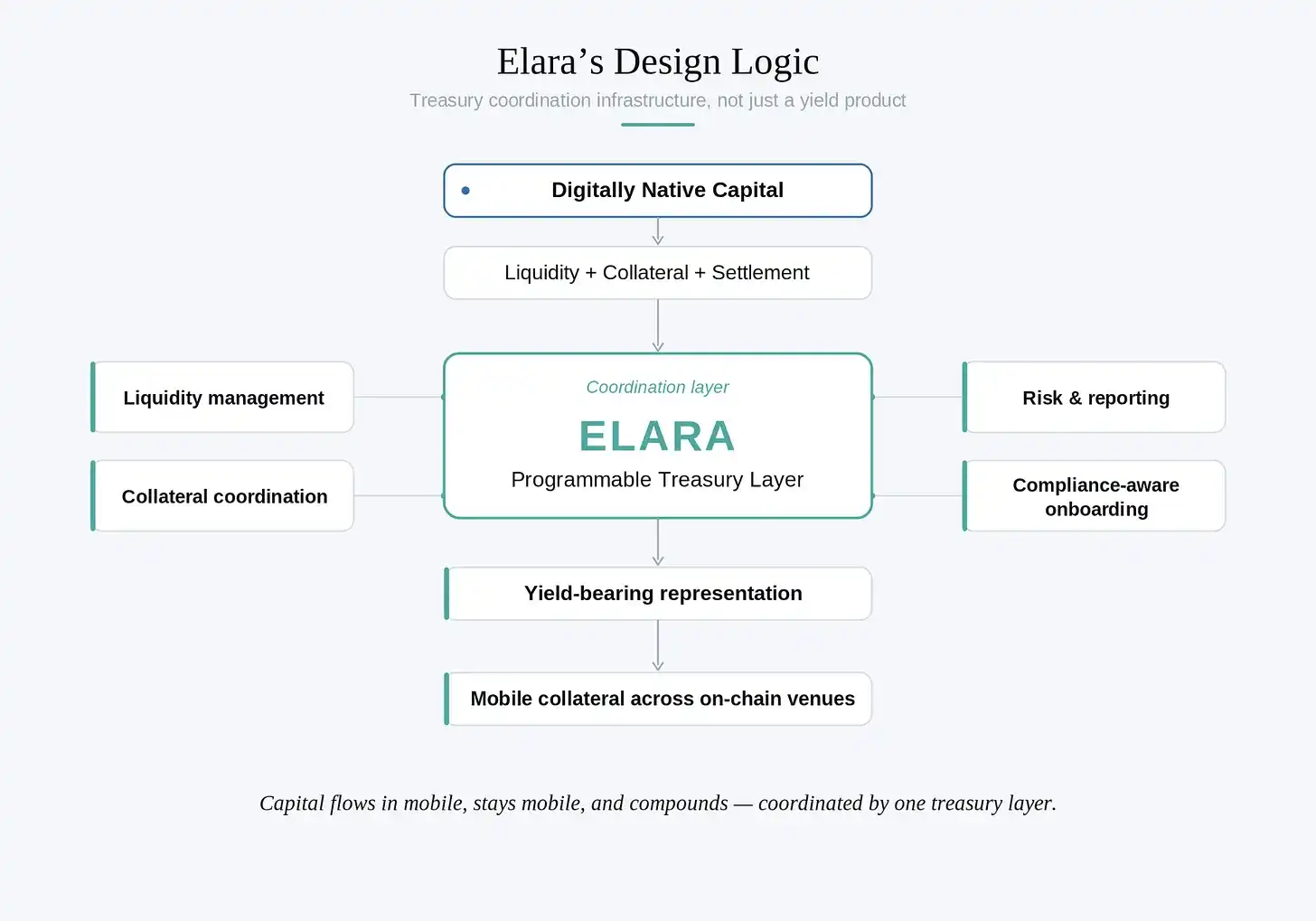
One of the most important architectural decisions was to separate liquidity from yield generation. Traditional fixed-income products distribute returns through periodic cash flows. In a programmable environment, value accrual does not need to follow that pattern. Rather than forcing holders to give up liquidity in exchange for yield, Elara was designed so users can deposit underlying assets and receive freely transferable yield-bearing representations.
Davies argues that the distinction looks subtle but matters operationally. As capital markets become more digital and interoperable, the ability for collateral to remain liquid while it compounds introduces a different treasury dynamic. Capital does not have to become static once it is deployed into a yield product. It can continue to function across wider on-chain systems. Staked representations can compound programmatically while remaining integrated with digital-native liquidity venues and collateral environments.
When assets like that are used in credit markets, he says, the implications are meaningful. Collateral no longer has to sit idle for the duration of a loan. The underlying yield can partially offset financing costs, creating a more capital-efficient relationship between treasury management and credit formation.
He uses this to make a larger point about why traditional finance operators are increasingly drawn to blockchain systems. The appeal is not necessarily that existing products are obsolete. It is that programmable infrastructure expands what those products can become. Instruments that were once static begin to look more like coordination software: composable, interoperable and continuously integrated with broader liquidity and settlement environments.
Davies is careful not to overstate the case. None of this removes the realities of operating in digital-native markets. Those environments remain faster, more fragmented and more reflexive than traditional fixed-income systems. Liquidity conditions can change quickly. Strategies involving market making, treasury coordination and on-chain liquidity management still carry execution risk, smart-contract exposure and operating complexity. Elara, as he presents it, is not meant to pretend blockchain infrastructure behaves like traditional finance. The aim is closer to the opposite: acknowledge the nature of low-viscosity digital markets and impose more discipline on how capital moves through them.
Liquidity itself becomes infrastructure
At the strategy level, Davies says the underlying approach centers on market making and liquidity provision in stablecoin pairs across decentralized finance markets. As stablecoin usage expands into trading, payments, collateral and treasury management, liquidity coordination itself becomes a financial function of growing importance. Fragmented liquidity conditions create demand for active capital deployment, spread capture, rebalancing and continuous treasury management across on-chain venues.
The returns generated there, he argues, come from actual market-structure dynamics inside digital-native capital markets: trading activity, liquidity fragmentation, volatility and the operating complexity involved in maintaining efficient settlement. Unlike many reflexive crypto yield structures from earlier cycles, these opportunities do not rely on leverage to create economic activity.
That also means the return profile differs sharply from traditional fixed-income markets. Outcomes depend on liquidity conditions, execution quality, volatility regimes, smart-contract risk and broader market participation. If trading activity contracts or liquidity compresses, the opportunity set can narrow quickly. In stressed periods, treasury coordination and risk management become more important. For Davies, that reinforces the broader argument: value is moving away from reflexive token-incentive structures and toward disciplined treasury management and infrastructure able to coordinate capital efficiently through changing conditions.
Why fundraising changed
Davies says the team's early instinct was still shaped by the prior cycle. They initially tried to raise capital around the vision itself: digital dollar infrastructure, programmable treasury systems and the long-run convergence of traditional finance with blockchain-based settlement rails.
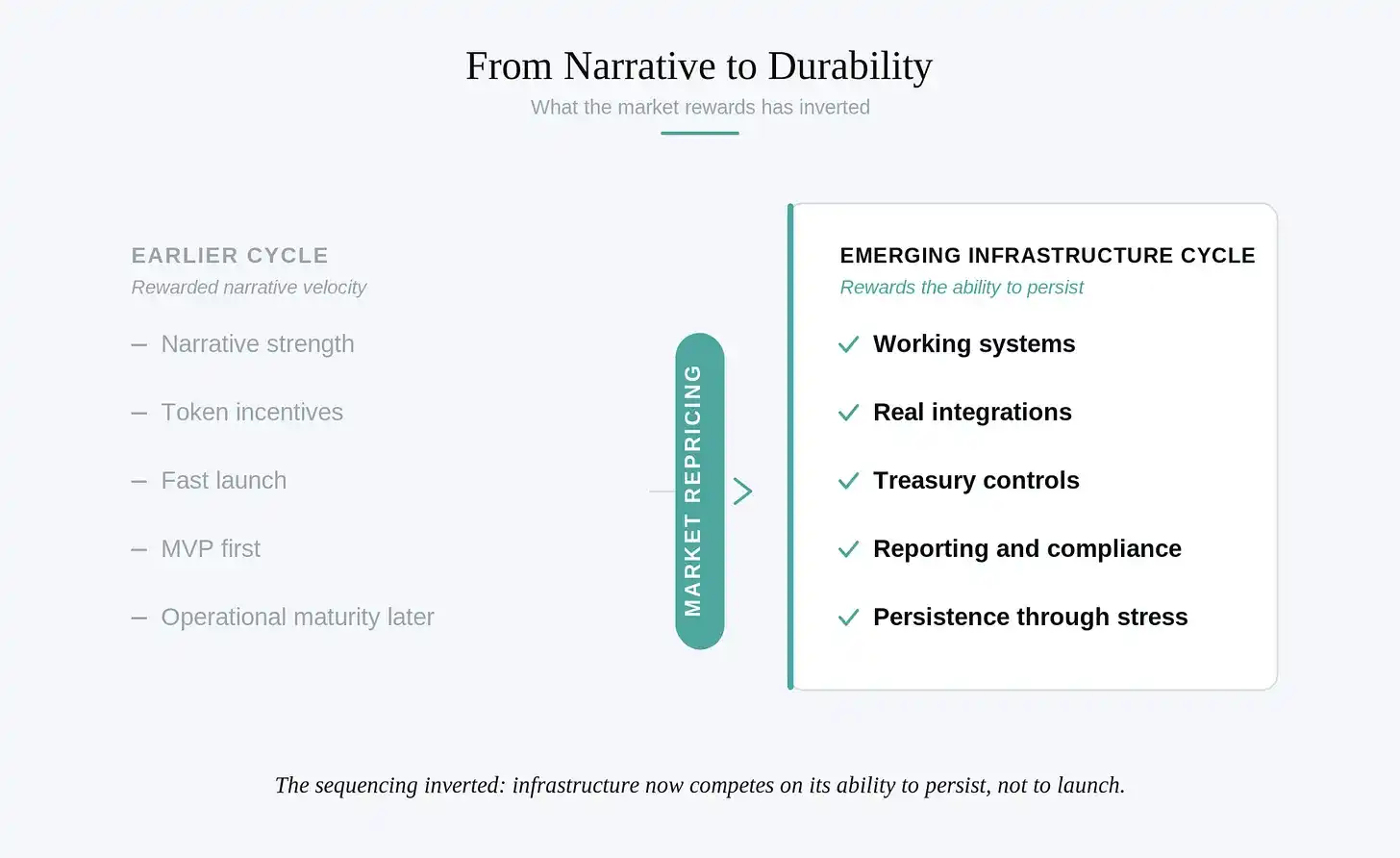
He thinks that approach might have worked a few years earlier. For much of the last cycle, crypto markets rewarded narrative velocity. A compelling argument and a token model could attract substantial capital before infrastructure was mature. By the time those conversations actually happened, however, the environment had changed.
Before meaningful infrastructure was fully built, the execution team engaged potential investors assuming the strength of the idea would drive the discussion. Instead, the discussion turned operational. Investors wanted running systems, integrations, reporting structures, treasury controls, counterparties, compliance frameworks and evidence that the infrastructure could operate under real market conditions.
Davies describes that shift as both inevitable and healthy. It reflects lessons from the prior cycle, when the market saw loosely built systems break under stress and became less willing to finance abstractions. He also says advances in AI-assisted software development accelerated the shift. Early code became less scarce. MVPs became easier to build. Interfaces became easier to copy. Infrastructure became easier to access. As software commoditized, operating trust became more valuable.
The result is a different kind of competitive edge. The question is no longer who can tell the best story. It is who can build systems that endure in real markets. In Davies' framing, the order has flipped. Earlier cycles rewarded teams that launched fast and operationalized later. The emerging market rewards the reverse: sustained capability matters more than launch capability.
Why institutional adoption still moves slowly
Davies then turns to a larger question: why has institutional adoption of digital assets been slower than many early builders expected? He returns again to viscosity.
Banks, corporate treasuries, asset managers and institutional allocators move slowly for rational reasons, he writes. Their operating models are built on continuity, auditability, risk control and procedural trust accumulated over decades. Reporting standards, investment committees, custody frameworks and compliance processes exist to reduce the probability of uncontrolled failure when large pools of capital are involved. What looks like friction from the outside is, from the inside, part of the infrastructure itself.
Crypto-native systems evolved around a different set of assumptions: capital mobility, composability, fast iteration and open deployment. That gave blockchain infrastructure the ability to scale quickly across global markets. The strength was adaptability. The weakness was that speed could outrun operational hardening, something the last cycle exposed when liquidity, incentives, governance and risk became deeply entangled.
Davies argues that the capital base most likely to migrate on-chain over time will retain high-viscosity characteristics even if the underlying settlement rails become more programmable. That insight shaped Elara. Building purely for speculative speed was not attractive, but waiting for large institutional allocators to move fully on-chain before building anything was not realistic either. The practical path is to build for the digital-native capital already in these markets while embedding the operating values institutions will eventually require.
ArkenYield, Keyring and the surrounding operating layers
In practice, Davies says that means designing for financial discipline, reporting awareness and durability from the outset rather than treating them as later upgrades. He points to the partnership with ArkenYield as an example of the same philosophy. At its core is a tokenized market-making and treasury-management strategy operating in low-viscosity digital markets while incorporating operating assumptions more often associated with institutional finance, including active liquidity management, controlled fund operations, risk monitoring and an emphasis on capital preservation beyond yield generation.
That positioning, he says, allows the system to remain economically productive in current market conditions while gradually aligning with the operating expectations of more traditional pools of capital.
He extends the point to the surrounding layers needed to support institutional participation responsibly. Identity verification, compliance coordination and onboarding workflows were often treated as secondary issues in earlier cycles, but have become foundational as the market matures. The partnership with Keyring is part of that effort, integrating compliance and identity infrastructure directly into the system architecture rather than leaving them as external afterthoughts.
Regulation and competition are changing the conditions for adoption
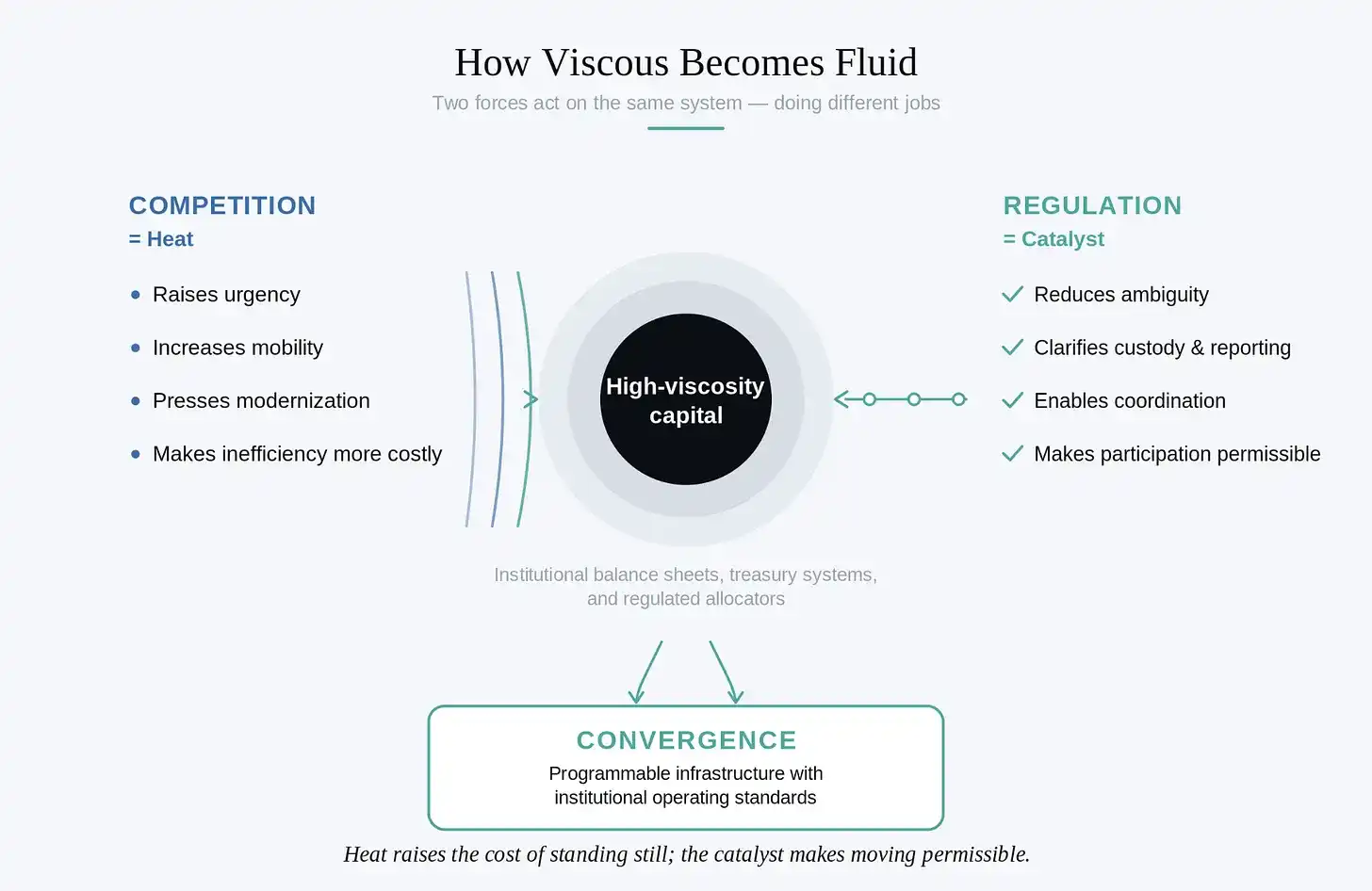
Davies closes by widening the lens. One of the more important developments of the last several years, he says, has been a gradual shift in how regulators approach digital asset infrastructure. Earlier discussions were centered mainly on restriction and risk control. More recent reforms have started to create pathways for institutional participation rather than simply blocking it.
He sees regulation less as an obstacle than as a catalyst. Rules alone cannot force adoption, but once markets reach a sufficient level of maturity, regulatory clarity can reduce uncertainty around custody, reporting, settlement handling and fiduciary responsibility. In high-viscosity systems, that matters because uncertainty is itself a form of friction. Large financial institutions rarely avoid new infrastructure simply because they do not understand it. More often, they avoid it because operational ambiguity creates unacceptable risk. Once that ambiguity narrows, adoption can shift faster than expected.
Competition adds a second force. In stable environments, institutional inertia can persist for years because the operating cost of change outweighs the immediate gains from optimization. As competitive pressure rises, systems start to reorganize. Davies likens competition to heat: it increases capital mobility and pushes market participants to modernize treasury management, settlement infrastructure and liquidity coordination.
This is central to how he thinks about Elara. One of the core limits of many early RWA models, in his view, was the assumption that institutional capital would move on-chain simply because the infrastructure was theoretically more efficient. In practice, high-viscosity capital providers were being asked to move assets into environments that still appeared operationally fragile, lightly governed and reflexive under stress. The friction remained too high relative to the perceived benefit.
Built for convergence, not for a sudden replacement
Elara's answer, as Davies describes it, is not to force institutional behavior to adapt prematurely to crypto-native systems. It is to build infrastructure that works efficiently in today's digital-native markets while embedding the operating assumptions institutional allocators will eventually need.
That means compliance awareness inside the architecture itself. It means treating trust, reporting and risk management not as external constraints on financial infrastructure but as parts of the infrastructure. It also means moving beyond reflexive incentive structures toward systems that can preserve economic usefulness as market conditions change.
Durable financial systems rarely emerge from speed alone, Davies writes. They compound through reliability, repeatability and the gradual accumulation of operational trust. In that sense, Elara is not meant to be a static product. It is infrastructure positioned for convergence. As digital asset markets mature and institutional participation grows, the systems most likely to last will be those able to operate in low-viscosity capital environments while also meeting the operating expectations of more traditional allocators.
He ends on a concise summary of that thesis. The aim is not to wait for finance to become fluid on its own. The aim is to build infrastructure capable of managing both forms of flow. Elara is designed to operate inside the high-speed liquidity of digital-native capital while remaining durable enough to support the slower, more deliberate movement of institutional balance sheets over time.