Elara

WuBlockchain
2026-09-02 09:05:48

WuBlockchain August tech report: BIP-110 stalls, Glamsterdam goes public, Solana moves toward 350ms

WuBlockchain’s August technology report tracked a broad set of blockchain infrastructure updates across Bitcoin, Ethereum, Solana, major Layer 2 networks, and several other ecosystems. The report said Bitcoin’s long-debated BIP-110 entered real activation in August but failed to gain support, with miner signaling at only about 2.5% during the mandatory signaling phase. Nodes enforcing the rule began rejecting non-signaling blocks from height 961,632, effectively creating a minority chain that produced only around two blocks before largely stalling, while the main Bitcoin network continued as normal. On Ethereum, the Glamsterdam upgrade moved from internal DevNet testing into a public test phase, with DevNet 8/Platåberget launched on Aug. 13 and the Gloas fork activated on Aug. 20. Testing has shifted from basic functionality to edge cases and client compatibility, while tentative testnet activation targets of Sept. 28 for Sepolia and Oct. 26 for Hoodi have been proposed. Hegotá also advanced from open proposal intake into a narrower candidate-selection stage. The report also highlighted rising performance competition across scaling networks. OP Mainnet upgraded from 250ms Flashblocks to 200ms Subblocks, Base outlined a 200ms Native Blocks plan, and Solana is preparing to reduce mainnet slot time to 350ms starting from epoch 1020. In parallel, Arbitrum said real mainnet blocks can now be proven with SP1-generated ZK proofs, extending its path toward a multi-proving architecture.

110
WuBlockchain August tech report: BIP-110 stalls, Glamsterdam goes public, Solana moves toward 350ms
WLFI
2026-08-23 10:24:03

Weekly crypto project updates: WLFI trust plan, Optimism shifts 546.9 million OP, Linera tees up new product cycle

A packed week of crypto project updates brought a mix of governance fights, infrastructure upgrades, legal structuring moves and new product plans. World Liberty Financial, or WLFI, said it is setting up World Liberty Trust Co., N.A. and promoted former general counsel Mack McCain to chief legal officer and chief administrative officer, while also naming him chief trust officer of the planned entity. The project also rolled out its first batch of USD1-denominated RWA perpetual markets on Aster DEX and said it would back them with 250 million WLFI and $12.5 million in USD1 liquidity. Elsewhere, Optimism approved a contentious proposal that redirects 546.9 million OP previously earmarked for user airdrops into a strategic ecosystem fund managed by the Optimism Foundation, after a late 8.486 million OP vote from Test in Prod swung the result. Arbitrum activated the ArbOS 61 "Elara" upgrade, adding optional compliance filtering for Orbit chains and raising the Stylus contract code size cap from 24 KB to 96 KB. Linera said it plans a new product wave around the LNRA token sale and said it wants to become "the next Hyperliquid." The week also included the Ethereum Foundation’s $1 million post-quantum research challenge, Gnosis Chain’s approval of a proposal to transition from an independent L1 to an Ethereum L2, Arthur Hayes’ return to lead Flop Labs, and Harmony’s confirmation of a network rollback that will permanently discard more than 109,000 user transactions.

630
Weekly crypto project updates: WLFI trust plan, Optimism shifts 546.9 million OP, Linera tees up new product cycle
Arbitrum
2026-08-20 22:50:28

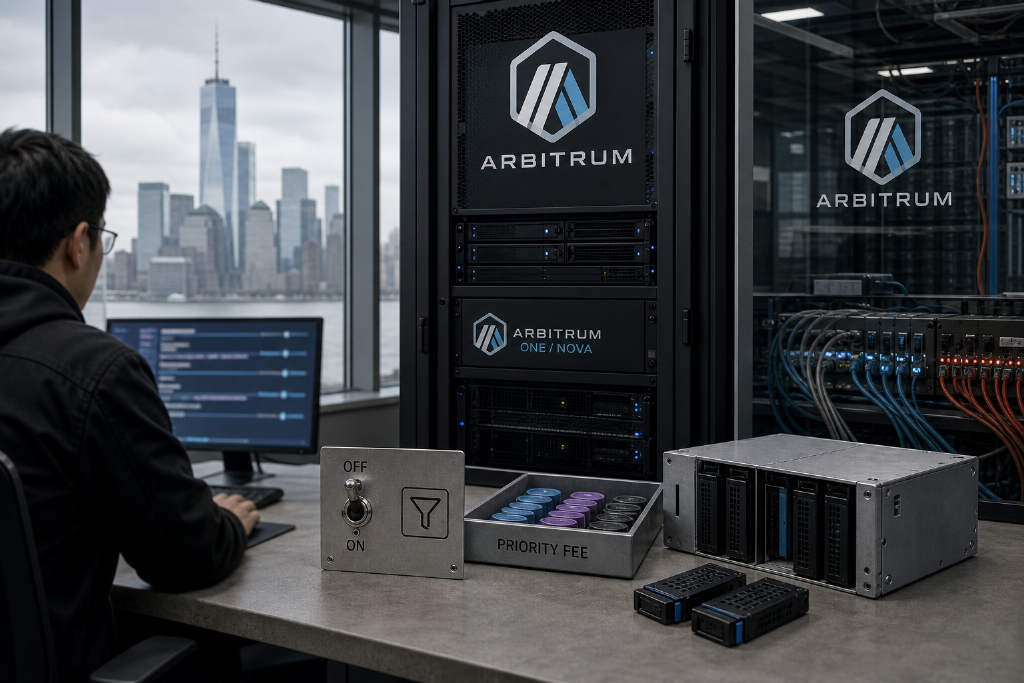
Arbitrum activates Elara, adding optional compliance filters and tip support for dedicated chains

Arbitrum activated ArbOS 61 Elara on Aug. 20 after governance approval, rolling out a package of infrastructure changes centered on dedicated chains while leaving the most sensitive features switched off on Arbitrum One and Nova. The release adds protocol-level transaction screening as an optional tool, but Arbitrum’s documentation says the compliance filter is disabled by default and must be explicitly configured by each chain owner. Operators can choose an outside compliance provider such as TRM Labs or Chainalysis and define rules for transfers, contract calls and other interactions tied to restricted addresses. The upgrade also introduces optional priority-fee collection for dedicated chains, though collecting tips does not by itself alter transaction ordering. Chains must separately update sequencer logic to sort by the priority-fee field. For Arbitrum One, Elara also adds a new BaseFeeManager contract, allowing Offchain Labs to adjust the minimum Layer 2 base fee within a DAO-approved 0.01 to 0.10 gwei range, subject to notice requirements, DAO revocation and a two-year expiration. Separately, Elara adds an alternative data-availability interface for dedicated chains and raises the code-size cap for Stylus contracts from 24 KB to 96 KB, without changing Solidity contract limits.

420
Arbitrum activates Elara, adding optional compliance filters and tip support for dedicated chains
TrueFi
2026-07-15 08:30:21

From TrueFi to Elara: Why On-Chain Finance Is Shifting Toward Liquidity Infrastructure

Sebastien Davies argues that on-chain finance is moving past the phase when narrative alone could carry a product or a fundraising round. Drawing on his experience with TrueFi and the development of Elara, he says the core challenge in digital asset markets is no longer simply putting credit, dollars or yield products on-chain. The harder problem is building infrastructure that can coordinate liquidity, collateral, settlement, treasury operations, compliance and risk across fragmented markets. In his view, blockchain rails can improve transparency and payment automation, but they do not remove counterparty risk or fix the underlying economics of credit. That is why many early real-world asset lending models ran into structural limits, especially when multiple platforms competed for the same small pool of high-quality borrowers and relied on token incentives to support growth. Davies says the next durable opportunity lies closer to the coordination layer: programmable treasury systems, liquidity routing, collateral mobility, controlled balance-sheet operations and infrastructure that can keep functioning under real market conditions. He also argues that institutional adoption has been slower than many expected because established capital moves through high-friction systems built around continuity, reporting and risk controls. In that setting, the winners are likely to be platforms that can operate in crypto-native markets today while speaking the operational language institutions will eventually require.

950
From TrueFi to Elara: Why On-Chain Finance Is Shifting Toward Liquidity Infrastructure