
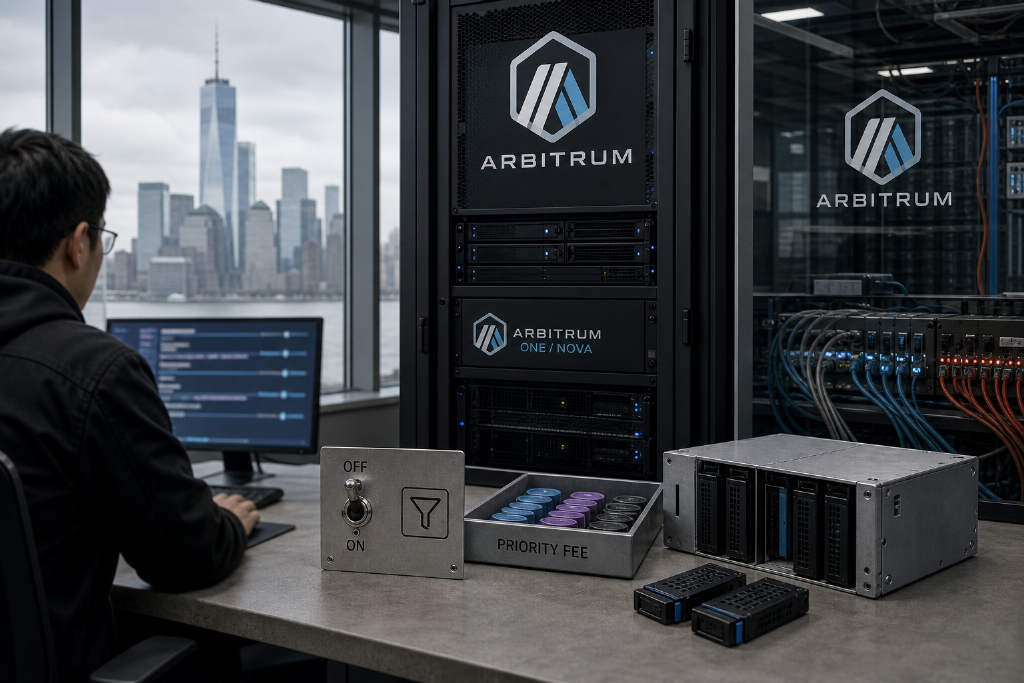
Arbitrum activated ArbOS 61 Elara on Aug. 20, adding optional protocol-level transaction screening, priority-fee support and an alternative data-availability interface for dedicated chains, while also changing base-fee administration and expanding Stylus capacity on Arbitrum One.
The upgrade went live after approval through Arbitrum governance. The governance proposal included compliance and priority-fee capabilities in ArbOS 61, but left both intentionally disabled on Arbitrum One and Nova. As a result, the compliance filter is not a new screening system for Arbitrum One users. It is configurable tooling for owners of dedicated Arbitrum chains.
Chain owners decide whether to turn filtering on
Arbitrum’s technical documentation says compliance filtering is off by default, and each component must be explicitly configured and enabled by the chain owner. An owner can select an outside compliance provider, such as TRM Labs or Chainalysis, to generate a restricted-address list. The owner can also define rules covering transfers, contract calls and other interactions involving those addresses.
Enforcement works at two levels. First, the sequencer simulates transactions and rejects any that break the configured rules before they enter a block.
Second, for transactions submitted through the parent chain’s Delayed Inbox, a sentinel can register the transaction hash with an onchain guardian. When that transaction is later included, the state transition function forcibly causes it to fail.
That second layer is meant to stop a restricted user from bypassing the sequencer through Arbitrum’s force-inclusion path. The documentation also says restricted addresses are stored as salted hashes rather than plaintext. It recommends that chains wait at least 30 days after the ArbOS 61 release on Arbitrum One before adopting the feature.
Priority fees are optional as well
Elara also gives dedicated-chain owners the ability to collect priority fees, or tips, but the feature ships disabled. Only the chain owner, typically an operator address or a DAO, can switch collection on through the access-controlled ArbOwner precompile.
Collecting tips alone does not change transaction ordering. A chain must also update its sequencer logic so that ordering uses the priority-fee field.
On Arbitrum One, turning on priority-fee collection still requires a separate constitutional DAO vote. Elara installs the underlying capability, but does not activate it by itself.
Base fee administration changes on Arbitrum One
For Arbitrum One’s base fee, Elara introduces a BaseFeeManager contract that lets Offchain Labs adjust the minimum Layer 2 base fee within a DAO-approved range of 0.01 to 0.10 gwei.
The delegation expires two years after mainnet activation, requires public notice through the Arbitrum forum and can be removed by the DAO. The upgrade itself does not raise fees.
Alternative DA interface and larger Stylus contracts
The alternative data-availability API is also aimed at dedicated chains. It allows operators to connect providers without maintaining custom Nitro forks. Arbitrum One is not expected to use that interface because its transaction data settles on Ethereum.
Separately, Elara raises the code-size limit for Stylus contracts from 24 KB to 96 KB. The change does not apply to Solidity contracts.