
PANews’ Aug. 20 daily roundup centered on U.S. crypto policy, new trading product rollouts, Bitcoin cycle calls, and a series of updates from the AI and robotics sectors.
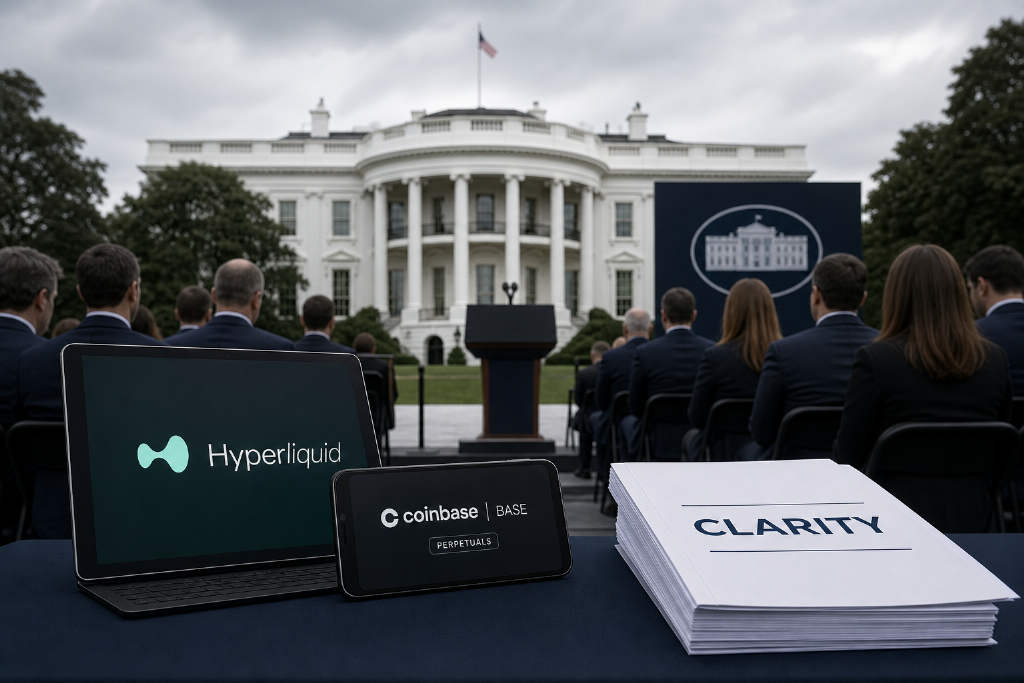
White House event puts the CLARITY Act and Hyperliquid in focus
U.S. President Donald Trump met at the White House with Securities and Exchange Commission Chair Paul Atkins, Commodity Futures Trading Commission Chair Michael Selig, and executives from Coinbase, Ripple, Gemini, Polymarket, Kalshi, Nasdaq, the New York Stock Exchange, CME, and DTCC. The meeting was held ahead of Thursday’s first session of the CFTC’s Innovation Advisory Committee and centered on regulatory innovation.
During the crypto event, Trump urged Congress to advance the CLARITY Act, calling it 「very strong structural legislation」 that would put the United States 「ahead of every country」. Coinbase Chief Executive Brian Armstrong said lawmakers should 「work together to get the bill across the finish line」, while SEC Chair Paul Atkins said the crypto-asset rules proposed by the agency this week complement the CLARITY Act and support congressional passage.
Trump later brought executives into the Oval Office for a closed-door discussion. Chainlink Labs Chief Executive Sergey Nazarov said Trump’s team sees the bill as 「very viable」 and that only a small number of issues and several senators still need to be addressed. According to the report, the bill needs 60 votes before the September recess to clear the Senate.
Trump also said at a Wednesday press conference with tech leaders and regulators that CFTC Chair Michael Selig is working to bring perpetual futures platform Hyperliquid to the U.S. in a 「fully compliant and lawful way」. HYPE, the platform’s native token, rose more than 20% over 24 hours as of publication. Binance founder Changpeng Zhao later said the development would not only affect Hyperliquid, but could also open the door for more perpetual DEXs and decentralized services to serve U.S. users.
Trump also said at the meeting that the U.S. has discussed plans to accumulate large reserves of Bitcoin and other cryptocurrencies. He added that after the meeting, the U.S. would make sure it remains the undisputed leader not only in Bitcoin and crypto, but also in prediction markets and artificial intelligence.
In a separate report, industry executives including Coinbase CEO Brian Armstrong, a16z’s Chris Dixon, Ripple CEO Brad Garlinghouse, and Kraken co-founder Arjun Sethi met with Commerce Secretary Howard Lutnick before Trump’s public remarks. Their discussion focused on the importance of passing the CLARITY Act and what it could mean for U.S. jobs, economic growth, and bringing crypto companies back to the country. They also discussed remaining hurdles, including ethics provisions and how the White House might help build bipartisan support.
CFTC advisory meeting and a call for comments on computing-power derivatives
The first meeting of the CFTC’s Innovation Advisory Committee is scheduled for Aug. 20 from 1:00 p.m. to 4:00 p.m. Eastern Time, or 1:00 a.m. to 4:00 a.m. Beijing time on Aug. 21. The agenda has three parts.
The first section will examine how crypto regulation can move from uncertainty to clarity, including the lack of a federal market structure, fragmented state licensing, overlapping regulatory authority, enforcement-led regulation, and how more clarity can be delivered under existing statutory authority. The second section will cover AI in trading, compliance, surveillance, risk management, and Agentic Finance, with explicit attention to the overlap between crypto and AI. The third section will focus on prediction markets and event contracts, including federal and state jurisdiction, state litigation and enforcement, market manipulation, customer protection, and long-term regulatory frameworks.
CFTC Chair Michael S. Selig, IAC Chair Walt Lukken, and designated federal officer Michael J. Passalacqua are set to deliver opening remarks. Separately, the CFTC said it plans to seek public comment on the launch of computing-power derivatives contracts.
Fed minutes show several officials leaned toward a rate hike last month
The latest Federal Reserve minutes showed several officials leaned toward raising rates last month, with many policymakers saying tighter policy could be needed if inflation fails to ease. Uncertainty, though, kept officials cautious at the July 28-29 meeting.
The minutes said: 「Regarding the outlook for monetary policy, participants reiterated that their interpretation of incoming information would be an important part of policy discussions.」 Dallas Fed President Lorie Logan, Cleveland Fed President Beth Hammack, and Minneapolis Fed President Neel Kashkari dissented in favor of a 25-basis-point increase. Kansas City Fed President Schmid and St. Louis Fed President Musalem, who did not have voting rights in July, said they would have backed a hike if they had been able to vote.
The document also said most participants expect inflation to gradually decline through the rest of the year as the effects of tariffs and higher energy prices fade, while many warned inflation could remain elevated for longer. The outlook was described as 「highly uncertain」, and the escalation of the Iran war was said to have made the inflation picture 「more blurred」. Officials said the labor market remains stable and roughly balanced, while the post-meeting statement was almost unchanged from the June version. Policymakers again pledged to restore price stability and described economic growth as 「solid」.
Project updates: Base adds Hyperliquid and Berachain renames HONEY
Coinbase said Wednesday that it has integrated decentralized perpetuals venue Hyperliquid into Base App, giving eligible users access to crypto perpetual futures trading with leverage of up to 50x. The feature is not available in jurisdictions that restrict leveraged crypto derivatives trading, including the U.S., the U.K., and Canada.
With the integration in place, Base App users can access more than 290 perpetual markets covering Bitcoin, Ether, as well as stock- and commodity-related markets. Execution is powered by Hyperliquid, and users can trade onchain derivatives without leaving the Base App wallet. Coinbase engineering lead Chintan Turakhia said roughly 75% of crypto trading volume now comes from perpetuals rather than spot, adding that leverage trading and perpetuals have long been among the most requested features from Coinbase’s most active users.
The Berachain Foundation said its stablecoin HONEY has been rebranded as Bera USD, with the ticker BUSD. The contract address and the token itself remain unchanged, with only the name and symbol updated. Berachain said the move is meant to make it immediately recognizable as a dollar stablecoin, especially for more institutionally oriented users. Because the token name is part of the EIP-712 domain separator design, any permits or offchain approvals signed under the HONEY name will no longer be valid and need to be signed again. The foundation said the BUSD update will roll out across integrations soon, with more changes to follow.
Ethereum core contributor Nethermind said it will exit LayerZero’s decentralized verifier network business after what it called a 「comprehensive review」 and move its cross-chain infrastructure to the Chainlink network. On Wednesday, Nethermind said it has stopped operating LayerZero’s DVN and joined Chainlink as a node operator and strategic technology provider. It plans to offer engineering tools, infrastructure services, and integration support to blockchain application developers.
The report noted that the shift comes after a security incident in the LayerZero ecosystem. In April, Kelp DAO’s rsETH bridge was attacked, resulting in the loss of about 116,500 rsETH valued at roughly $292 million at the time. Several companies have since started shifting cross-chain business from LayerZero to Chainlink. Nethermind did not say whether its move was directly tied to the Kelp DAO incident, nor did it disclose any specific technical issue with LayerZero or any change in commercial terms.
Coinbase also said it will list Aligned (ALIGN). Users can already generate deposit addresses for ALIGN on coinbase.com, Coinbase App, and Coinbase Exchange, though deposits will only be available once transfers are unlocked by the asset issuer.
Earlier, zero-knowledge infrastructure company Aligned released the details of its ALIGN airdrop and opened an eligibility checker, while leaving the TGE date undisclosed. The genesis airdrop accounts for 8.74% of the total 10 billion ALIGN supply, with 44.36% of that unlocked at TGE, or about 3.88% of total supply. The community allocation represents about 6.54% of supply. Users with wallet balances of no more than 10,000 tokens will receive full unlock at TGE, while users above that amount will get 10,000 tokens at TGE and the remainder linearly over 12 months. Smaller allocations are claimable on Base, while larger ones will be claimed on Ethereum mainnet. ZK Arcade game activity accounts for 0.10% and unlocks in full at TGE. Another 2.10% goes to distinguished contributors, with 1.5% for Protocol Guild and 0.2% each for L2BEAT, ZachXBT, and Zero Knowledge Podcast. Of that pool, 2.08% unlocks at TGE and the rest vests linearly over 47 months. Aligned finalized eligibility in December 2024, when 986,843 people qualified and more than 160,000 wallets completed registration. The Proof Verification Layer used for the airdrop was retired in July and replaced by the Proof Aggregation Service, which supports SP1 zkVM.
Linera said it will launch a sale for its LNRA token and described its ambition as becoming 「the next Hyperliquid」. The Layer-1 project, founded by former Meta engineers, also introduced a Linera Originals product line that includes a badge system and prediction markets that settle in under a minute. Linera said event markets often take days or weeks to settle, while real-time markets have been left underserved because traditional public chains cannot support them. Its architecture uses parallel lightweight chains, or microchains, where each user and each market has a dedicated microchain. Finality is below one second and throughput scales linearly with the number of microchains. Details of the LNRA token sale have not yet been released, though badge holders will get access to a dedicated participation pool.
BitMEX co-founder Arthur Hayes said he is 「coming back」 to lead Flop Labs and launch FLOP, a token aimed at AI agents and described as 「fuel for AI agents」. Hayes said FLOP will follow a no-presale, no-venture-capital, 100% fair-launch model. The project expects a large airdrop in the fourth quarter of this year and plans to launch its genesis block in the first quarter of 2027.
In a separate essay titled The Book of Genesis, Hayes expanded on the plan for a decentralized compute network called Flop Network. FLOP would serve as the network’s native token and represent a direct claim on computing power. Miners would earn block rewards and inference fees by providing Proof of Useful Inference, while AI agents would use FLOP to buy compute and pair it with decentralized storage for persistent memory. Testnet participants are set to receive about 20% of token supply, distributed over 10 years.
Robotics and AI: Unitree launches a new arm, while funding and listing plans expand
Unitree released a 7-axis bionic dexterous robotic arm priced from 9,900 yuan, with a weight of 5.5 kilograms. The company said the product uses high-precision seven-axis bionic joints and can support coordinated dual-arm workflows for material sorting and assembly. It is also designed for research and education use cases and may be used to explore service robotics applications.
At the 2026 World Robot Conference, Unitree founder and chairman Wang Xingxing said humanoid robots have not yet reached large-scale deployment in factories and homes mainly because their current efficiency and capability are still insufficient. He said robots can already perform some work, but their efficiency remains below that of humans. He also said new tasks often require retraining, which lowers efficiency further. The company wants broader, more generalized capabilities before pushing into large-scale rollout in specific scenarios.
Zhang Feng, Party secretary of the board of the Chinese Institute of Electronics and chairman of the 100-person committee for humanoid robots and embodied intelligence, released the 2026 Humanoid Robot Industry Development Report at the same conference. The report listed four core findings: technological innovation has entered a new phase of clustered emergence; the supply chain has made a dual leap in quality and industrial capacity; industry applications have moved into a deeper phase of broad deployment; and ecosystem building is taking shape under a new model of co-development. The report said China shipped more than 40,000 humanoid robots in the first half of 2026, accounting for 97% of the global total.
Chery-backed Mojia Robotics has started preparing for an independent IPO. Zhang Guibing, president of Chery International and head of Mojia Robotics, said the company is in talks with several potential listing venues and plans to sharply increase humanoid robot deliveries next year, with the goal of entering the top tier of the global robotics industry. Mojia was incubated by Chery in January 2025. It has delivered more than 3,000 units globally so far, including 2,000 sold overseas, with business in more than 60 countries and regions. The company has already launched humanoid police robots, with 110 deployed in multiple Chinese cities to assist with traffic management, crowd guidance, and public safety outreach. It also plans to target overseas police and service robotics markets.
On the AI side, OpenAI Chief Financial Officer Sarah Friar told employees at a Wednesday all-hands meeting that the company 「will be a public company in 2027」, though it could list earlier if business momentum remains strong. According to attendees, Friar said OpenAI and Anthropic are both quietly preparing IPO filings, and Anthropic may make its confidential documents public in the coming weeks and list in September. Friar added: 「An IPO is not the finish line. It is a milestone, and also another financing opportunity. We raised $122 billion in March, and that gives us a lot of flexibility.」
SK hynix and researchers from the University of Virginia and other institutions published a paper in Nature Electronics outlining a roadmap for co-packaged optics in high-performance computing and AI. The paper said compute power is tripling every two years while interconnect bandwidth is only rising 1.4x, making the 「bandwidth wall」 a core bottleneck for AI scaling. It identified CPO as a key breakthrough and laid out a longer-term vision of extending CPO to memory interfaces so multiple AI accelerators can share the same memory pool.
Funding and deal flow: DataVita, ZeroStack, Fractile, Current Robotics, and Callosum
According to Bloomberg, AI data-center operator DataVita raised £300 million, or about $406 million, from investors including ING, ABN AMRO, Banco Santander, the Scottish National Investment Bank, and Siemens Financial Services. The company said the new capital will be used for an AI data-center campus and that it has signed a 15-year data-center lease with AI cloud provider CoreWeave.
Nasdaq-listed ZeroStack Corp. said it has entered into a transaction with Puple AI Inc. and Blockcat Pte. Ltd., under which the counterparties will contribute roughly $1 billion worth of Memecore (M) tokens in exchange for 3.5 million ZeroStack common shares and up to 36,198,293 prepaid warrants at a subscription price of $25.19 per share. The company said that price represents a premium of more than 12x to its recent market price. The contributed 925,925,926 M tokens are valued at $1.08 each. Shares issued on warrant exercise are subject to shareholder approval under Nasdaq Rule 5635, and the lock-up period can extend to as long as 10 years. Memecore head Rudy Rong will become ZeroStack president as part of the deal.
People familiar with the matter said AI chip startup Fractile is seeking about $600 million at a pre-money valuation of $6.5 billion. Lightspeed Venture Partners and Redpoint Ventures are expected to co-lead, with Thrive Capital and Founders Fund also participating. The talks are still ongoing and terms may change. Fractile raised $220 million about three months ago at a valuation of roughly $1 billion. It has also reached a preliminary agreement to sell about $250 million worth of chips to Anthropic, with delivery expected in 2027. The company was founded in 2022 by Oxford robotics expert Walter Goodwin and focuses on AI inference chips.
Humanoid intelligence company Current Robotics disclosed its financing progress for the first time, saying it has completed seed, angel, and pre-Series A rounds totaling several hundred million yuan. Investors include BV Baidu Ventures, GL Ventures, Oasis Capital, Monolith, Qianhai Ark, Fosun Capital, and Junshan Capital, along with strategic backers such as AgiBot, Xinghaitu, and Jike Technology. The company said proceeds will be used to scale full-body human data collection and invest in core technologies including whole-body dexterous manipulation foundation models and interactive world models.
Multi-chip AI compute scheduling platform Callosum said it has raised $100 million in a round led by Atomico, with participation from Plural, DCVC, and the U.K. sovereign AI fund. The company said the capital will support development of an 「intelligent orchestration layer」 that connects AI applications with underlying compute by breaking workloads into separate tasks and routing each one to the most suitable model and chip.
Market calls: Standard Chartered, VanEck, and Glassnode on Bitcoin
Geoff Kendrick, head of digital asset research at Standard Chartered, said Bitcoin could reach $100,000 by the end of 2026 as the U.S. Treasury expands liquidity support for the long-dated Treasury market. In a recent client note, he said Bitcoin’s key technical resistance now stands at $65,500, and a break above that level could signal that the cycle low is already in place. He said investors should start positioning for a move to $100,000 by year-end.
The U.S. Treasury plans to raise the cap on buybacks for 10-20 year and 20-30 year Treasuries from $2 billion per operation to at least $4 billion, with the expansion set to run from Sept. 9 through Nov. 4. Kendrick said that kind of buyback environment has historically suited Bitcoin, because the asset has often benefited from government liquidity interventions and its fixed supply gives it properties that can resist currency debasement.
VanEck said in a new report that Bitcoin has triggered eight of 12 market capitulation indicators, suggesting the market is getting close to historical bear-market bottom zones, though not necessarily confirming a price bottom. Over the past three months, all 12 indicators have at some point entered their trigger ranges. The measures track market conditions during extreme sell-offs, including drawdowns from cycle highs, miner profitability, and the share of holders sitting on losses.
VanEck said prior major bottoms saw maximum drawdowns of about 94%, 85%, 84%, and 78%, in periods when spot ETF support was absent, institutional ownership was smaller, and the market was dealing with events such as Celsius and FTX. The structure of the current cycle is different. Looking at four full Bitcoin cycles since 2011, VanEck found that bear markets lasted about 11 months on average from peak to trough, or about 12.7 months if the special 2011 cycle is excluded. Bitcoin is now in the 10th month since its October 2025 high, and the next potential accumulation window may fall between September and November this year. VanEck said the indicators are better suited to helping long-term investors judge cycle position than to signaling a short-term bottom, with any edge appearing mainly over a one-year horizon.
Glassnode, in its latest weekly report, said Bitcoin remains in a 「capitulation phase」 and that the current rebound may be only a local bounce within a broader basing process. The report said a weaker U.S. dollar has not lifted Bitcoin. The 10-year Treasury yield has climbed to nearly 4.7%, financial conditions remain tight, and high real yields are still the main macro factor weighing on price. Gold has moved above $4,400 and oil has climbed into the mid-$80s, yet Bitcoin has not joined the wider rally in scarce assets and continues to trade as a liquidity-sensitive risk asset.
Onchain, spot price and the short-term holder cost basis of $68,500 both remain below the true market mean of $75,800, confirming a capitulation phase in which coins are changing hands below the cost basis of recent buyers and broader active investors. Relative unrealized loss peaked at about 0.25, versus above 0.6 in previous cycles, suggesting the drawdown is shallower and more distributed. The realized profit-to-loss ratio stands at 0.75, while historical seller exhaustion typically arrives below 0.5, meaning that exhaustion has not yet appeared. Offchain, demand for perpetuals has turned positive and ETF outflows have stabilized after hitting a trough of minus 5,000 BTC per day, but the Coinbase premium remains negative and implied volatility has compressed to cycle lows, signaling that spot participation and directional confidence have not recovered. Glassnode said any rally should be treated as part of the basing process until yields fall and the realized profit-to-loss ratio climbs back above 2.
At the SALT conference, Zhao said Bitcoin’s 「supercycle」 has not arrived and the market is still following a fairly strict four-year cycle, with the current phase still in a bear market. He added that volatility should narrow as the market grows. Zhao also said this is the friendliest regulatory environment he has seen in his 12 years in the industry, and that the U.S. framework is setting an example globally. Hong Kong, he said, is also moving quickly to align its legislative approach with U.S. thinking. On investment strategy, Zhao said YZi Labs allocates about 70% of capital to core crypto and blockchain sectors, about 20% to AI, and the rest to areas such as biotech.
Key data: whale short wiped out as spot Bitcoin ETFs post a third day of inflows
According to Ember, one address opened a short position worth 1,800 BTC when Bitcoin was around $63,991, for a notional value of roughly $125 million. As BTC rebounded to about $69,500, the short was liquidated over two nights and the entire position was closed out, wiping out around $2.92 million in principal.
Strategy said 12 of its top 15 institutional shareholders added to positions in the second quarter, increasing their combined holdings by $1.2 billion. Capital International Investors remained the largest holder at $3.49 billion after adding $346 million from the previous quarter. Goldman Sachs posted the largest increase, lifting its position from $149 million to $555 million, an increase of about $407 million. Norway’s sovereign wealth fund increased its holding by $45 million to $398 million. Geode Capital, UBS, and Capital Research Global Investors were the only three firms to reduce positions.
Data from SoSoValue showed spot Bitcoin ETFs recorded net inflows of $517 million on Aug. 19, U.S. time, extending the streak to three consecutive trading days. BlackRock’s IBIT led with $285 million of daily net inflows, bringing cumulative historical inflows to $61.684 billion. ARKB, from Ark Invest and 21Shares, followed with $77.7056 million in daily inflows and cumulative historical inflows of $1.389 billion. As of publication, the total net asset value of spot Bitcoin ETFs stood at $84.313 billion, with ETF net assets equivalent to 6.08% of Bitcoin’s market capitalization and cumulative historical net inflows reaching $52.792 billion.
Other moves
Binance said it will stop trading and delist ICON (ICX), Secret (SCRT), and Storj (STORJ) at 11:00 a.m. Beijing time on Sept. 3, 2026, following a recent review.