
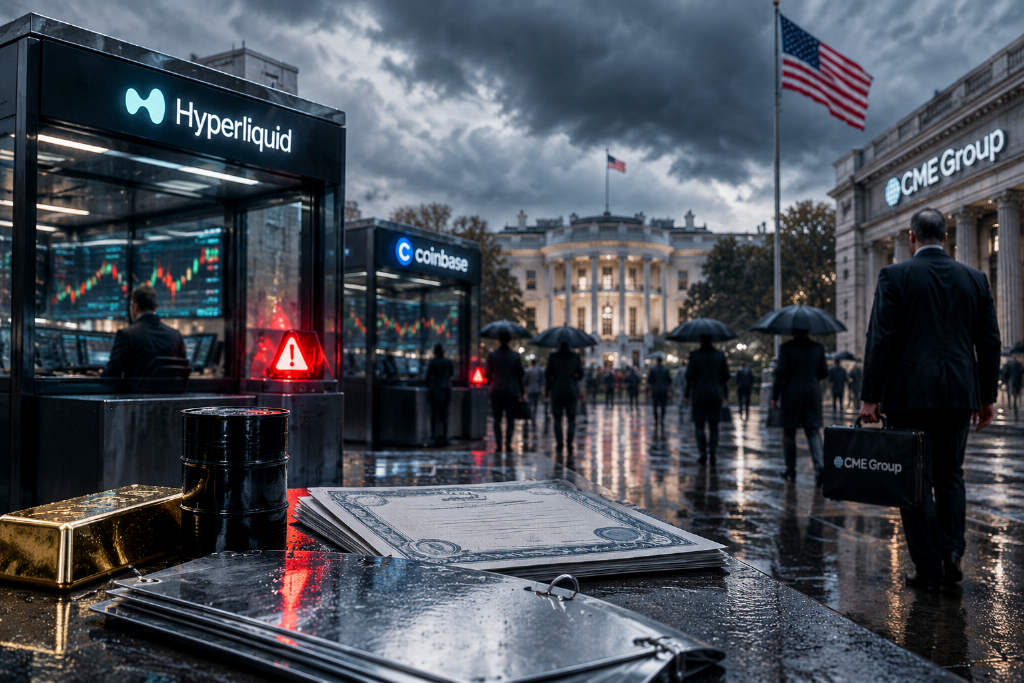
Donald Trump is pushing perpetual futures closer to the US market, and Hyperliquid has become one of the main platforms in that effort.
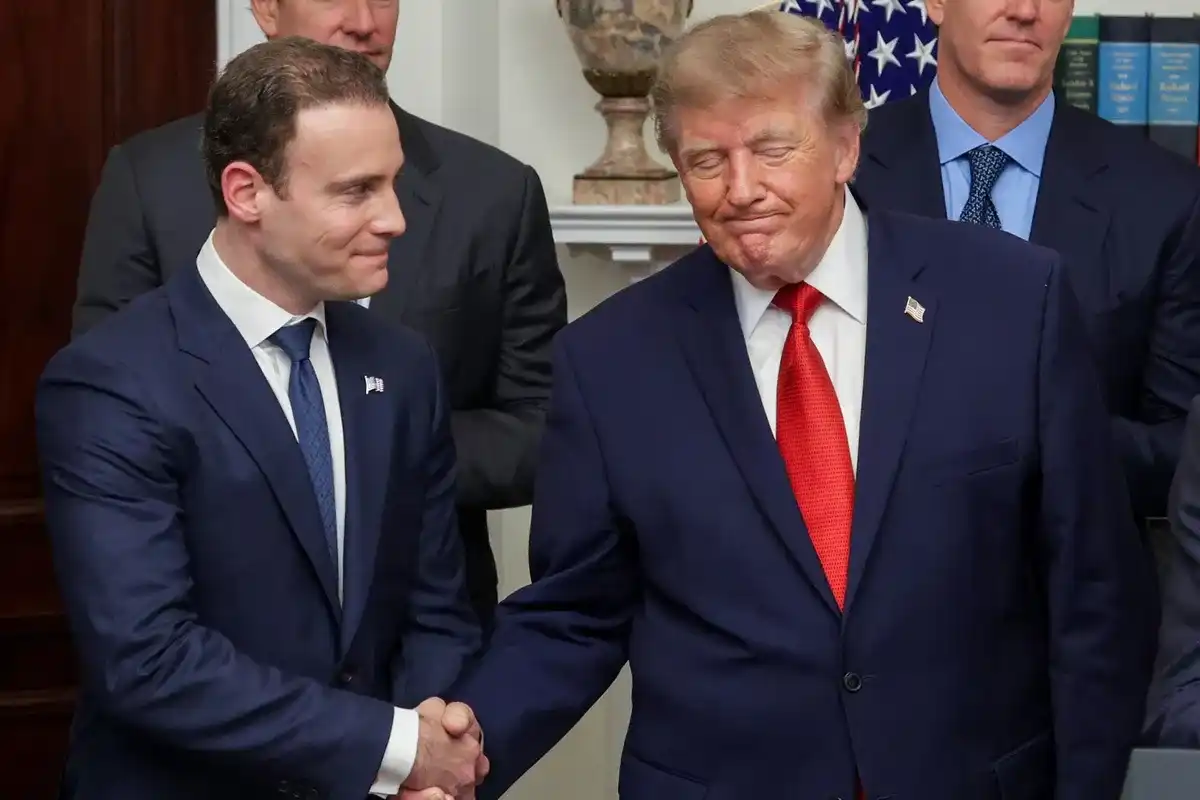
At a White House event last month, Trump praised financial regulators for working hard to bring Singapore-based online exchange Hyperliquid into the US. Trump has long cast himself as a pro-crypto president. He holds a digital token bearing his own name, and his family has earned at least $1.2 billion from crypto-related ventures.
Hyperliquid is not a standard crypto project. Its core product is perpetual futures, and the contracts span cryptocurrencies, crude oil, precious metals, and shares of US-listed companies. If those products gain a path into the US, they could alter how investors trade across several asset classes.
Why perpetual futures have gained traction
Traditional futures let investors buy or sell an asset at an agreed price on a contract with an expiry date. They can be used for speculation or hedging. An investor, for example, can buy gold futures to hedge against a weaker US dollar.
Perpetual futures work differently. They have no expiry date, trade around the clock, and allow heavy leverage. The product first took off in crypto markets. Arthur Hayes, co-founder of Seychelles-based BitMEX and widely credited with inventing the perpetual contract, said, 「From a pure product perspective, perpetuals are just a better product.」
The upside has come with steep losses for many traders. Some have made fortunes using perpetuals, but many more have been hurt by leverage and volatility. A recent study by hedge fund Event Horizon Labs found that fewer than one-quarter of accounts on Hyperliquid were profitable.
Last year, perpetual futures volume on crypto exchanges reached $62 trillion, more than three times the size of the crypto spot market. Almost all of that activity took place offshore. Hyperliquid accounts for only a slice of the total, but it has been expanding quickly into traditional assets, especially precious metals, crude oil, and stocks.
The US opens a regulatory lane, and Wall Street reacts
Hyperliquid traders argue that perpetuals offer a cleaner way to capture price moves than existing financial tools because contract prices track spot prices. Bloomberg Businessweek interviewed six Hyperliquid traders, most of whom declined to be identified for security reasons.
Earlier this year, the Commodity Futures Trading Commission, led by chairman Michael Selig, set access conditions that allow licensed US platforms to offer perpetual futures trading. In an emailed statement, a CFTC spokesperson said, 「The CFTC believes onchain finance is the next frontier in finance and hopes it can develop legally and compliantly in the United States.」
Prediction market platform Kalshi and digital asset exchange Coinbase have already launched crypto perpetuals, marking the first time the product has gone live in the US market. Hyperliquid does not want to miss that shift.
Some Wall Street firms are uneasy. After Trump made the remarks in mid-August, shares of CME Group, the world’s largest traditional derivatives exchange, fell as much as 3.4%. CME then sued the CFTC, saying Selig had 「sidestepped the regulatory framework required to approve perpetual futures products.」 CME argued that regulators had failed to confront the real-world consequences of the new framework. The CFTC responded at the time that the lawsuit was 「without merit.」
Leverage, liquidations, and the ADL problem
The biggest concern is that perpetuals could reshape trading while remaining difficult products even for experienced professionals. Their mechanics are not simple.
About a year ago, crypto perpetuals across several exchanges saw roughly $19 billion in liquidations, dealing a heavy blow to the broader crypto market. The market still has not fully recovered. Because the sector developed with limited oversight, perpetuals became a favored venue for anonymous traders. As more contracts are tied to real-world assets, US regulators are expected to tighten supervision.
Perpetuals stay anchored to spot prices through a funding-rate system. When Hayes and his team designed the no-expiry contract in 2016, the central challenge was how to keep a contract that never settles aligned with the underlying asset. The answer was continuous funding payments between traders. When the perpetual price trades above spot, long traders usually pay shorts, raising the cost of holding long positions and making short exposure more attractive. When the contract trades below spot, the payment flow reverses. Hayes said, 「That core mechanism has not changed in ten years.」
Traders using leveraged perpetuals can build positions far larger than their initial capital, magnifying gains and losses alike. If the market moves against them, exchanges liquidate positions once certain thresholds are hit. In extreme conditions, even profitable orders can be forcibly closed through auto-deleveraging, or ADL, a mechanism triggered when markets swing sharply and the exchange needs to protect platform stability.
James Newman, managing partner at investment platform Republic, explained it this way: 「Auto-deleveraging means your profitable order can be forcibly closed to cover someone else’s losses.」 He added that traders use perpetuals frequently while understanding the product poorly.
BitMEX’s legacy and Arthur Hayes’ place in the story
Before this latest push, traders largely had to use offshore and unregulated venues to access perpetuals. If a platform wanted to offer very high leverage, it also had to make sure it could survive violent market moves, which is how shared-loss mechanisms emerged. Newman said that feature is built into perpetual trading, but the public has never fully understood it.
That system helped BitMEX become the world’s largest crypto derivatives platform for several years. Its dominance later ended as legal troubles mounted, and the exchange is now in the process of shutting down. The product itself, though, kept spreading.
Hayes remains one of the best-known figures in the sector. He is known for a flamboyant style, supercars, months-long ski trips in Japan, and stem-cell infusions. His Substack newsletter has a large following and ranges across meme coins and economic history.
His record is also controversial, and it intersects with Trump. Last year, Trump pardoned BitMEX co-founders Arthur Hayes, Benjamin Delo, and Samuel Reed. The three men pleaded guilty in 2022, admitting they had failed to build controls to stop illicit funds from entering the exchange.
Hyperliquid’s expansion into real-world assets
In October 2025, just days after Bitcoin broke its record high above $126,000, Trump suddenly threatened a new round of tariffs on China. Risk appetite contracted quickly and crypto prices turned sharply lower. Even seasoned perpetual traders were hit.
Walter Li, a former Royal Bank of Canada ETF trader who now invests on his own and trades heavily on Hyperliquid, said, 「The biggest risk is liquidation.」 During the crypto selloff, several exchanges suffered severe delays, leaving some traders unable to add margin or track markets in real time. Hyperliquid kept operating through the liquidation wave.
Hyperliquid was co-founded in 2023 by Jeff Yan, a former trader at quantitative firm Hudson River Trading. Its move into real-world assets began with the HIP-3 upgrade in October last year, which allowed third parties to list contracts on Hyperliquid infrastructure.
One of those third parties, Trade.xyz, moved quickly. Run by a small and largely anonymous team, the platform built the largest market on Hyperliquid by listing contracts tied to stock indexes, silver, oil, and stocks. Its cumulative trading volume has surpassed $500 billion.
In July this year, monthly volume in real-asset perpetuals on Hyperliquid reached $115 billion, overtaking the platform’s native crypto trading volume. In an emailed statement, a spokesperson for the Hyperliquid Policy Center said perpetuals complement traditional futures markets rather than replace them. 「Once the US regulatory channel opens, Americans will be able to access market services built on onchain infrastructure through US-licensed institutions.」
Investors have embraced that narrative. HYPE, the token linked to Hyperliquid, at one point reached an all-time high of about $98. It is up nearly fourfold this year and has doubled since early August.
Weekend price discovery and rising institutional interest
When the US-Iran conflict broke out in late February, major global oil markets were closed for the weekend. Hyperliquid kept trading. Crude oil perpetuals on Trade.xyz continued to change hands and signaled the direction of oil prices before traditional markets reopened.
Tobias Reisner, a Hyperliquid trader and enthusiast based in Germany, said, 「Trump’s policies create a lot of market volatility, and the traders brought in by the HIP-3 upgrade are making substantial profits from that volatility.」
One of Hyperliquid’s main arguments to regulators is that the system can generate price signals during major events when traditional markets are closed. The Hyperliquid Policy Center submitted documents to US Securities and Exchange Commission officials using that point to support the exchange’s push into the US. Bloomberg News’ observations during the Iran war offered limited support for that case.
The spokesperson said research by the Hyperliquid Policy Center found that in nearly 75% of the traditional-market weekend closure cases it studied, weekend prices in crude oil perpetuals were closer than Friday’s closing benchmark to where the traditional market reopened on Sunday.
Mainstream trading firms are already paying attention. Amsterdam-based Flow Traders trades real-asset perpetuals on several venues, including Hyperliquid. Chief executive Thomas Spitz wrote in an email, 「Once these products are accepted by professional traders as a price indicator, more institutional capital will enter. Greater regulatory clarity and better infrastructure will be the turning point for this market.」
If Hyperliquid enters the US, what changes
The US market matters not only in theory but also in structure. Payward, Kraken’s parent company, plans to offer perpetual futures to US customers using Hyperliquid technology. That provides a possible template: a CFTC-regulated exchange and clearinghouse under Payward would handle the business, while another Payward entity would manage customer onboarding.
If that partnership model becomes Hyperliquid’s route into the US, another question follows. Can the platform keep the features that made it attractive in the first place?
Some traders interviewed by Businessweek said the product would lose much of its edge. Reisner expects Hyperliquid to require identity checks for US users, while the offshore platform currently does not require KYC. Margin thresholds, leverage caps, and self-certification rules for investor eligibility remain open questions.
Hayes put it bluntly: 「This is very difficult. If you want to enter the US market, you have to give up many of the core mechanisms that made the offshore market successful, and then your competitiveness declines.」
In one sense, Hyperliquid is already in the US. The exchange has not formally opened to US traders, but the Hyperliquid Policy Center says any company can use its infrastructure to launch products in the country.
Yesha Yadav, a Vanderbilt Law School professor whose research focuses on digital assets, said US traders currently access offshore platforms through VPNs. More than a dozen experts interviewed by Businessweek shared the view that many of those traders are in the US. Yadav said, 「A large amount of liquidity comes from within the United States.」
In an earlier period, that fact alone could have pushed a crypto exchange into a severe legal crisis. Now it is more likely to become the infrastructure layer for a business that may soon face looser regulation.