

$TRUMP, the token tied to U.S. President Donald Trump, produced plenty of overnight-riches stories during its run. Interest around those stories had faded over the past year, but one of them is now back in focus on crypto X: the account @kimchi1x, which has been linked to claims of a $40 million profit from the token.
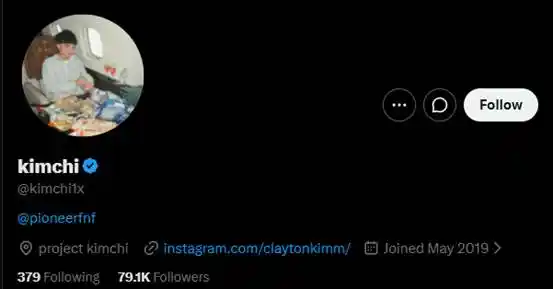
The account stands out for a simple reason. Unlike many well-known meme-coin traders who became public after posting wins, trade logs or market commentary, kimchi’s X feed contains none of that. The report says he has nearly 80,000 followers, yet he has never posted about meme-coin trading there.
Instead, his timeline is made up of wealth-showing content: food, luxury cars and expensive watches. Since February last year, the account has largely posted photos or short videos without text, appearing every few months to document life after getting rich.
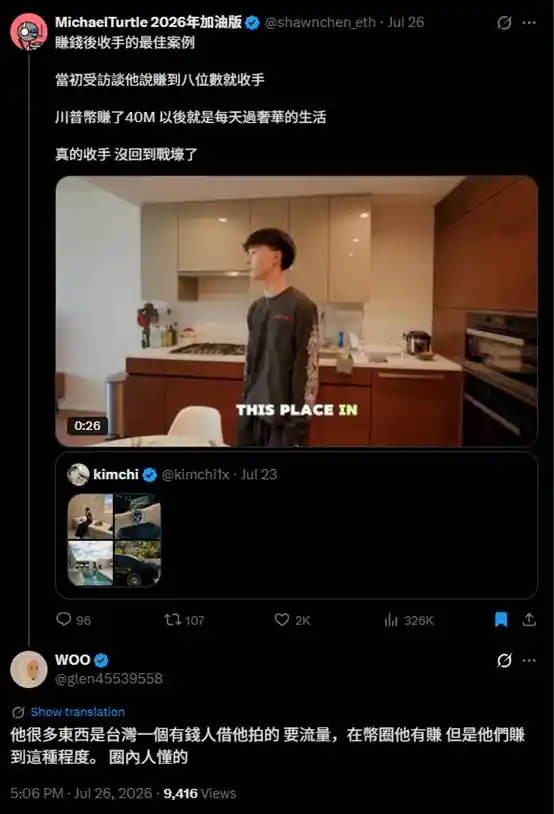
That made the latest wave of attention look unusual. He had been posting in that style for more than a year, but only recently did X become flooded with posts saying he made $40 million on $TRUMP. One of his newest posts reached 25.6 million impressions, while earlier posts were getting roughly 500,000, according to the article.
Questions remain because the profit claim has no on-chain confirmation
The article notes that there is substantial skepticism on X over whether kimchi really made that much from Trump’s token.
People who became known for profiting from $TRUMP have often had traceable on-chain records, or they were already recognized meme-coin traders before the token launched. In kimchi’s case, the reported $40 million gain has not been verified through on-chain data.
X user @sukie234 argued that several of kimchi’s wealth-display images appeared to be AI-edited.
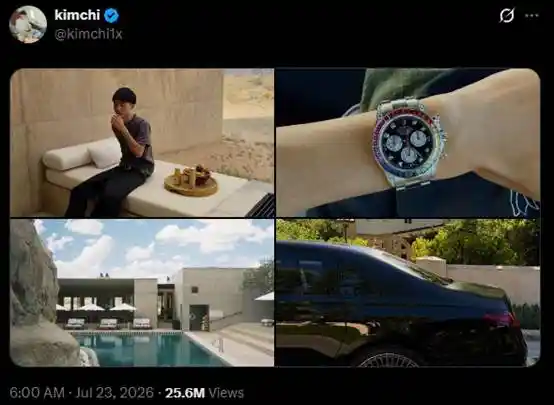
Others said some of the luxury items shown in his posts may have been borrowed from other people.
An Orangie interview gives a partial picture of his background
The report points to a face-to-face interview that well-known meme-coin trader Orangie conducted with kimchi before Trump’s token launch. From that interview, the article says kimchi only started trading meme coins in early April 2024, but picked it up quickly. By November 2024, he was already making at least six figures in U.S. dollars in a single month.
The interview also showed part of his trading setup. A Solana address with a $150,000 balance appeared on a computer screen, and kimchi said he spent 15 hours a day scanning the chain and trading meme coins.
Some personal details came up as well. He said he was studying business at the University of Southern California and that he was there mainly because his parents wanted him to attend. In the video, Orangie also used a Discord video call to share the meeting live with members of a smaller private group, which the report describes as the kind of chat made up of traders who recognize one another on-chain and already have money, track records and name recognition.
He said he would stop after making eight figures
The original article says the author is inclined to believe the $40 million claim, or at least not to doubt it, arguing that $TRUMP created many wealth stories and had enough liquidity for traders to exit with profits. That is the author’s judgment in the source text, not an independently verified finding.
According to the timeline in the piece, Orangie interviewed kimchi on January 14, 2025. During that interview, kimchi said he would stop once he made eight figures in U.S. dollars. A few days later, $TRUMP appeared, and the article links that timing to his stated goal before describing him as having moved on to enjoy life after a major win.
One exchange took place in kimchi’s Porsche 911. Orangie asked him, “You don’t believe in long-term holding?”
Kimchi answered that he did believe in it, but had developed PTSD around the idea of holding long term. Orangie initially thought that came from being trapped in 2021 after choosing to hold, but kimchi said the real reason was that he had taken large positions near the top in $POPCAT and several other large-cap meme coins, suffered heavy losses, and then stopped believing in long-term holding, choosing instead to become what the article calls a “paper hands” trader.
His story is framed as part of the 2024–2025 meme-coin boom
The article says that when kimchi first entered meme-coin trading in April 2024, he believed the run might end with that summer. At the time, he could not have seen what the author describes as a life-changing opportunity ahead. Later, he came to think that meme coins might never really reach a clear ending point.
The piece places his story inside the broader meme-coin surge of 2024 and 2025. It argues that pump.fun, by making token launches cheap and the issuance and trading process much simpler, changed how meme coins were played. Before that, the market was used to slower cycles and longer community-building periods. The newer attention-driven style broke with that pattern.
The article also says that anyone paying close attention to meme-coin traders on X will find many young traders like kimchi. They sit in front of screens for long stretches, try to catch the newest on-chain moves faster than everyone else, click through trades quickly, and sometimes make amounts of money they had never imagined.
According to the report, kimchi first got into meme coins after a friend he knew through Fortnite told him that trading them could generate decent daily income. Looking back, the author writes that the 2024–2025 meme-coin boom may have been the most successful case of mass adoption in crypto since NFTs.
The source argues some profits have already left the market
The article goes on to argue that Trump, through his token, pulled enormous liquidity out of crypto. It also says many young traders who got rich through $TRUMP either never had strong conviction in crypto before they found meme coins, or lost that conviction after trading the fast, brutal meme-coin cycle. As a result, the wealth they made is no longer circulating inside the market.
In the source text, these traders are described as young but already shaped by the market and aware of the kind of game they are playing.
The author then raises the question of whether meme coins can ever regain their former scale. The source says young people still look for speculative opportunities well beyond equities, including betting during the World Cup, trading sneakers, streetwear, Pokémon cards and video-game skins. As long as money can be made, the article argues, even niche markets can remain active.
The piece also points to recent complaints from traders that Jimothy, a meme figure that spread globally and was posted by the White House X account, only barely pushed past a $50 million market capitalization. The author reads that as a sign of narrative fatigue in pure attention-driven meme plays: a topic or image that goes viral on TikTok or other social platforms may no longer be able to reach market values in the hundreds of millions or tens of billions of dollars.
Even so, the article stops short of calling an end to meme coins and says the story is not over yet.