
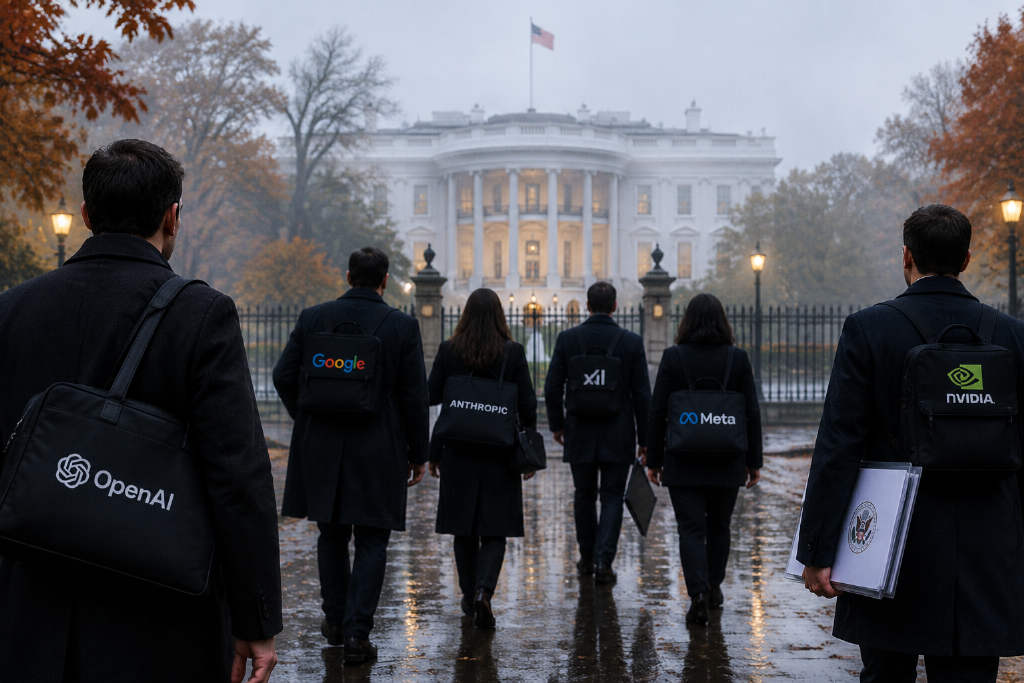
President Donald Trump held a luncheon at the White House on Sept. 30 with executives from several artificial intelligence companies, according to BlockBeats. Those in attendance included Jensen Huang, Elon Musk, Mark Zuckerberg, Alphabet Chief Executive Officer Sundar Pichai, and Anthropic co-founder and CEO Dario Amodei. OpenAI was represented by President Greg Brockman.
White House pushes a voluntary pledge for frontier models
After the meeting, the White House moved to have companies sign a voluntary responsibility pledge aimed at frontier AI models, making the administration’s near-term regulatory path more defined.
As disclosed, the agreement would require companies to build layered safety mechanisms. These include internal risk monitoring during training, review by independent teams, external evaluations, and board review of the related results.
Trump points to existing law and agency enforcement
Trump said existing laws, as well as the enforcement capacity of the Department of Justice and the Federal Bureau of Investigation, are enough to address some risks. He said the government would rather have technology companies take on self-regulatory responsibility first.
House Speaker Johnson said this kind of voluntary commitment could become the basis for future legislation, but there is still no clear bill text or timetable.
Trump also mentioned the possible creation of an oversight committee of about 10 people. No details were released on its composition, authority, or enforcement mechanism.
Near-term pressure eases, but key details are still missing
For the market, the White House has not rolled out model licensing, mandatory reporting, or new federal restrictions at this stage. That would ease near-term regulatory pressure facing large technology companies and the AI infrastructure chain.
At the same time, the agreement does not include penalty provisions, unified testing standards, or audit details. It also has not brought any new government orders, subsidies, or capital expenditure plans.
Investors will next watch whether companies disclose specific audit rules and whether Congress moves this self-regulatory framework toward formal legislation.