
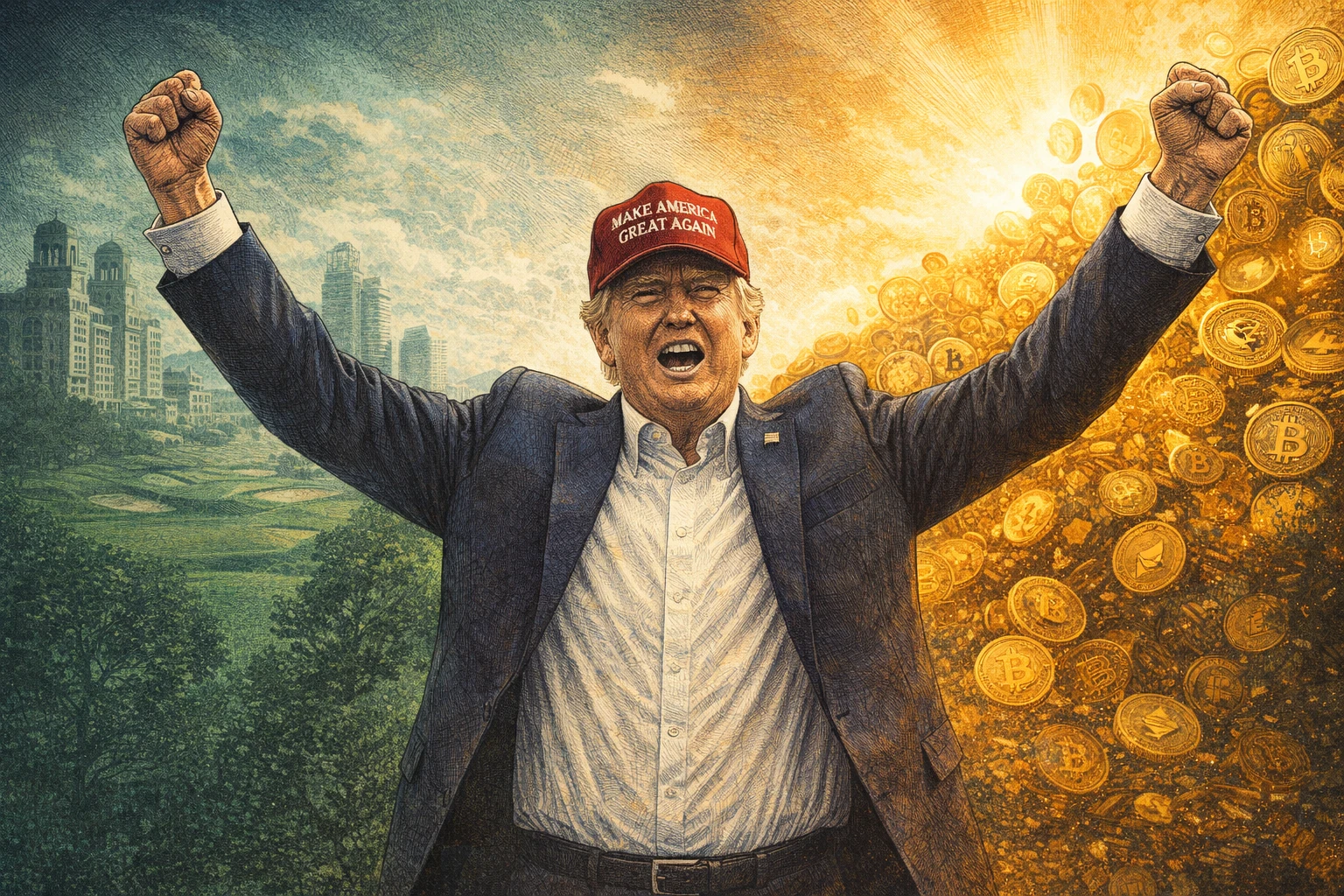
Donald Trump made more than $1.4 billion from crypto-related businesses in 2025, overtaking the roughly $290 million generated by his real estate and resort operations, according to a 927-page annual financial disclosure released by the U.S. Office of Government Ethics on June 30. The filing lays out the scale of his crypto business activity, personal token holdings, and the political scrutiny attached to both.
TRUMP licensing and WLFI token sales led the revenue mix
The largest single source of income came from the meme coin tied to Trump’s name, “Trump Coin (TRUMP).” Under a licensing agreement with Celebration Coins, Trump reported about $635 million in royalty income in 2025. The filing describes it as his biggest individual business line, ahead of any single golf club or hotel asset.
The second-largest crypto revenue stream came from World Liberty Financial, or WLFI, a DeFi platform led by the Trump family. Token sales brought in about $588 million during the year. Trump also reported $197 million in gains from the sale of an equity stake in a stablecoin joint venture. Taken together, those three lines account for the bulk of the crypto income disclosed in the filing.
Disclosure also revealed personal crypto holdings
The report also gave a clearer look at Trump’s personal digital asset portfolio. Data compiled by Galaxy Research, as cited in the source material, shows Trump held more than $50 million in Bitcoin and between $5 million and $25 million in Ether. Those assets were stored in cold wallets. The filing also listed holdings in the USDC stablecoin and the USD Key (KEY) token.
White House deputy press secretary Anna Kelly said Trump was proud to have made the United States the “crypto capital” of the world and said the president and his family had never been involved in conflicts of interest. The Trump Organization said the filing demonstrated unprecedented financial transparency.
Conflict-of-interest criticism intensified after the filing
The disclosure triggered a fresh round of criticism from watchdog groups. Public Citizen, a nonprofit consumer advocacy organization, called it “disgusting crypto corruption.” Co-president Robert Weissman said Trump’s personal financial incentives are now aligned with the crypto industry and warned that legislation shaped under those conditions could enable large-scale fraud and threaten financial stability.
The source material also says the Trump administration pushed crypto-friendly policy in 2025, including executive actions favorable to digital assets and the appointment of regulators seen as supportive of the sector. During the same period, Bitcoin briefly rose above $150,000, setting a record high. That market backdrop coincided with a sharp rise in revenue across the Trump family’s crypto ventures and added to scrutiny over the overlap between public authority and private gain.
A major shift in Trump’s income structure
The figures point to a clear change in how Trump’s business empire generated cash in 2025. For decades, real estate development, hotels, and golf clubs were the core of his commercial identity. In this filing, crypto moved ahead of those legacy businesses. With the 927-page disclosure now public, attention is likely to remain fixed on TRUMP, WLFI, and the broader flow of funds tied to those ventures.