
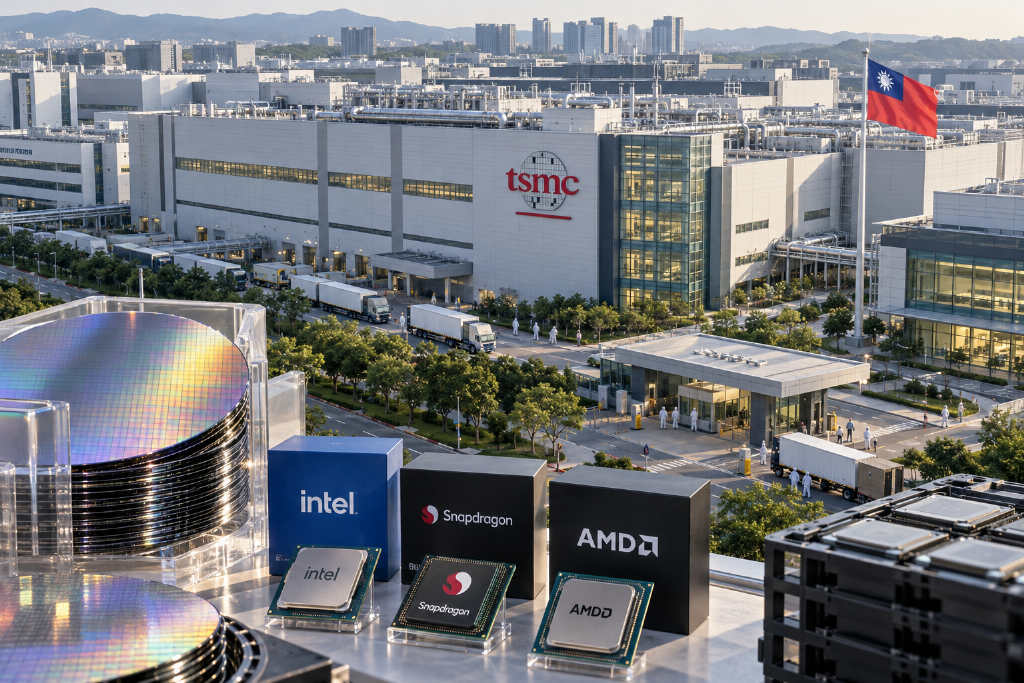
A new round of CPU price increases is moving through the market. ABMedia, citing a Commercial Times report published on Oct. 12, said Intel raised prices on multiple PC processors in September, with high-end Panther Lake models up 15% to 20%. Qualcomm also increased pricing by about 10% from October for chip platforms including the Snapdragon X series, and AMD is reportedly preparing to follow.
The report said the common thread behind the moves by the three processor makers is higher costs tied to TSMC’s advanced manufacturing nodes, along with capacity competition driven by AI PCs, servers, and high-performance computing demand.
Intel marks a third price increase since late last year
According to supply-chain information cited in the report, Intel has raised processor prices three times since late last year. The latest round started on Sept. 1 and applied different increases across product lines.
High-end Panther Lake products saw increases of 15% to 20%, while Meteor Lake and Arrow Lake series products were raised by about 5% to 10%. The report added that the increase did not apply across the entire Panther Lake lineup and was mainly concentrated in models equipped with high-end GPU tiles.
Panther Lake uses a heterogeneous integration architecture. Its CPU compute tile is produced on Intel’s own Intel 18A process, while the high-end GPU tile is still manufactured by TSMC on N3E. That left the biggest increases concentrated in models with heavier reliance on TSMC’s advanced-node capacity.
The report said this shows that even as Intel pushes its own foundry business, high-end processors still face cost pressure from external advanced-node supply chains.
ABMedia also referred to an earlier Chain News report saying that as AI inference and AI Agent applications spread quickly, CPUs have become more important in data scheduling, memory management, and system coordination. With data-center CPU demand rising, Intel has prioritized capacity for higher-margin Xeon server processors and high-end PC products, leaving some lower-end products facing tighter supply and longer lead times.
The report also said Intel had already raised CPU prices twice by about 10% since late 2025, and that this third round again reflects changes in its supply-demand structure and pricing strategy.
Qualcomm lifts Snapdragon X pricing; AMD plans remain unconfirmed
Beyond Intel, Qualcomm raised prices on multiple chip platforms from Oct. 1, including Snapdragon X and Snapdragon X2 Elite, with increases of about 10%.
The report said Qualcomm has been expanding from the smartphone SoC market into Windows on Arm PCs, edge computing, and high-performance computing. As processors integrate higher-spec CPU, GPU, and neural processing unit, or NPU, components, reliance on advanced manufacturing and packaging technologies has also increased.
AMD has also reportedly been preparing adjustments to some CPU prices, though the exact increase, affected products, and effective date have yet to be confirmed. Supply-chain information in September said AMD had informed some partners that it planned to raise prices on certain chip products by about 10% in the fourth quarter, potentially covering AI accelerators, consumer GPUs, and motherboard chipsets.
The report said AMD is highly dependent on TSMC’s advanced nodes. That pressure extends across Ryzen consumer processors, EPYC server chips, and Radeon GPUs as wafer foundry costs rise.
Still, AMD has not formally confirmed whether Ryzen CPUs are included in any increase, and it has not disclosed a specific adjustment range. The report said supply-chain talk should be distinguished from official pricing policy.
TSMC advanced-node costs seen as the shared variable
As the three CPU vendors move to raise prices, the report pointed to rising TSMC advanced-node costs as one shared factor. AI accelerators, smartphones, and high-performance computing chips are all competing for 3 nm capacity, while 2 nm production is moving through its ramp-up stage. Wafer manufacturing, chip design, and advanced packaging costs have continued to rise.
Earlier market talk said TSMC could raise some foundry prices from early 2027, with mature-node increases of about 3% to 10% and 2 nm wafer pricing potentially rising another 6% to 8% in the first quarter. Nikkei information cited in the report said TSMC’s 2027 pricing for advanced and mature nodes could rise by 5% to 10%, while some additional orders for high-performance computing chips could face an extra 10% to 15% premium.
Demand for advanced nodes has also shown no clear sign of cooling, according to the report. Apple, Nvidia, AMD, Qualcomm, and MediaTek were said to have increased reservations for TSMC’s 2 nm family capacity by 10% to 20%.
To meet customer demand, TSMC has also reportedly accelerated expansion. Its monthly 2 nm capacity target for the end of 2026 could rise to 120,000 wafers, above the earlier estimate of 90,000 to 100,000 wafers.



