
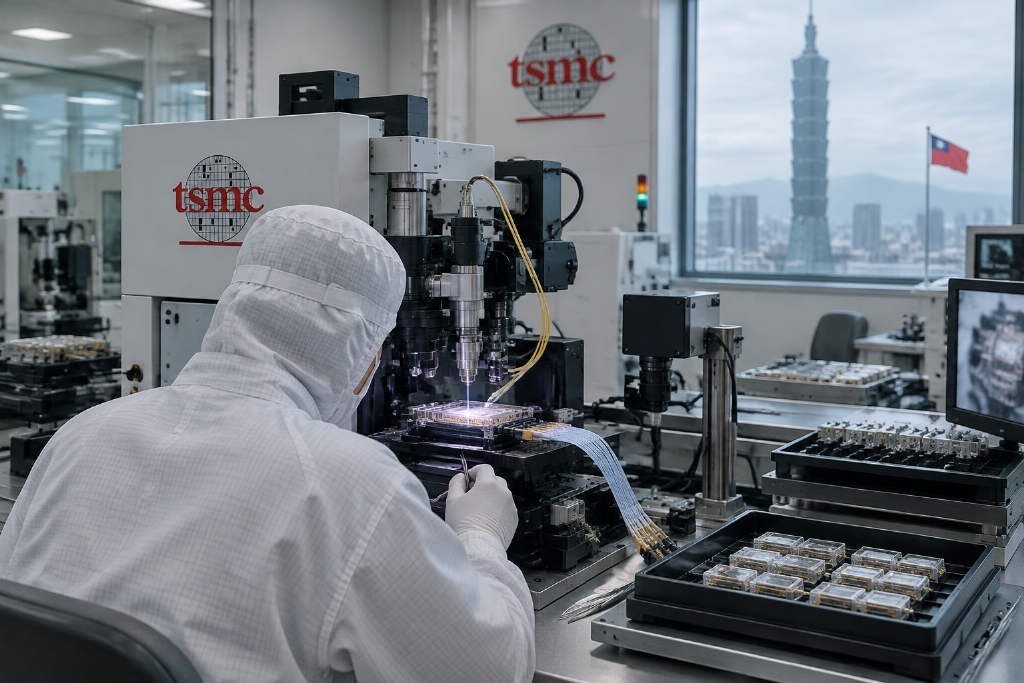
Fiber array units are coming into sharper focus as co-packaged optics moves closer to volume production. In a report released on Oct. 7, TrendForce said FAUs, while considered passive optical components, have become one of the key bottlenecks in CPO manufacturing and testing because of the precision required in the coupling process.

The report said the challenge sits in "FAU coupling," the step where the FAU is aligned and fixed onto the optical engine, or OE. That process demands extremely tight accuracy and has a direct effect on yield and manufacturing efficiency.
Why FAUs matter more in CPO
An FAU is a high-precision passive optical component that serves as the interface between optical fibers and the waveguides on a photonic integrated circuit, or PIC. Its role is to align and secure multiple fibers so light can be coupled accurately into the waveguide. Depending on the coupling architecture, the optical path may also include microlenses, microlens arrays, or other optical elements.
TrendForce said the importance of the FAU has changed because the optical engine itself has moved. In the shift from pluggable optical modules to CPO, and then to OOI structures that integrate the optical engine further into the interposer, the optical engine has moved from the circuit board into the package and closer to the compute die. That shift turns the FAU from a module-side component into part of the packaging process.
The report linked that transition to rising bandwidth pressure. As rack bandwidth keeps doubling, the limits of copper interconnects in distance, power consumption, and thermal management become more pronounced. In that setup, the yield and speed of FAU coupling become one of the variables that determine whether CPO can scale in volume.
TSMC backs both grating and edge coupling in COUPE
On silicon photonics chips, there are two common coupling methods between the fiber and the PIC.
- Grating coupling (GC): light enters from the chip surface, making wafer-level optical testing easier, though it is usually more sensitive to wavelength and polarization.
- Edge coupling (EC): light enters from the optical facet on the chip side. It usually offers lower coupling loss and a wider operating wavelength range, but the facet must be formed and accessible, and wafer-level testing is more difficult.
TSMC's COUPE platform supports both approaches. The two routes share integration features including SoIC bonding and TDV, with the main difference lying in the optical coupling architecture between the fiber and the PIC.
Roadmap and demand visibility
At SEMICON Taiwan 2026, TSMC laid out an aggressive COUPE roadmap. Single-package COUPE bandwidth is set at 3.2 Tbps in 2026 and is expected to double to 6.4 Tbps in 2027, with a long-term target above 51.2 Tbps.
TSMC also said integrating the optical engine onto the substrate can deliver energy efficiency four times that of traditional copper interconnects while cutting latency to below 0.1x. When the optical engine is integrated further into the interposer, or OOI, energy efficiency can rise to 10x and latency can fall below 0.05x.
On demand, TSMC Senior Vice President of Advanced Packaging Technology and Service Kuoh-Jin Syue said at the SEMICON Taiwan silicon photonics forum in late August that market testing and validation data had addressed doubts over CPO reliability. He said leading manufacturers are expected to begin mass production in the second half of 2026, and silicon photonics is expected to take more than 50% market share in optical transceivers before 2027.
On the customer side, Nvidia is expected to use TSMC's upgraded A16 process on its Feynman platform and introduce CPO and SoIC at scale for the first time, targeting mass production in the second half of 2028. That timeline lines up with TrendForce's expectation for stronger OE shipment growth in 2027 and 2028.
Six equipment names flagged by TrendForce
TrendForce named six companies in the FAU coupling equipment market: ficonTEC, Suruga Seiki, Dong Yow Dah (7942), Gallant Precision (4573), All Ring Tech (6187), and Fittech (6706). The report also covered suppliers tied to key FAU, lens, and fiber components.
From TSMC's perspective, the supply-chain gap is not limited to coupling. Syue said Taiwan's foundry ecosystem already has the ability to manufacture optical engines at scale, but four areas still constrain the commercialization of silicon photonics: laser light sources, optical fibers, fiber connectors, and product testing.
If the market's projected CPO ramp window does land in 2027 to 2028, the precision and capacity of FAU coupling equipment will help decide the actual pace of optical engine shipments and the speed at which TSMC can ramp COUPE into volume production.