
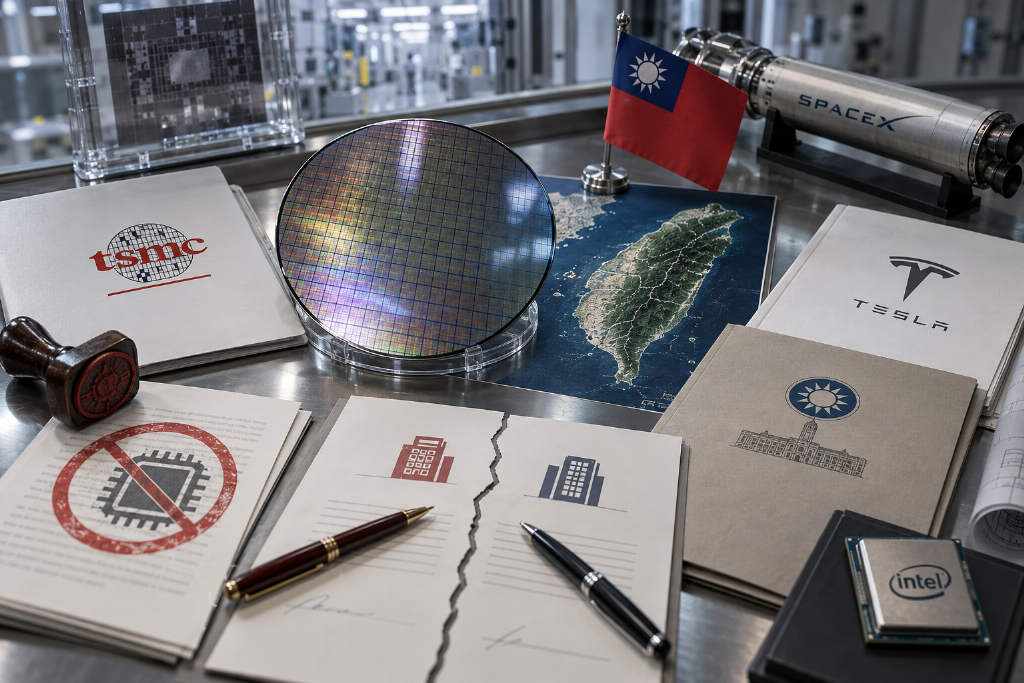
Elon Musk has confirmed that TSMC is in talks with Tesla and SpaceX over the planned Terafab chip plant, but he said the effort is still "just discussions." That remark briefly fueled market speculation around a structure in which TSMC could take an equity stake and license process technology. Semiconductor independent analyst Alex, however, argued on X that TSMC is unlikely to accept the terms Musk would want, making a deal hard to close.
The report noted that Alex is generally seen as more favorable to Intel, but said the obstacles he identified are difficult to avoid in any cross-border fab partnership of this kind.
A proposed structure drew on TSMC's 1999 SSMC precedent
The discussion began after X user @teslayoda reposted Musk's comments and outlined a hypothetical framework. The idea referenced TSMC's 1999 investment in Singapore's SSMC, where TSMC held a minority stake, licensed process technology, collected royalties, and both sides committed to buying capacity.
Applied to Terafab, that model would mean SpaceX and Tesla owning and controlling the fab, with TSMC taking a minority stake and licensing mature-node technology. Nvidia would serve as a connecting party in the arrangement.
Alex rejected that scenario and laid out why he believes the TSMC route is unlikely to work.
First hurdle: advanced-node licensing is unlikely
Alex_Intel_ said that, from TSMC's perspective, licensing advanced process technology under restrictive terms is not really on the table. In his view, TSMC would not hand over a leading-edge process package to another company and then let that company control the pace of production and future development.
That is also why the SSMC model does not transfer neatly to Terafab. SSMC was established in 1999 as one of TSMC's earlier overseas joint ventures. The competitive and geopolitical setting at that time was very different from today's race around leading-edge nodes. A "license plus equity" structure may work for mature processes, but that does not mean it can be replicated for advanced ones.
Second hurdle: ownership and control point in different directions
The next issue is control. In @teslayoda's proposal, Musk would control Terafab while TSMC would hold only a minority stake. Alex said that in TSMC's joint ventures in Japan and Europe, TSMC has remained the majority shareholder. Even if TSMC were open to a joint venture with Musk, he does not expect special treatment.
That leaves a basic conflict between the two sides. Musk wants his own fab and his own capacity. TSMC, by contrast, would be more likely to support a structure that it leads. If neither side moves on control, a formal agreement becomes difficult.
Third hurdle: Taiwan tightly controls sensitive chip technology
The third issue is political and security-related. Alex described advanced process technology as a "State secret for Taiwan." The report added that Taiwan has in recent years placed some key semiconductor technologies under a protected framework for core critical technologies, meaning transfers abroad are subject to government review.
In practice, that means even if TSMC were willing to compromise on commercial terms, any outbound transfer of technology would still face scrutiny from Taiwanese authorities. Unlike the first two issues, this is not something a company can settle on its own.
Alex says Intel would face many of the same limits
Alex also said Intel is not an easy alternative. In his view, any agreement between Intel and Musk would need to limit Terafab to internal use by SpaceX and Tesla. It could not operate as an external foundry, and it could not branch off and develop Intel's process IP without paying licensing fees. Otherwise, Intel would face major losses.
He pointed to another possible sticking point as well. Musk may want a site he referred to as "Grimes Fab" to prioritize memory production. If Intel does in fact have a joint venture arrangement with SK hynix, that could create a conflict of interest, because Tesla and SpaceX would need to develop their own memory process nodes. Alex said this may be one reason progress on the Intel side appears to have stalled.
Public information still points to speculation, not a deal
Based on what is publicly available, the same divide appears whether the potential partner is TSMC or Intel: Musk wants a fab he can control, while chipmakers are not willing to give up protection over their technology and commercial interests.
The report added that the current discussion is still based on public posts and industry speculation. Whether anything concrete emerges next will depend on official statements from the parties involved.