
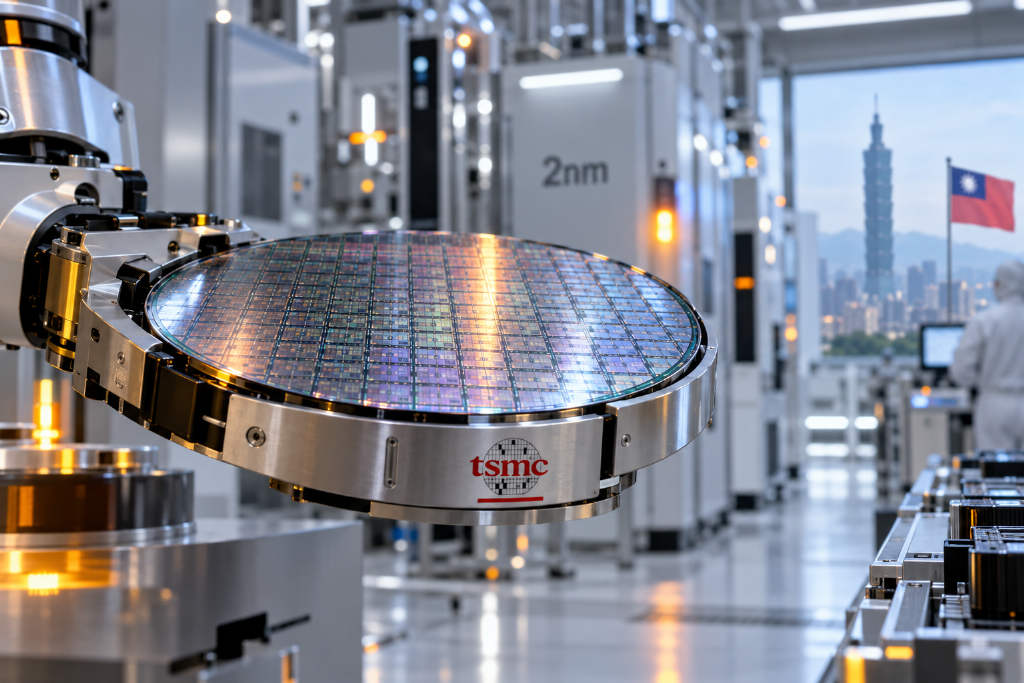
Taiwan Semiconductor Manufacturing Co. (TSMC) reported third-quarter results on Oct. 15 showing revenue of NT$1.49 trillion, up 51% from a year earlier, and net profit of NT$763.1 billion, up 68.7%. It was the company’s sixth consecutive quarter of record profit. By the calculation cited in the source article, that worked out to roughly RMB 1.7 billion in net profit per day.
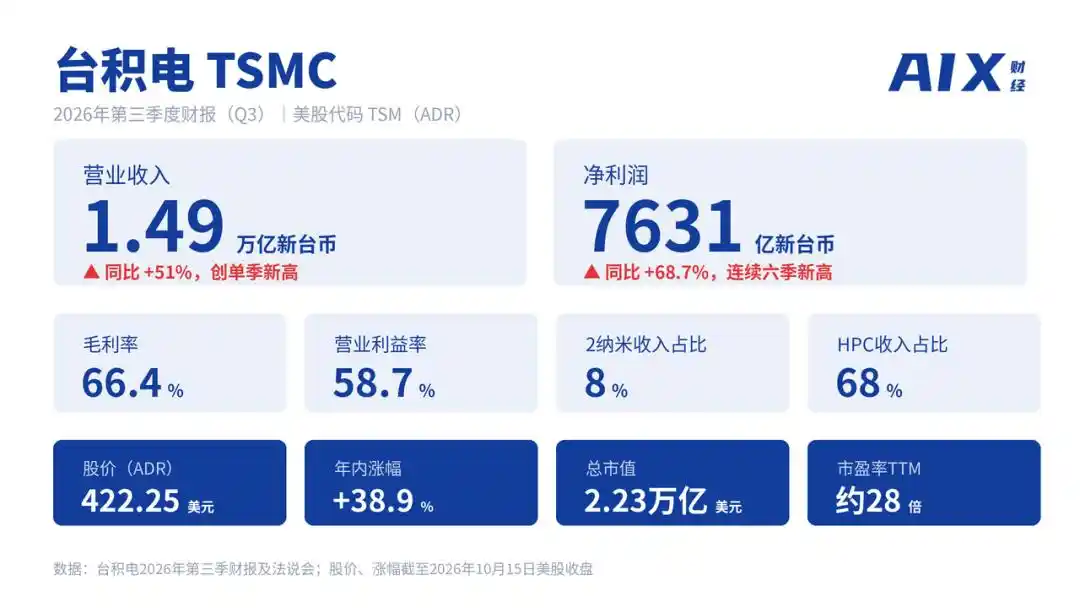
The number that moved lower was gross margin. As 2-nanometer production entered large-scale manufacturing this quarter, depreciation on new lines rose and yields were still climbing, pushing gross margin down to 66.4% from 67.7% in the second quarter. The decline stayed within the company’s own guidance range, but came in below market expectations.
Profit rose while gross margin fell, pointing to early-stage production costs from new capacity rather than weakness in demand.
Investors still reacted cautiously. Even though revenue and profit both beat expectations, TSMC’s U.S.-listed shares were down as much as 5% intraday and finished 2% lower. Three months earlier, the stock had also fallen, down 4%, after the company released second-quarter results that had also topped expectations.
In the current AI wave, TSMC has become one of the market’s central names. The article said its market capitalization reached $2.23 trillion, ranking it among the world’s top six companies. NVIDIA GPUs, Google TPUs and AMD accelerators — along with many of the best-known AI chips on the market — are produced on TSMC lines.
That valuation has also raised the bar for expectations. By October, news that OpenAI revenue had missed expectations revived talk of an AI bubble, and TSMC shares had retreated 13% from their peak. Before the earnings release, the options market was pricing in a move of more than 4%.
At the same time, TSMC is spending heavily on 2nm capacity, advanced packaging and U.S. fabs. Capital spending this year has moved above $60 billion, the highest in the company’s history. The question investors are now asking is whether the pace of earnings growth can continue to outrun the pace of spending.
Margin pressure did not stop profit from climbing
Three months ago, when TSMC gave guidance for the next quarter, it warned that the initial phase of 2nm mass production would weigh on profitability. That pressure showed up in the third quarter, with gross margin down by a little more than one percentage point from the previous quarter, even as revenue came in above the company’s own forecast.
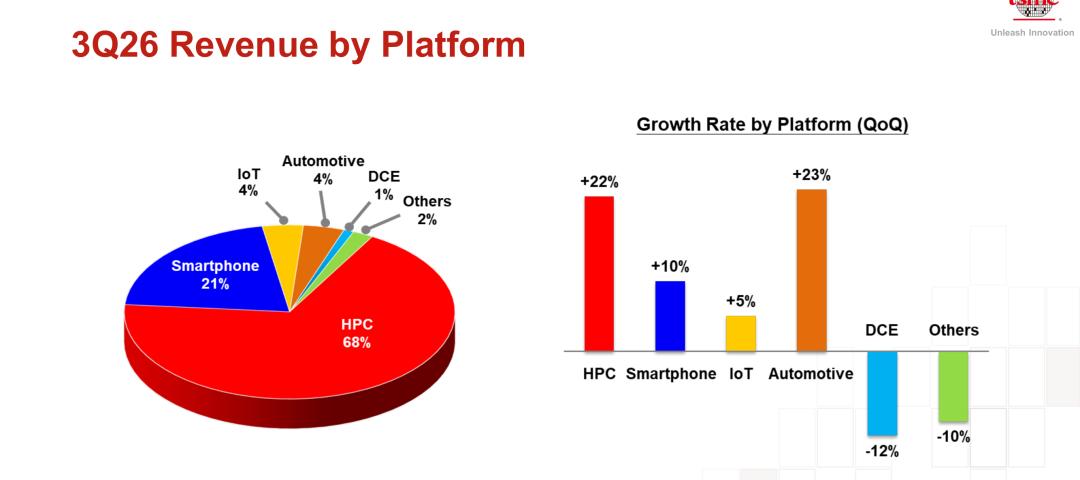
Revenue beat the top end of guidance largely because of high-performance computing, or HPC. Revenue tied to chips such as AI accelerators and server processors rose 22% from the previous quarter and made up nearly 70% of total revenue. Smartphone revenue also recovered, rising 10% quarter over quarter.
Profit was the more notable point. Operating profit reached NT$876.4 billion, up 14.3% from the previous quarter and 75% from a year earlier. That growth rate was more than 20 percentage points faster than revenue growth.
The source article noted that operating profit differs from net profit because it excludes interest, foreign-exchange effects and asset sales, making it a cleaner measure of how much the core business is earning. Net profit attributable to shareholders was up only 8% from the prior quarter because the previous quarter included more than NT$90 billion in non-operating income, including a one-time gain from the sale of Vanguard International Semiconductor shares. That figure fell back to a little more than NT$30 billion this quarter, lifting the prior-quarter base and making the sequential comparison look weaker. Excluding that distortion, operating margin came in at 58.7%, above the high end of the company’s guidance.
One reason TSMC became more profitable is simple: its most advanced capacity sold at its highest prices.
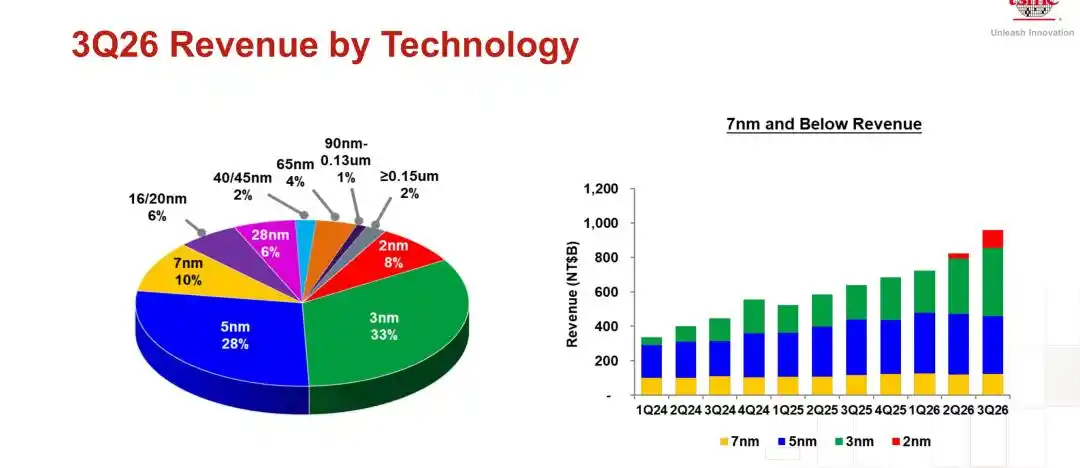
In the third quarter, 2nm accounted for 8% of wafer revenue, up from 3%, marking the fastest ramp so far. The article said a 2nm wafer was priced at around $30,000, above earlier process generations. Apple took more than half of the first batch of capacity, and NVIDIA’s next-generation products were also in the queue.
At the same time, 3nm rose from 30% to 33% of wafer revenue and remained the company’s largest contributor by process node.
Elio, described in the article as a semiconductor foundry industry practitioner, told AIX Finance that customers using mature nodes are more price-sensitive. At advanced nodes, though, customers need to complete design verification on the foundry’s production lines, adjust the technical modules required for the design and run through the mass-production process. Once that time and those resources are committed, switching foundries would mean starting over, creating a high migration cost. That stickiness is what gives TSMC room to raise prices year after year.
Inventory also pointed to solid demand. Inventory days rose from 80 to 87 in the previous quarter, which the company said reflected materials preparation for 2nm. This quarter, that figure dropped back to around 78 days, suggesting those inputs had been converted into revenue.
So why did gross margin still fall? Because spending climbed at the same time. Newly launched 2nm lines are in the heaviest stage of equipment depreciation, and yields are still improving. Yield determines how many working chips can be produced from a wafer. Lower yield means higher cost per good chip. On top of that, plants in Arizona and Japan are running at lower efficiency and higher cost than those in Taiwan, China, and summer electricity prices also rose. Those three factors together pulled down gross margin this quarter.
Elio said he remains relatively optimistic about where gross margin goes next. Market chatter cited in the article suggests TSMC could raise prices for advanced nodes by another 5% to 10% in the first quarter of 2027. Morgan Stanley, based on that expectation, forecast TSMC’s gross margin could approach 70% in 2027. The article also said 2nm is selling at higher prices and ramping faster than 3nm did at the same stage. According to estimates cited there, defect density at 2nm reached target levels two quarters earlier than 3nm did in its own early mass-production phase, allowing costs to fall faster.
For the fourth quarter, TSMC kept gross margin guidance at 65% to 67% and said it expects to maintain a relatively high profit level in the near term. Even so, the early cost burden from 2nm is only one piece of the current expansion cycle. A bigger test will come when fabs still under construction begin production and the market can see whether they can match the profitability of existing operations.
Heavy capital spending is now central to the story
To secure capacity for customers’ next several chip generations, TSMC has entered what the article called an era of large capital expenditure.
In July, the company raised its full-year capital spending plan from $52 billion-$56 billion to $60 billion-$64 billion because AI orders came in above expectations. On the earnings call, Chief Financial Officer Huang Jen-chau said total spending over the next three years would be significantly higher than the roughly $100 billion spent in the previous three years. JPMorgan expects TSMC to spend $100 billion in a single year by 2028, equal to what it used to spend over three years. The article said TSMC’s fab investment alone already accounts for more than one-quarter of the global semiconductor industry’s capital spending this year, and the market broadly believes that is still not the ceiling.
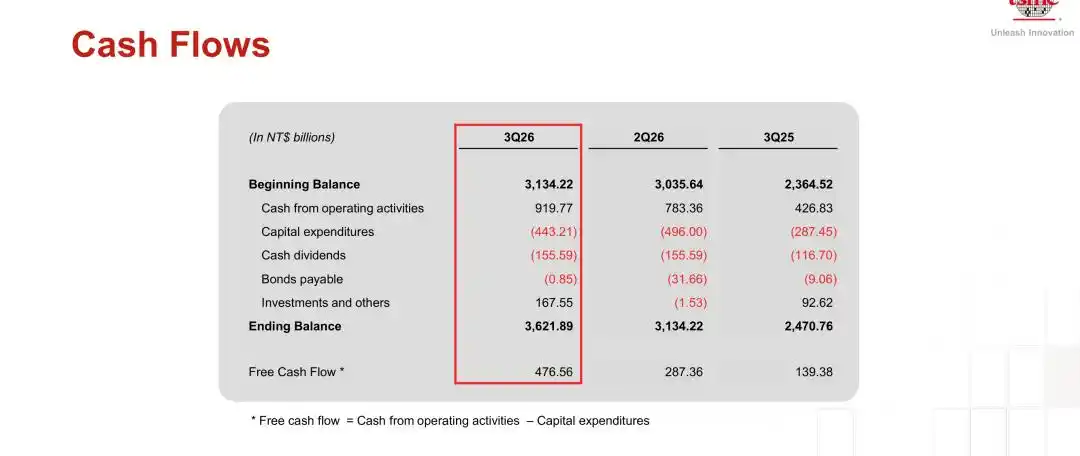
During the first three quarters of this year, TSMC spent about NT$1.29 trillion on plants and equipment. Operating cash flow this quarter was NT$919.8 billion, more than twice capital expenditure. After paying for fabs and tools, about NT$476.6 billion remained. Free cash flow increased from the prior quarter because operating cash flow rose while quarterly capital spending eased slightly. The company also held NT$4 trillion in cash and marketable securities, leaving it in no immediate shortage of funds for expansion.
That money is being directed into three main areas: new advanced-process fabs and equipment, expansion of advanced packaging, and overseas factories. The certainty attached to each area is different.
Advanced process capacity remains the most secure bet
The first category is the most stable and also the largest. The article said roughly 70% of TSMC’s capital expenditure goes to advanced process technology. These fabs are expensive, but TSMC still controls pricing power and customers are still lining up.
TSMC’s share of the global foundry market reached a record 72.5% in the second quarter, and the more advanced the node, the higher that share becomes. JPMorgan expects TSMC’s share at 2nm to exceed 95%. The article described Intel’s 18A as only comparable to an enhanced version of TSMC’s 3nm, while Intel’s next-generation 14A is not due for mass production until the end of 2028 and would still be chasing TSMC’s previous node. Samsung’s 2nm yields remain unstable, according to the same article. Against that backdrop, TSMC Chairman C.C. Wei said in April that undersupply should last at least until 2027.
Advanced packaging is the immediate bottleneck
The second category is advanced packaging, which the article described as the biggest bottleneck right now. After an AI chip is manufactured, it still needs to be packaged together with high-bandwidth memory before it can operate. That step is known as CoWoS. Even if front-end wafer production moves quickly, customers still cannot ship products if packaging capacity lags. The article said packaging has been tight since 2024.
In July, an analyst asked Wei how he viewed competition from Intel in advanced packaging. Wei replied that TSMC’s packaging capacity had become tight enough to limit customer growth, so the company welcomed other suppliers offering more options. If customers can complete packaging elsewhere, that still helps TSMC by lifting front-end wafer demand. In August, TSMC outsourced part of its packaging orders to providers including ASE.
A supply-chain source told AIX Finance that TSMC’s priority is to defend its share in front-end manufacturing and keep control over deliveries. Packaging margins are thinner, so outsourcing creates more room to schedule capacity. Goldman Sachs expects CoWoS capacity by 2027 to reach four times the 2025 level, implying annual growth of more than 100%.
Overseas fabs carry the most uncertainty
The third category is overseas factories, and it comes with the greatest uncertainty. According to the article, these plants are being built mainly at customers’ request, as clients want more chips produced locally. Investment in Arizona has already been increased to $265 billion.
Huang said overseas fabs are expected to dilute overall gross margin by nearly 2 percentage points this year. As more U.S. plants come online, that drag could widen to 3 to 4 percentage points over the next few years. The article said that based on TSMC’s expected revenue scale next year, that would amount to nearly NT$100 billion in gross profit annually.
Wei also confirmed that TSMC has sent a team to Texas to assess expansion opportunities and is discussing possible cooperation with Elon Musk’s Terafab project. He set out one clear condition: any factory would have to be operated by TSMC. Musk has previously said Terafab would build and run its own factory, so the two sides are still in talks. Goldman Sachs said that even if a new Texas fab is approved, mass production would not begin until after 2032.
Whether these investments pay off will depend on demand several years from now. On the earnings call, Wei said TSMC had sent its own team to inspect construction progress and power availability at U.S. data centers, and the feedback was positive. When it evaluates demand, the company also factors in cloud providers’ capital spending, electricity supply and component availability. By TSMC’s own assessment, demand is still running ahead of supply.
TSMC has enough cash to build ahead. The harder part is timing. Move too slowly, and customers’ next product cycles are missed. Move too fast, and capacity can fall out of step with demand. Huang said revenue would stay ahead of capital spending. The article argued that TSMC has managed that over the past three years, effectively turning itself into a toll booth for the AI era. But that toll booth needs another few hundred billion dollars every two or three years to build the next one, and the company is now trying to stay ahead not only of capital spending, but also of the market’s rising expectations.