
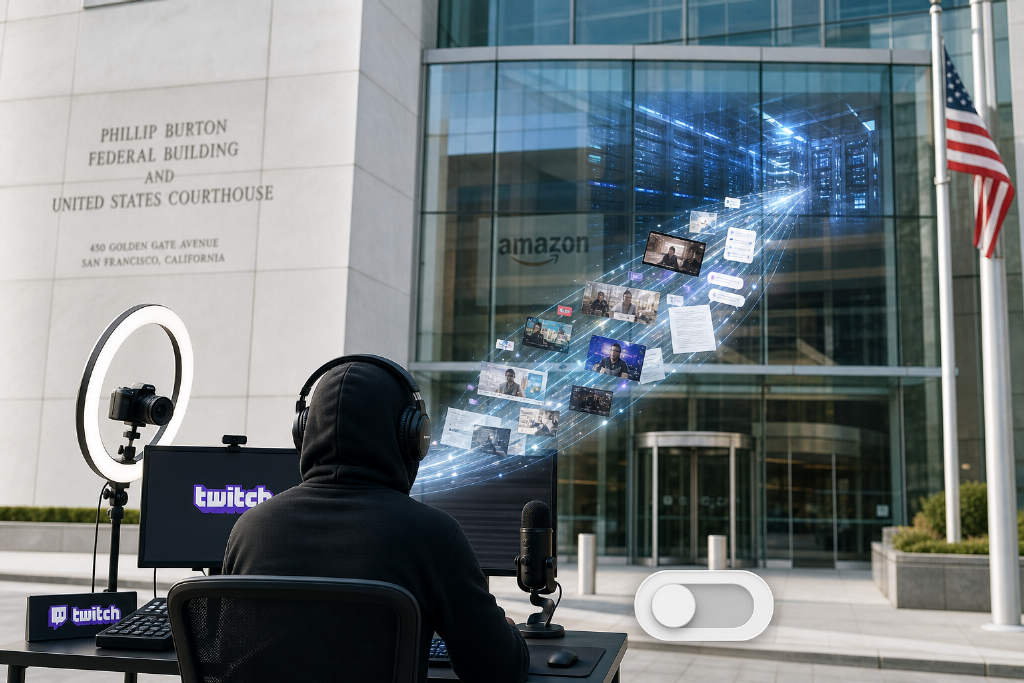
Twitch and its parent company, Amazon, are facing a proposed class action after Connecticut streamer Warren Pandiscia accused them of using creators’ livestream content to train generative artificial intelligence models without permission or compensation.
The 37-page complaint was filed in the U.S. District Court for the Northern District of California. It alleges that Twitch and Amazon copied millions of videos to develop generative AI products, breaching an implied contract with creators and violating California unfair competition law.
Complaint targets Amazon’s use of Twitch content for AI products
According to Courthouse News, Pandiscia is a small streamer with just over 900 followers. The complaint argues that Amazon’s commercial AI business created an overwhelming incentive to gather training data at unprecedented scale, instead of negotiating licenses or asking creators for consent.
Pandiscia wrote in the complaint: 「Because Amazon AI products are commercialized, Amazon has an overwhelming incentive to obtain training data on an unprecedented scale. Rather than negotiate lawful licenses or seek permission, the defendants directly scraped Twitch streams and videos, turning them into a massive dataset that supports Amazon AI products.」
Twitch added an opt-out setting this month
On the 12th of this month, Twitch said in a post on X that it had added a setting allowing users to opt out of having channel content used to train Amazon’s generative AI systems. The company also updated its terms of service and privacy policy the same day.
Based on the FAQ cited in the source material, the content Amazon may use includes livestreams, VOD replays, clips, chat messages, images, and text. The scope also extends to training for 「future models developed by Amazon for generating or synthesizing text, audio, images, or video.」 One example provided by Twitch was that user voice data could be used to improve speech-to-text models, improving not only subtitles on Twitch but also subtitles across Amazon’s wider ecosystem.
Chief product officer’s remark intensified the backlash
The sharpest reaction followed comments from Twitch chief product officer Mike Minton. During Twitch’s official Patch Notes livestream, he was asked why the AI training option was not switched off by default. His response was direct: 「If it was opt in, nobody would do it.」
That means channels are included in AI training by default, and users who do not want to participate must manually opt out.
The complaint also challenges how the setting works. The opt-out applies at the channel level, not the individual level. As described in the source material, even if a user has opted out, their content may still be collected if they appear in a participating channel, such as by posting in another streamer’s chat. Pandiscia argues that Twitch’s system is 「inherently incapable of obtaining consent from all participants」 and claims the platform had already started collecting content without permission in 2024.
Part of a wider wave of AI training data litigation
The lawsuit arrives as disputes over AI training material continue to spread across media, platform, and technology companies. The source material notes that three YouTubers sued Apple earlier this year over alleged scraping of copyrighted material for model training. OpenAI and Microsoft have also faced class action claims tied to ChatGPT training data. CNN sued Perplexity over the alleged verbatim copying of 17,000 reports, while Reddit previously sued Anthropic for allegedly using platform content without paying licensing fees.
In music, Sony’s case against Suno has put the question of whether training AI on copyrighted songs can qualify as fair use before a court.
Core legal question is whether default consent is valid
Across these cases, companies and platforms have argued that the content was public or that user agreements already covered the relevant permissions. Creators, by contrast, say their work has been turned into free fuel for AI systems.
In this case, the central issue is whether default authorization can hold up legally. Twitch’s position, as described in the source material, is that updated terms plus an opt-out mechanism are enough to establish consent. Pandiscia argues the opposite. For smaller creators without the means to spend heavily on legal fees, he says, treating silence or inaction as agreement strips them of a meaningful choice. He also argues that Amazon is using creator content to train commercial products without sharing any of the economic benefit, making the practice unfair competition.
A ruling against the opt-out model could reach beyond Twitch
The source material says that if the court finds Twitch’s opt-out structure insufficient to establish valid consent, the decision could affect other AI data collection models built on default participation followed by later withdrawal, including social platforms and other user-generated content businesses.
It also notes that legal approaches to AI training data are starting to diverge across jurisdictions. The source describes the U.S. path as one shaped by civil litigation and fair use case law, the European approach as one tied to copyright directives and transparency duties, and parts of Asia as showing early signs of criminalization. As one example, it points to what it calls China’s first criminal case involving an employee prosecuted for deleting AI training data under a charge related to damaging a computer information system.
For now, the case is centered on Twitch and Amazon, the use of livestream content in AI model training, and the limits of consent secured through revised platform terms and an opt-out mechanism.