
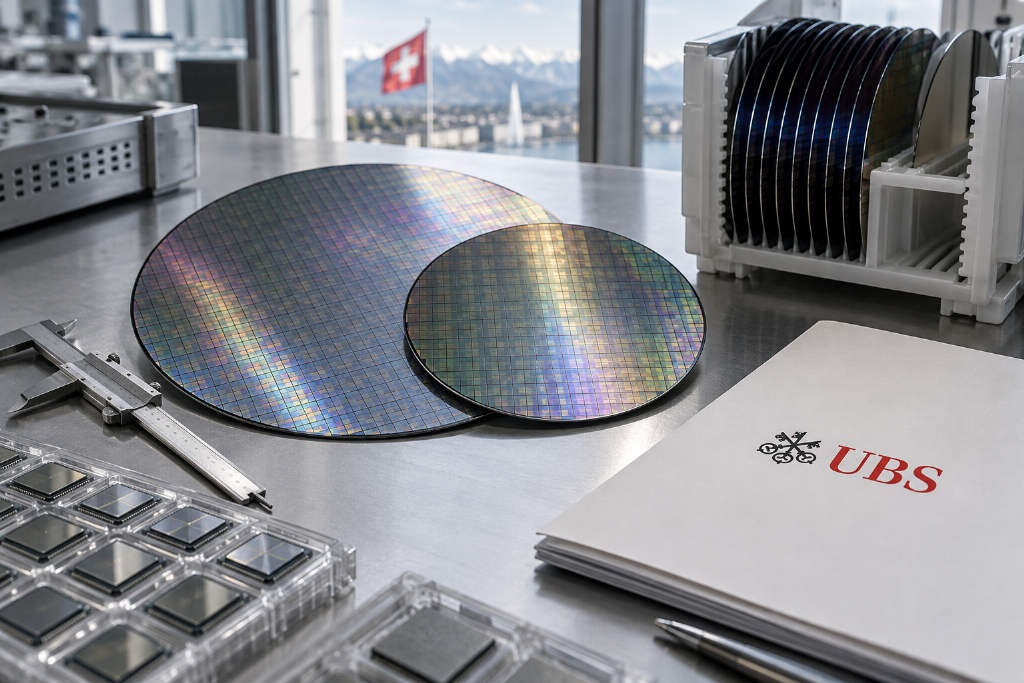
UBS said in a global wafer industry report dated Sept. 18, 2026 that wafer prices may need to rise sharply before manufacturers are willing to build new capacity, even as supply-demand conditions for both 12-inch and 8-inch wafers tighten over the next two years.

The report, summarized and interpreted by Chaoxiang Research, said wafer makers remain cautious on expansion after a downcycle that ran from 2023 to 2025.
Supply and demand are expected to tighten through 2028
UBS raised its 2026 growth forecast for 12-inch wafer demand to 11% from 9%. It projected demand growth of 14% in 2027 and 13% in 2028. For 8-inch wafers, the bank forecast demand growth of 11% in 2026, 9.9% in 2027, and 8.8% in 2028.
On utilization, UBS expects 12-inch wafer utilization to reach 84%, 91%, and 99% from 2026 to 2028, up from its previous estimates of 82%, 88%, and 94%. It forecast 8-inch wafer utilization at 80%, 90%, and 97% over the same period.
UBS said the demand upgrade was mainly driven by stronger customer restocking and faster DRAM capacity expansion. It added that supply-demand conditions in 2027 should be tighter than in 2026, while utilization in 2028 would be close to full production. If manufacturers do not expand, utilization would reach 103.7% in 2029, with shortages starting to emerge that year.
UBS says higher prices are needed to unlock expansion
The bank’s core view is that wafer manufacturers have become much more cautious on expansion after the 2023-2025 downturn. It cited a current operating margin of 12.3% and return on equity of 6.8%, both well below the 18.3% and 19.1% seen over 2017 to 2022.
UBS said large customers would need to offer better pricing if they want producers to commit to additional capacity. It expects wafer prices to rise more than 20% a year in 2027 and 2028, in a pattern similar to the upcycle of 2017 to 2018. Still, the report argued that this alone may not be enough to trigger fresh investment.
Based on industry feedback cited by UBS, wafer makers may need to see price increases of more than 40% to 50% before they consider new capacity expansion for 2028 and beyond. In that framework, higher prices are not only the result of a cyclical rebound. They are also a prerequisite for new supply.
UBS warned that if manufacturers choose not to expand, severe shortages could appear after 2028 and limit growth across the semiconductor industry.
UBS sees limited impact from Chinese competition
Chinese wafer manufacturers are expanding aggressively, but UBS said their effect on global supply and demand in 2027 and 2028 should be limited. The bank said the main opportunity for Chinese suppliers may be new mature-node logic fabs in China, while leading Chinese logic and memory customers still tend to prefer overseas wafers because of yield considerations.
For non-Chinese customers, UBS said broad adoption of Chinese wafers in mature logic foundry production is difficult because of requalification requirements, while Chinese products still lag in advanced logic and memory performance.
The report pointed to NSIG, described as China’s largest wafer maker. UBS said NSIG’s average selling price for 12-inch wafers was $54, versus an industry range of $100 to $120, suggesting that most of its shipments are still non-production wafers. UBS therefore said Chinese suppliers remain limited in the high-end wafer segment and are unlikely to materially alter the global supply picture in the near term.
Ratings and target price changes
UBS rated Shin-Etsu Chemical, GlobalWafers, and Siltronic as Buy, and kept SUMCO at Neutral.
For GlobalWafers, UBS cut its target price to T$1,750 from T$2,000, based on 7.5x forward price-to-book, down from 8.5x previously. The bank also lowered its earnings per share forecasts for GlobalWafers by 7% for 2026 and by 14% for both 2027 and 2028. Even so, it said sales growth should accelerate in the fourth quarter of 2026 and in 2027.
UBS raised Siltronic’s target price to €120 from €105. SUMCO remained Neutral with a target price of ¥4,000.
The bank also said the wafer sector’s price-to-book multiple had fallen to 2.6x from 3.3x in July 2026. That places the group around the midpoint of its 1.0x to 4.0x range over the past 10 years. UBS said the pullback created a buying opportunity tied to a structural upcycle.
Disclosure carried in the source article
Chaoxiang Research said the article was a summary and interpretation of a third-party brokerage report from UBS dated Sept. 18, 2026, combined with publicly available market information. It said the ratings, target prices, earnings forecasts, and related judgments cited in the piece were the views of the brokerage analysts and represented only the position of their institution, not the view of Chaoxiang Research, and did not constitute investment advice.
The source article also said market risk remains and decisions should be made independently. It added that the article should not be used as the basis for buying or selling any securities.
