

The UK government has appointed six major banks to lead the issuance of its first digitally native government bond, with the pilot expected by the first quarter of 2027. The instrument, called the Digital Gilt Instrument, or DIGIT, is designed to test distributed ledger technology in the sovereign debt market.
Six banks selected as joint lead managers
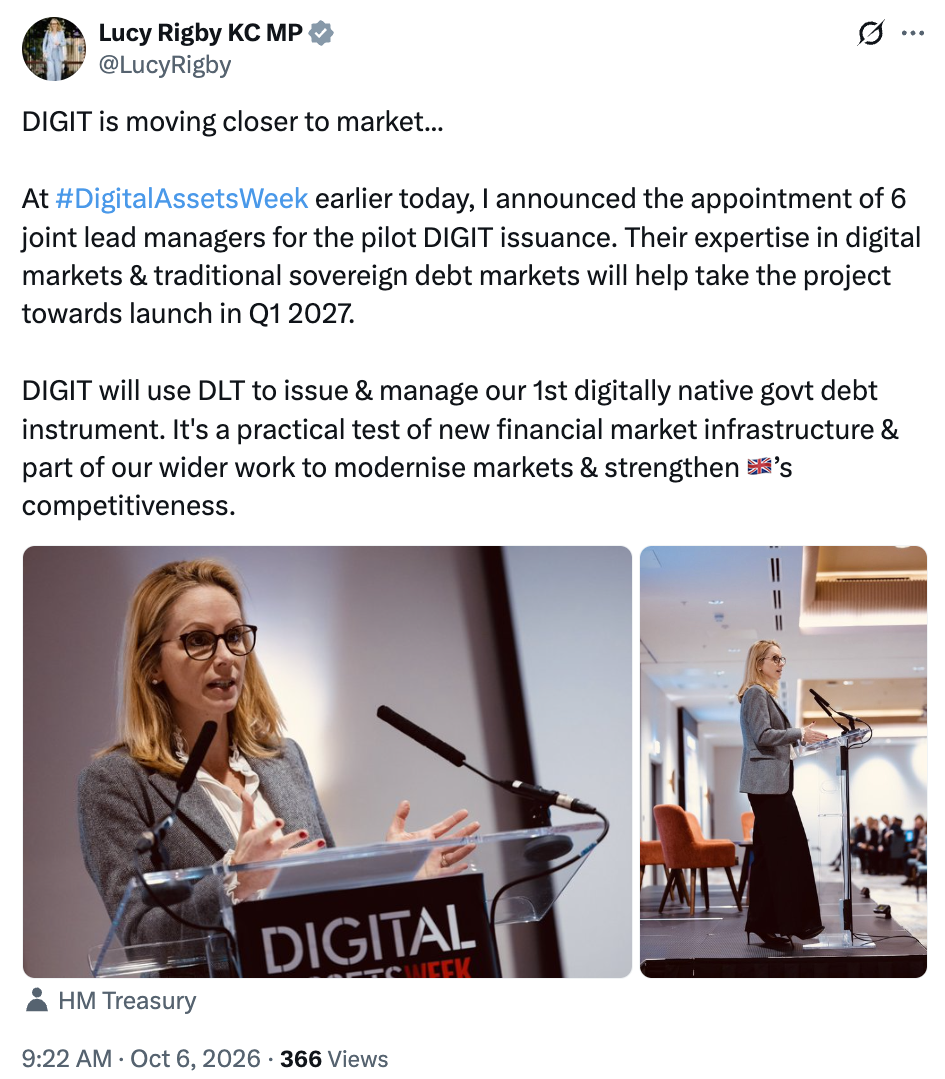
Barclays, HSBC, Lloyds, Morgan Stanley, NatWest and RBC Capital Markets were named joint lead managers for DIGIT after a competitive procurement process. Economic Secretary to the Treasury Lucy Rigby announced the appointments on Tuesday during a keynote speech at UK Digital Assets Week.
The banks will provide underwriting, investor engagement and distribution services for the pilot issuance.
Sandbox issuance will test DLT and onchain settlement
DIGIT will be issued on a platform operating within the UK’s Digital Securities Sandbox. The government said the pilot will test the use of distributed ledger technology across the bond’s issuance and lifecycle, including onchain settlement.
According to the government, the pilot is intended to explore how DLT could be used in sovereign debt markets while also encouraging the development of digital financial infrastructure in the UK.
Project follows earlier technology and market structure steps
The initiative follows HSBC’s appointment in February as the pilot’s DLT supplier. In July, HSBC and London Stock Exchange Group also reached an agreement to develop a digital securities depository link.

In a post on X on Tuesday, Rigby said the appointments were an important step toward issuing the digital gilt early next year. She described DIGIT as 「a practical test of new financial market infrastructure」.
Infrastructure links remain a key test for the pilot
In comments shared with Cointelegraph, Richard Baker, CEO and founder of Tokenovate and a member of HM Treasury’s Wholesale Digital Markets Industry Taskforce, said the pilot will need to address how digital securities connect with existing financial infrastructure.
Baker said that building that connectivity from the outset could help show whether tokenization can improve liquidity and market efficiency without creating new digital silos.
Marius Jurgilas, CEO of Axiology and a former central banker, added that the potential impact of DIGIT could extend beyond government borrowing.