
Unitree Technology’s IPO has turned into one of the most closely watched listings in China’s market this year, with investor attention quickly shifting from subscription demand to a more contentious question: what should the company be worth once trading begins?

On Aug. 11, Unitree released its preliminary offline placement results and online lottery results. Its online winning rate came in at just 0.01809759%, while the offline placement ratio for institutional investors was 0.03341824%. The source article said that placed the online rate on the low side among the 93 IPOs listed this year, and ranked the offline placement ratio sixth among the 46 new listings that included offline subscription participation.
For comparison, Changxin Technology, listed in July, posted the highest online winning rate among this year’s IPOs at 0.47141739%. Based on the figures cited in the article, Unitree’s online winning rate was only 3.8% of Changxin’s, and its offline placement ratio was 19% of Changxin’s.
Subscription demand topped 8,288 times
The company said 9.7846 million retail investors took part in the online subscription, setting a new participation record for the STAR Market and surpassing the 9.4288 million reached by Changxin Technology. Valid online subscription volume reached 53.637 billion shares, producing an initial effective oversubscription multiple of 8,288.82 times.
In the final allocation, retail investors received about 19,414 winning numbers, while 313 institutions were allocated 22.65 million shares through the offline tranche.
Because demand ran so high, Unitree activated its callback mechanism and moved 3.236 million shares, equal to 10% of the shares remaining after the final strategic placement portion was excluded, from the offline tranche to the online tranche. That lifted the online winning rate from the initial 0.012% to about 0.018%, though the source article described it as still marking a record low for the STAR Market.
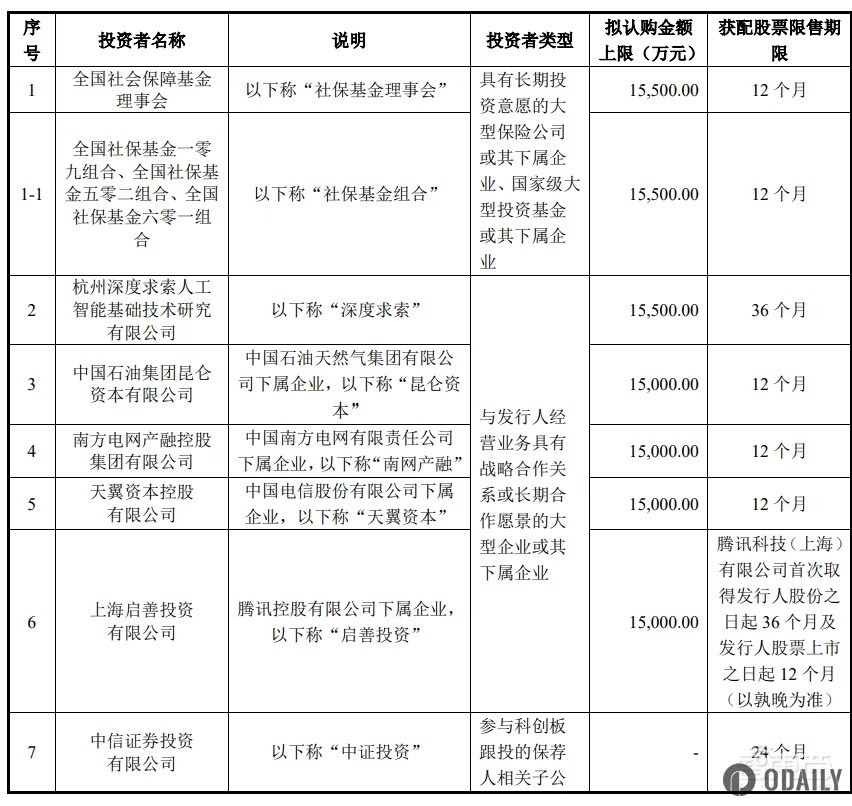
Strategic investors include state-backed funds, corporates, AI firms and brokers
The strategic placement roster was broad. According to the article, it included organizations related to China’s National Social Security Fund, artificial intelligence company DeepSeek, China National Petroleum Group, China Southern Power Grid, a unit under China Telecom, an affiliate under Tencent, and CITIC Securities.
Founder Wang Xingxing said DeepSeek would provide commercially competitive cooperation plans for Unitree, including but not limited to model architecture solutions, intelligent computing cluster construction, and data center operations, if needed. The article characterized such institutions as strategic partners or companies with long-term cooperation plans that can strengthen Unitree’s competitiveness through industry resources and supply chain positioning.
CITIC Securities participated through an "equity investment + IPO follow-on investment" structure, and five brokerages were said to have joined indirectly through LP positions. The article’s description was that Unitree had attracted support from state-owned enterprises, state-backed funds, technology giants, AI companies and securities firms.
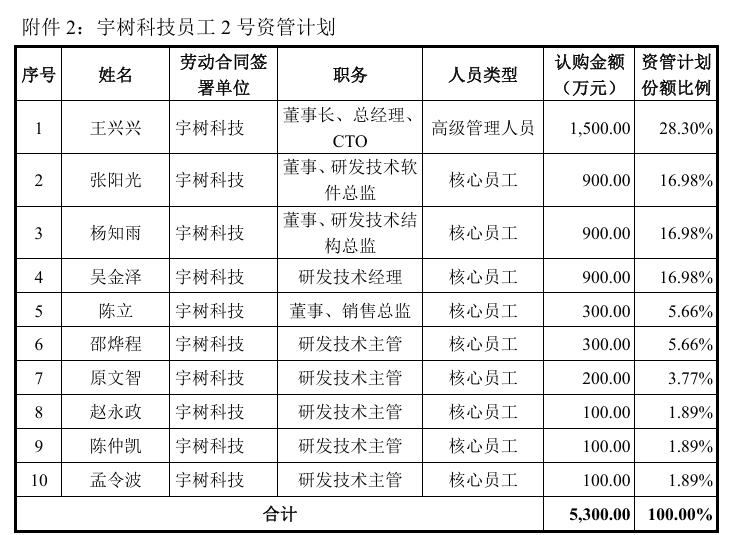
Employees also joined the strategic placement through two asset management plans. Plan No. 1 raised RMB 218.5 million and Plan No. 2 raised RMB 53 million. The first plan included 161 participants, among them CFO Wang Feng. The second included 10 participants, among them chairman Wang Xingxing, whose subscription amount was RMB 15 million.
IPO raised nearly RMB 6.1 billion
Unitree priced the offering at RMB 150.8 per share and issued 40.4464 million shares, equal to 10% of its post-offering total share capital. Total proceeds came to about RMB 6.099 billion, 45.15% above the original fundraising plan of RMB 4.202 billion.
From acceptance on March 20 to approval, the process took 73 days. By Aug. 10, when the subscription opened, the full IPO process had taken less than five months, which the article described as the fastest pace this year.
After the strategic placement callback, the offline issuance size stood at 25.886148 million shares, accounting for about 80.00% of the shares issued after excluding the final strategic placement amount. Of those shares, 90% carry no lock-up and can circulate from the first day of trading on the Shanghai Stock Exchange, while 10% are subject to a six-month lock-up.
Based on earlier statistics cited by the source, Unitree will have about 404 million shares outstanding after the offering, with roughly 29.77 million shares available for trading on the first day, or about 7.36% of total share capital. More than 90% of the shares will remain locked up.
Pre-IPO contract pricing implied roughly RMB 239 billion
Data from trade.xyz showed Unitree’s pre-IPO perpetual contract trading at around $87.8. Based on a total share count of 404 million, that implied a market capitalization of about $35.47 billion, or roughly RMB 239 billion.
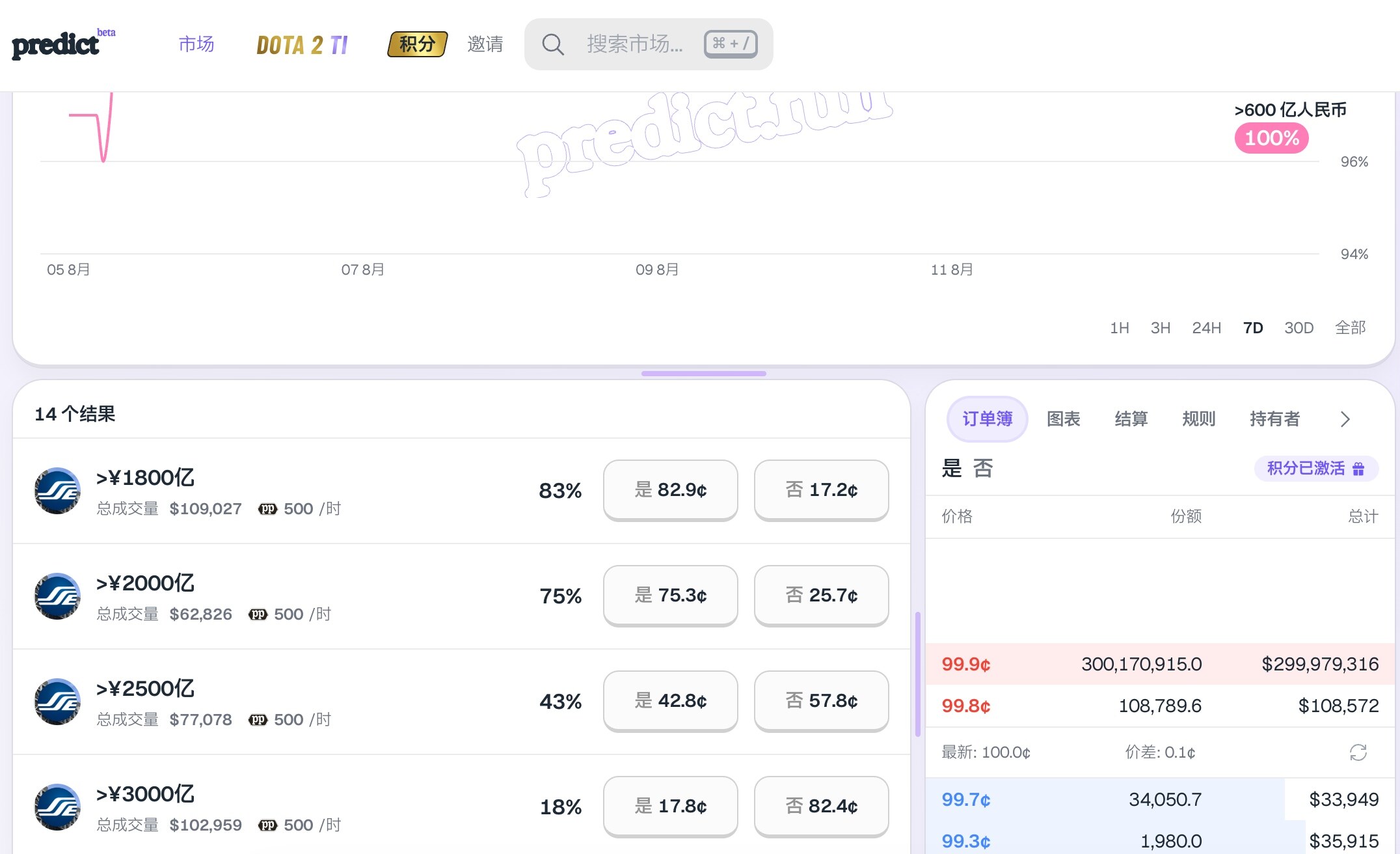
Prediction market platform predict.fun also attached probabilities to Unitree’s closing valuation bands:
- 75% for a closing market capitalization above RMB 200 billion;
- 43% for above RMB 250 billion;
- 18% for above RMB 300 billion.
Estimated profit per lot ranged from RMB 170,000 to RMB 351,800
The article laid out several scenarios for IPO gains. If Unitree opens at a RMB 200 billion valuation, that would translate to a share price of about RMB 500. A standard lot of 500 shares would then be worth RMB 250,000, against an input cost of about RMB 75,400, leaving an unrealized gain of about RMB 170,000.
If benchmarked against the average first-day gain of 276.04% for A-share IPOs since 2026, book profit on one lot could exceed RMB 200,000. If benchmarked against the 466.61% average first-day gain for STAR Market IPOs this year, profit on one lot could reach RMB 351,800.

The article also said Wang Xingxing will hold about 30% of Unitree, directly and indirectly, after the listing. If the company’s valuation rises above RMB 200 billion, the value of his holdings would reach RMB 60 billion, overtaking Muxi Shares’ Chen Weiliang to become the richest founder on China’s STAR Market, according to the source.
Most of the proceeds are earmarked for R&D
Unitree plans to direct 85% of IPO proceeds into research and development across four areas:
- RMB 2.022 billion for intelligent robot model R&D;
- RMB 1.110 billion for robot body development;
- RMB 445 million for new intelligent robot product development;
- RMB 624 million for intelligent robot manufacturing base construction.
The company expects revenue in the first half of 2026 to come in between RMB 1.052 billion and RMB 1.128 billion, up 35.62% to 45.41% year over year. It expects net profit attributable to shareholders of the parent company to be RMB 258 million to RMB 306 million, and net profit excluding non-recurring gains and losses to be RMB 236 million to RMB 283 million.
At the same time, the article noted that Unitree’s 219x price-to-earnings ratio on profit excluding non-recurring items remains controversial, and that the market is far from aligned on valuation.
Valuation calls range from RMB 109 billion to above RMB 400 billion
Financial data from the past three years help explain both the enthusiasm and the disagreement. From 2023 to 2025, Unitree’s revenue climbed from RMB 159 million to RMB 1.699 billion, representing a compound annual growth rate of 226.78%. Net profit excluding non-recurring items moved from a loss of RMB 18.0191 million to a profit of RMB 591 million. Gross margin in core operations rose from 44.22% to 60.13%, and gross margin for humanoid robots reached 63.18%.
In 2025, net operating cash flow was RMB 670 million. Cash on hand stood at RMB 1.419 billion, and the company had almost no interest-bearing debt.
Still, the pace moderated in the first quarter of 2026. Revenue was RMB 423 million, and year-over-year growth slowed from 332.64% for full-year 2025 to 68.49%. Net profit excluding non-recurring items fell to RMB 40.2536 million, down 52.55% from a year earlier. Wang attributed that to a much higher revenue base, a gradual cooling in industry heat, and increasingly intense competition. The article added that heavy marketing spending around the Spring Festival was also part of the reason.
CCB International estimated Unitree’s market capitalization at RMB 109 billion, citing the scarcity value of the "first humanoid robotics stock," its leading global market share, and expectations for strong earnings growth. That valuation corresponds to a target 2026 price-to-sales ratio of 32x.
Some market institutions, looking at longer-term industry potential, placed a more bullish estimate in the RMB 200 billion to RMB 300 billion range.
CITIC gave a 6-to-12-month bullish case that would value Unitree at about 20x sales. For that to happen, the company would need revenue of RMB 11.5 billion, roughly seven times its 2025 revenue base of RMB 1.7 billion, according to the article’s calculation.
Investor Serenity, referred to in the article as "Bai Mao Gu Shen," wrote that Unitree’s IPO drew retail oversubscription of more than 8,000 times, reflecting what he described as "extremely large" demand for a pure-play humanoid robotics company. He added that pre-IPO perpetual contract pricing already showed elevated expectations, and that if Unitree lists with a market value above $30 billion, it could attract more attention over the next one to two weeks to leading U.S. humanoid robotics companies.
Yu Wenchao, an early Unitree investor and partner at Dunhong Asset, offered the highest estimate cited in the article: "A post-listing market capitalization above RMB 200 billion is very reasonable. I think it could even exceed RMB 400 billion in the short term. Compared with overseas peers, that is not exaggerated."
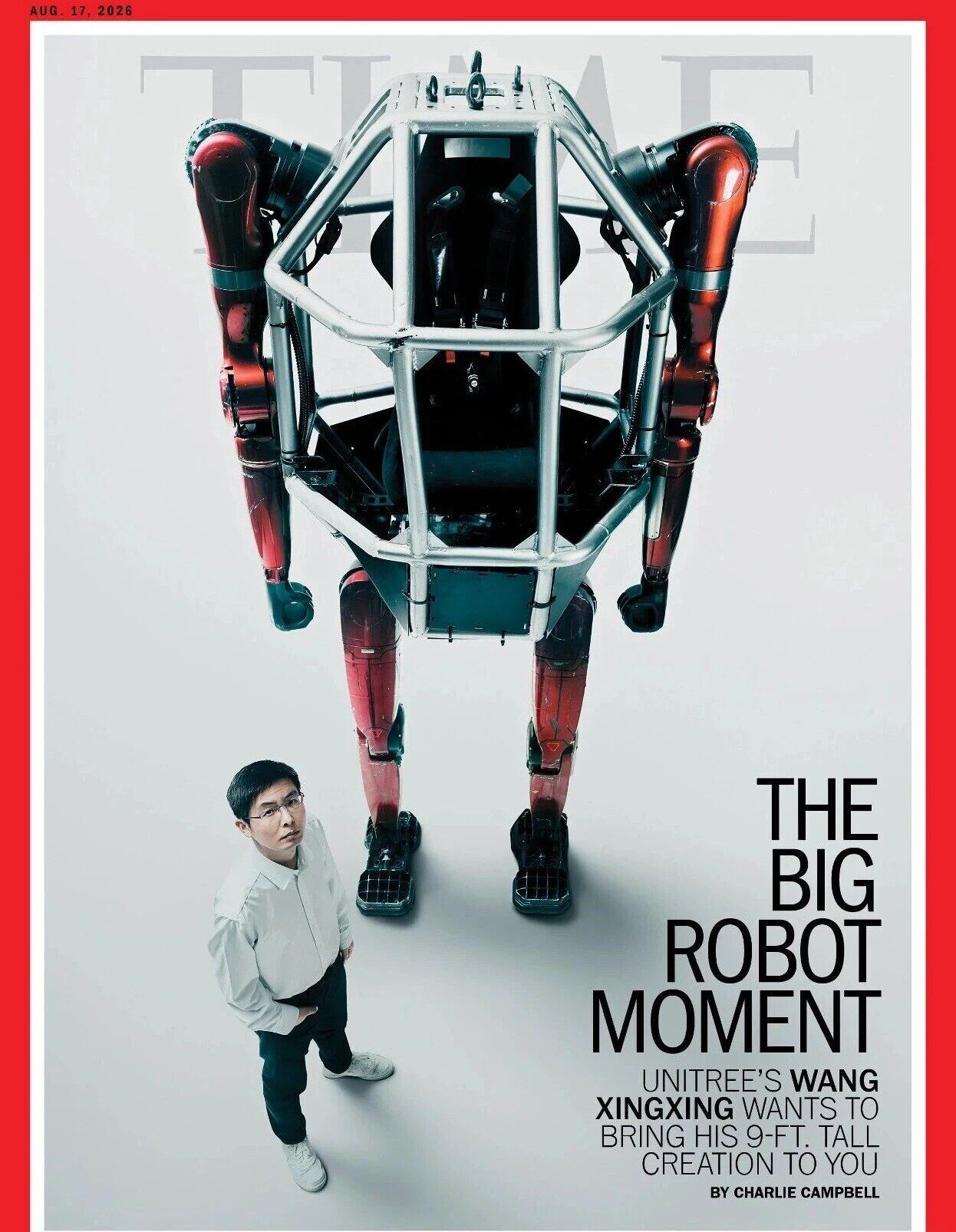
Wang Xingxing answered questions on valuation, shipments and remote control
At the roadshow, one of the sharpest criticisms centered on Unitree’s 219x valuation on profit excluding non-recurring items compared with an industry average of 38.56x. Wang responded that based on 2025 net profit excluding non-recurring items, the issue price of RMB 150.5 implied a price-to-earnings ratio of 92.92x. He said the embodied intelligence sector has broad market space and that the pricing matches the company’s operating condition and industry development.
On operations, Wang said Unitree shipped more than 5,500 humanoid robots in 2025, excluding wheeled dual-arm robots, and described that figure as the highest globally.
On criticism that the company is weak on the "brain" side, Wang said Unitree has already laid out two routes, WMA, or world model, and VLA, short for vision-language-action model. He said the company’s overall R&D capability and technology maturity place it in the global first tier.
Another investor asked whether Unitree’s robots are essentially remote-controlled toys. Wang answered by comparing humanoid robots with intelligent driving in the auto industry. He said: 「The remote controller is the highest-priority safety redundancy, just like a smart driving car still comes with a steering wheel and brake pedal. In extremely complex terrain, communication failures, or logic errors, operators can use it for emergency shutdowns and forced risk avoidance.」
The source article added that, based on the current listing schedule, the market widely expects Unitree to begin trading on China’s A-share market as early as next week. Looking at the company’s revenue trajectory over the past three years and the pre-IPO contract pricing on trade.xyz, Odaily said the market has high expectations for a move toward RMB 200 billion in valuation, while a spike toward RMB 250 billion followed by a pullback into the RMB 190 billion to RMB 210 billion range may be more likely.