
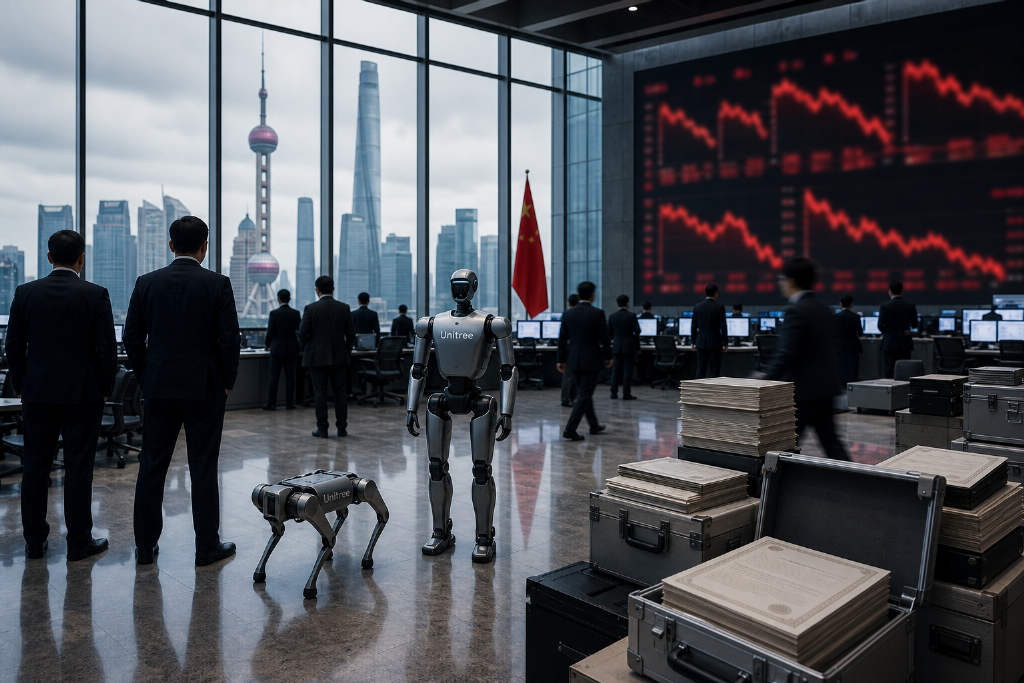
Unitree Technology’s share price has been highly volatile since listing. On its August 19 debut, the stock at one point rose more than sixfold, lifting the company’s market capitalization above RMB 440 billion. It then fell in the following sessions, almost halving from those levels and erasing more than RMB 200 billion in value.
Exchange data shows first-day turnover reached RMB 23.2 billion, with 25.66 million shares traded. Turnover in the tradable float hit 85.28%, setting a 2026 high for first-day turnover among newly listed STAR Market companies.
Small float and fast circulation of offline allotments
At the start of trading, Unitree had only 30.0877 million tradable shares, equal to about 7.44% of total post-IPO share capital. Of that amount, offline institutional investors held 20.3807 million shares, or about 68% of the tradable float. The top 20 institutions alone accounted for 45% of all tradable shares.
About 90% of the offline placement shares were eligible for trading on the first day. That gave low-cost IPO allocations a quick exit window and became a major reason for the unusually high turnover.
Large and mid-sized investors led the selling
By investor type, first-day selling totaled 1.69 million shares from institutions, 10.78 million shares from large investors, 12.96 million shares from mid-sized investors, and 230,000 shares from retail investors. Large and mid-sized accounts were the main source of selling pressure. Over the same period, margin financing posted net buying of RMB 1.56 billion, showing that some leveraged money was still entering at elevated prices.
Industry observers said heavy turnover on the first day shows that a large amount of IPO allocation stock moved into the hands of secondary-market trading capital, rapidly lifting the market’s holding cost. If later earnings delivery falls short of expectations, trapped positions at high levels could add to pressure for valuation mean reversion.
Those same observers also said there is currently no evidence that the opening price of RMB 1,100 per share on the first trading day involved market manipulation. In their view, the high price reflected a combination of capital flows, a limited float, and strong interest in the humanoid robotics sector.
228.7 million shares to be unlocked after one year
Unitree also faces substantial lockup-expiry pressure. Data shows that about 228.7 million shares will be unlocked one year after the listing, equal to 56.56% of total share capital. The earliest possible date for share sales by eligible holders is August 19, 2027.
Pre-IPO shareholders including Meituan-affiliated investors, HongShan China, Shunwei Capital, Tencent, and ByteDance all have potential room to exit. Even so, some long-term investors have said they do not plan to sell immediately after the IPO.
Valuation gap remains wide
As of the August 27 close, Unitree’s market capitalization stood at about RMB 230 billion, implying a price-to-earnings ratio of about 426 times, well above the average level for the general equipment industry.
Broker views differ sharply. Nomura assigned a 12-month target price of RMB 370 per share, corresponding to a market capitalization of about RMB 149.6 billion. CCB International had previously estimated a fair market value of about RMB 109 billion. CITIC Securities, the IPO lead underwriter, gave a post-listing fair valuation range for the next six to 12 months of RMB 50.6 billion to RMB 55.9 billion.
The central dispute in the market is whether Unitree should be valued as a traditional hardware manufacturing company or as an AI and embodied intelligence platform business.
R&D intensity and revenue mix are under scrutiny
In 2025, the company’s R&D spending was RMB 145 million, accounting for 8.53% of revenue. That was noticeably below the roughly 25% R&D ratio seen at several peers.
At the same time, 73.6% of humanoid robot revenue in the first three quarters of 2025 came from purchases by research and education institutions. Large-scale repeat orders in industrial and commercial use cases have not yet formed.