

Unitree Technology’s IPO pricing has triggered a debate over whether investor enthusiasm has run far ahead of the company’s current business fundamentals.
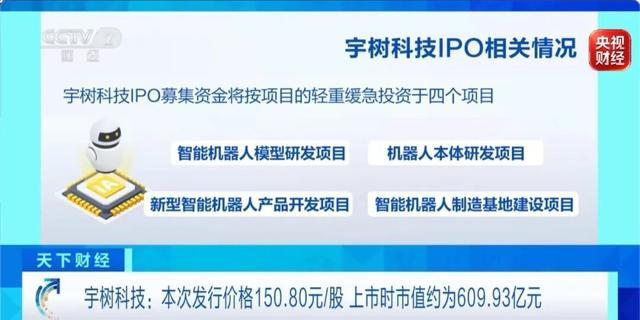
On Aug. 6, Unitree disclosed its offering price for Shanghai’s STAR Market at RMB 150.80 per share, implying a post-offering valuation of RMB 60.993 billion. Four days later, on Aug. 10, 9.78 million retail investors joined the online subscription, and the preliminary valid subscription multiple hit 8,288.82 times, leaving the issue with a record-low winning rate for the board.
That frenzy spilled into premarket trading proxies. On Hyperliquid, the UNITREE-USDC perpetual contract briefly traded around $90. Based on Unitree’s total share count of 404 million, that price would imply a market capitalization of about $35.47 billion, or roughly RMB 239 billion, almost four times the IPO valuation.
IPO pricing came in far above the industry average
Odaily’s report centers first on Unitree’s valuation multiple. At the IPO price, the company was valued at 219.23 times earnings.
For comparison, the CSI industry data cited in the article showed the average static price-to-earnings ratio for general equipment manufacturing over the previous month at about 38.56 times. On that basis, Unitree’s IPO multiple was about 5.7 times the industry average.
The article noted that some retail investors jokingly called it a “dream valuation,” suggesting buyers were paying not for current earnings power but for a distant growth story.
Off-market and premarket quotes pushed valuations even higher
The second point in Odaily’s analysis was that pricing outside the IPO process stretched expectations even further.

According to the article, Unitree shares were quoted as high as $61.63 on overseas secondary-market platforms including Hiive between Aug. 10 and Aug. 11. That level would imply an equity valuation of nearly $22.4 billion, more than double the valuation tied to the offering price.
Hyperliquid showed an even more extreme reading. As of the article’s publication, the UNITREE-USDC premarket perpetual contract had traded around $90. Using Unitree’s 404 million shares outstanding, that translated to a valuation of about $35.47 billion, equivalent to roughly RMB 239 billion.
Odaily’s conclusion was not that these venues set the official price, but that they reflected unusually aggressive expectations around the company’s future.
Most humanoid robot revenue still comes from research and showcase use
The article’s third argument focused on the business mix behind Unitree’s humanoid robot story.
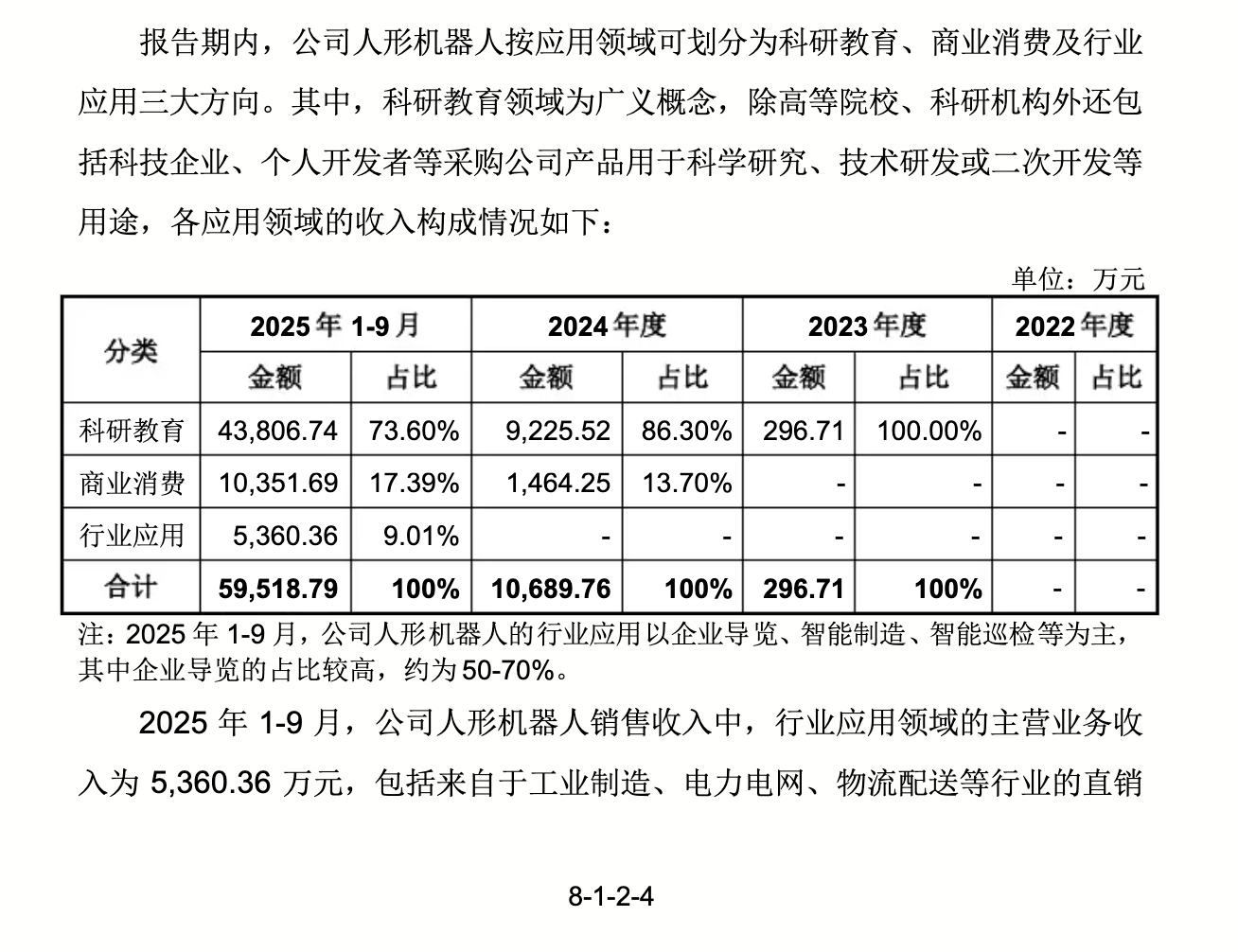
Unitree’s prospectus and written replies to regulators showed that, in the first nine months of 2025, 73.6% of humanoid robot revenue came from research and education, while 17.4% came from commercial exhibition and demonstration. Industry applications accounted for 9.01%.
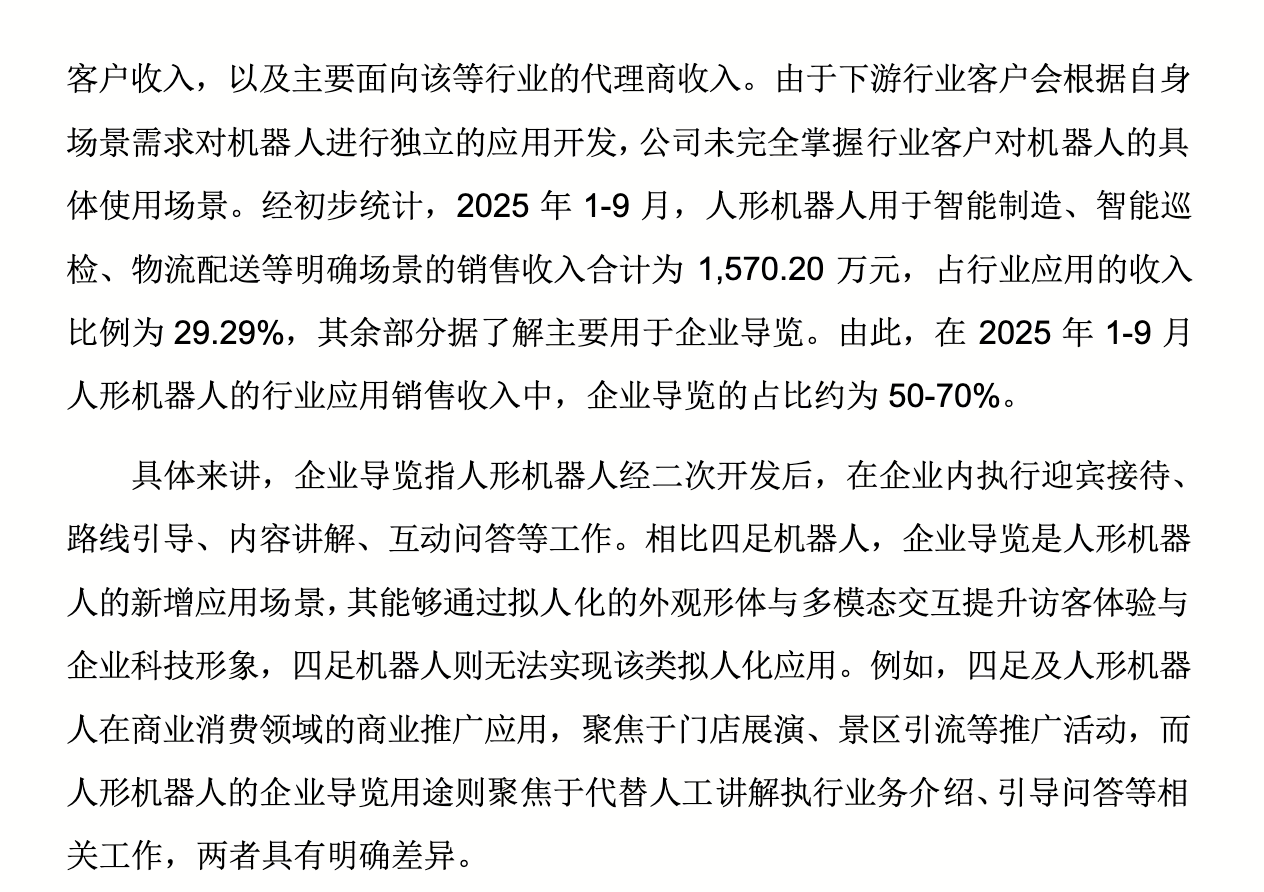
Within that 9.01%, the portion tied to actual manufacturing, inspection, and logistics use cases was described as less than 3% of total humanoid robot revenue. The article cited RMB 15.702 million in revenue for those scenarios, equal to 29.29% of industry-application revenue. The rest, according to the company’s own description cited by Odaily, was “mainly used for corporate guidance and tours.”
That distinction matters to the valuation debate. The article argued that “industry application” can sound like scaled factory deployment, but in practice a large share still goes to reception, route guidance, explanations, and interactive Q&A after secondary development.
Odaily also referenced a 36Kr article titled “Humanoid robots got rich before they benefited society,” which raised the question of whether Unitree’s ability to generate revenue necessarily proves humanoid robots have already become a proven business. The data cited there came from Unitree’s written response to the Shanghai Stock Exchange’s second-round inquiry.
The article said the main buyers today remain universities, research institutes, and technology companies that purchase robots for algorithm research, model training, and educational experiments, rather than for large-scale deployment on mature industrial lines.
Odaily added a comparison with UBTECH. Even though UBTECH’s humanoid robots have won large orders, the article said the company accumulated losses of more than RMB 5 billion from 2020 through the first half of 2025 and had not yet turned profitable. In that framing, strong orders do not automatically settle the commercialization question.
Revenue is still growing, but profit and growth momentum have weakened
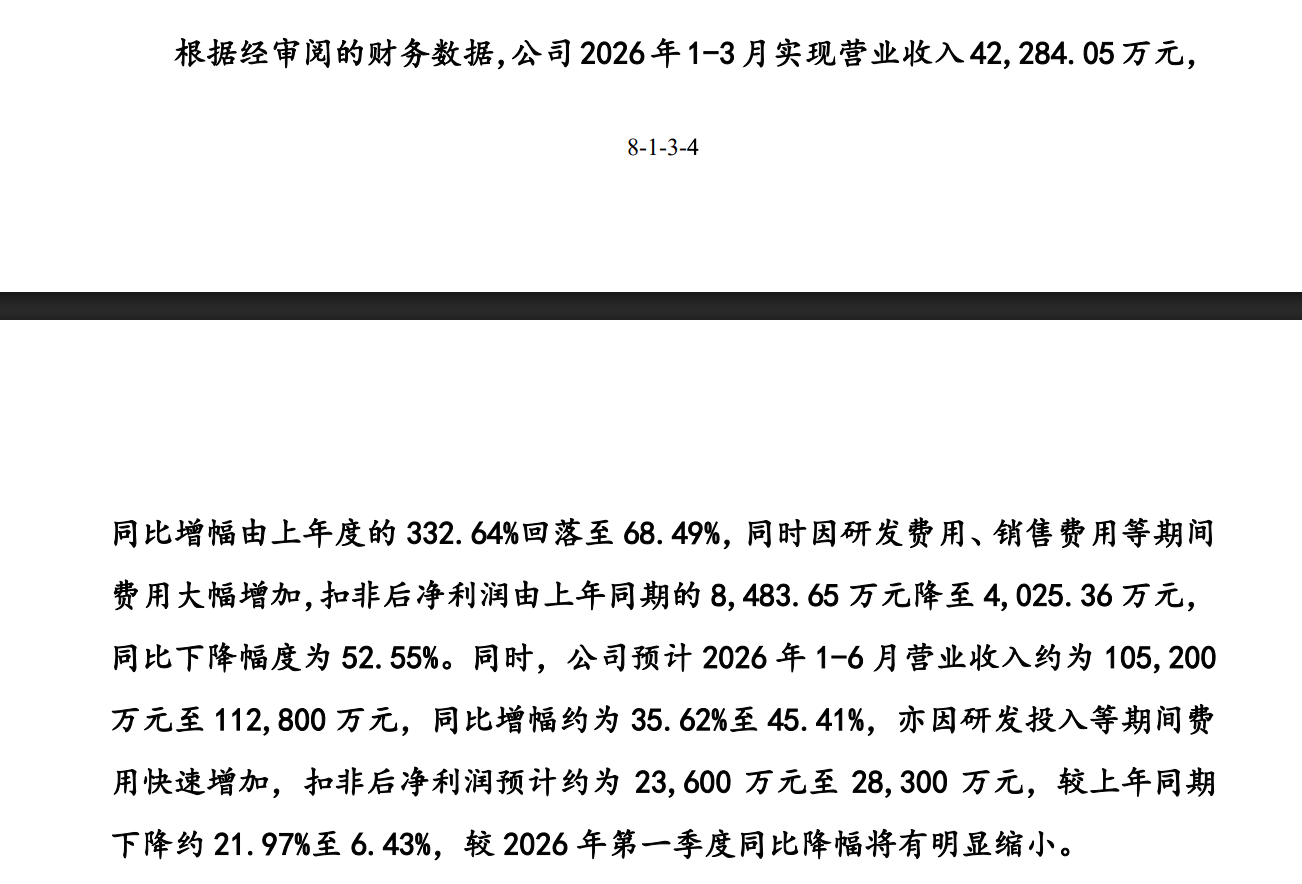
Unitree reported first-quarter revenue of RMB 423 million this year, up 68.49% year over year. Odaily noted that the number still looked strong in isolation, but it marked a steep slowdown from the 332.64% growth rate recorded in the first quarter of 2025.
Non-recurring adjusted net profit dropped from RMB 84.8365 million a year earlier to RMB 40.2536 million, a decline of 52.55%.
The company said research and development spending rose by a net RMB 38.328 million year over year, with investment directed to embodied intelligence large models, motion-control algorithms, and body-structure development. It also said branding efforts through platforms including CCTV’s Spring Festival Gala lifted selling expenses.
Odaily also pointed to changes in Unitree’s risk disclosures. Comparing the filing submitted in March with the meeting draft disclosed in May, the company revised five parts of its special risk warnings. The article highlighted the addition of a warning on year-over-year net profit decline and the replacement of the broader “technology breakthrough and product innovation fall short of expectations” language with “risk of slowing growth and fluctuations in operating performance,” which was placed first among seven special risk reminders.
The prospectus also named Tesla as a competitive threat. Unitree acknowledged that Tesla’s Optimus Gen-3 had entered small-batch trial production and was targeting annual capacity of 1 million units, with scale manufacturing and supply-chain integration potentially creating direct competition.
Wang Feili, an industrials analyst at UBS Securities China, said that even if several manufacturers push for shipments in the tens of thousands this year, humanoid robots may still not have reached a true commercialization inflection point because orders remain driven mainly by validation purchases rather than expansion purchases tied to productivity demand.
Investors and researchers also expressed caution
The fifth argument in the article came from outside views on the IPO.
Reuters quoted Zhuo Wang, a partner at an investment institution in Shanghai, as saying, “This IPO is priced expensively, and the investment risk is already quite high.” He also said most of Unitree’s sales revenue still came from research and showcase scenarios, while large-scale commercial adoption remained far off.
Even Shenwan Hongyuan Research, which Odaily described as relatively constructive, used guarded language in its comments on the pricing. The firm said the high issuance valuation could shift market attention toward the broader commercial value of the robotics sector and drive re-rating across related stocks.
Research firm SemiAnalysis estimated that only about 250 Unitree robots were actually put into industrialized scenarios in 2025, despite total shipments exceeding 5,500 units that year. Odaily treated that gap as another sign that market pricing may be running ahead of real deployment.
Valuation still has to answer to fundamentals
Odaily’s conclusion was that Unitree’s pricing has been lifted by two forces at once: the global excitement around humanoid robots and the strong appetite of A-share retail investors. The article grouped Unitree with other companies associated with “embodied intelligence,” including Tesla Optimus, Zhiyuan, Dobot, and DEEP Robotics, saying the market has assigned valuations well ahead of current earnings across the theme.
In that framework, the present valuation would require several assumptions to hold at the same time: a near-term surge in humanoid robot demand, Unitree’s ability to defend market share against rivals such as Zhiyuan Robotics and Tesla Optimus, and the preservation of its gross margin of about 60% without giving way to price competition.
The article said structural factors such as a small free float and index-fund support could keep the shares strong in the short term, and even leave room for additional gains soon after listing. Over the medium term, though, it argued that valuation would still need to be tested by fundamentals, especially as those supports fade and as the one-year mark approaches for the unlocking of institutional restricted shares.
If industrial-scene revenue does not rise meaningfully and profit growth continues to weaken by then, Odaily argued that the premium now built on long-dated expectations could face a substantial reset. The article ended by saying that pattern looks strikingly similar to the path taken by many crypto assets.