
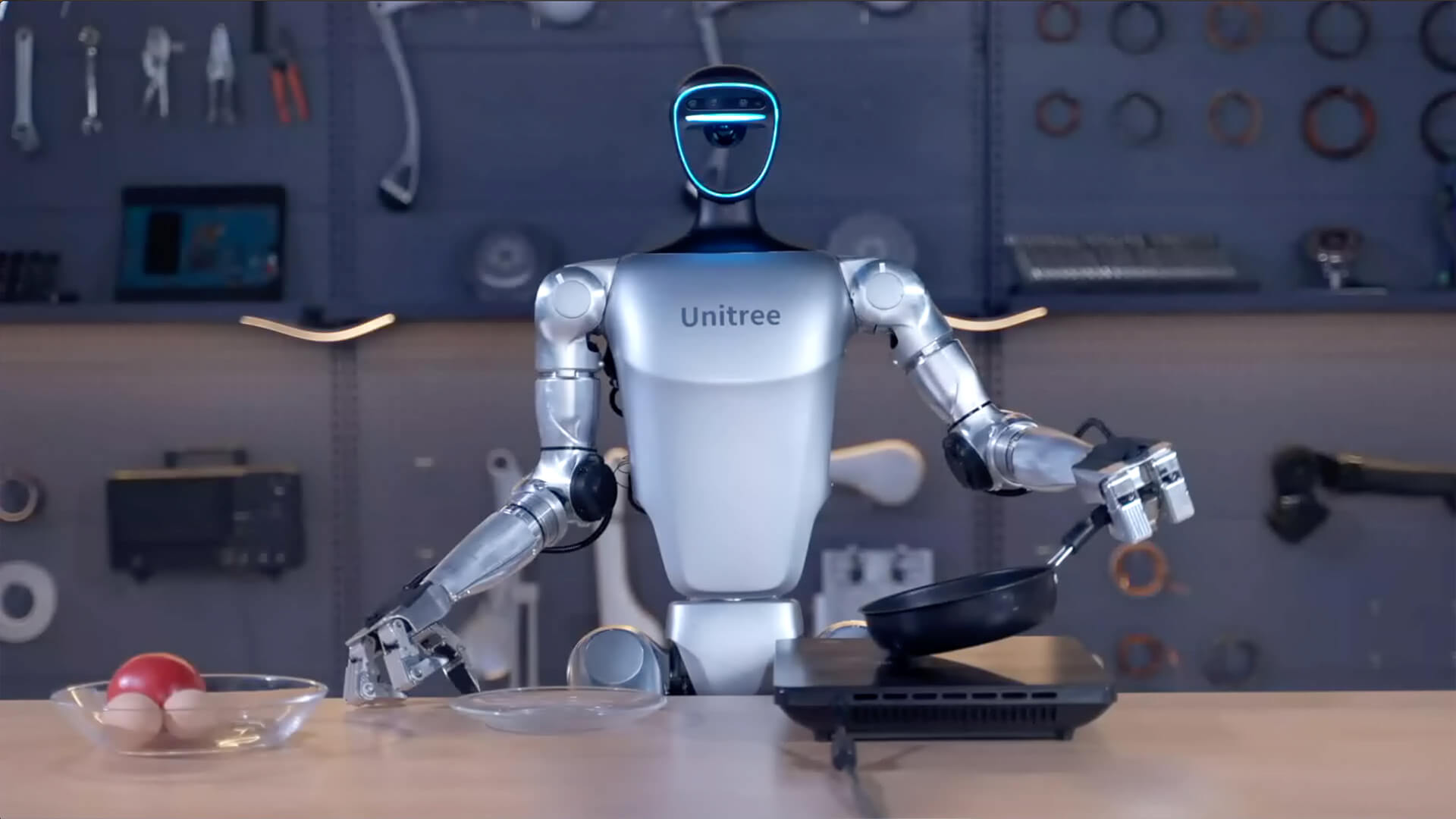
Unitree Robotics is scheduled to set its IPO price on Aug. 6, a date that could become one of the most closely watched pricing moments in China’s A-share market this year.
Using the company’s disclosed offering plan as a guide, Unitree intends to issue 40.4464 million new shares and raise about 4.2 billion yuan. That implies a reference price of roughly 104 yuan per share and a post-offering base valuation of about 42 billion yuan, or around $6.2 billion. The number is only a calculation based on the public deal structure. The actual price will be fixed after bookbuilding and announced on Aug. 6.
The bigger question is where the stock trades after listing. ChangXin Memory’s 466% jump on its first trading day on the STAR Market on July 27 has already pushed market discussion around Unitree toward the 100 billion yuan range. Unitree sits in an unusual position: it has real revenue and profit, yet it also belongs to a sector where valuation frameworks are still unsettled. Figure AI in the U.S. was reportedly valued at $39 billion in private markets without large-scale revenue, while Hong Kong-listed UBTech has stayed loss-making for an extended period. Unitree lands between those two ends.
How the implied 104 yuan reference price is derived
According to Gasgoo, Unitree will issue 40.4464 million shares in the IPO, equal to 10% of total share capital after the offering, and all of them will be new shares. Preliminary inquiry was set for Aug. 5, with online and offline subscriptions opening together on Aug. 10. CITIC Securities is serving as sponsor and lead underwriter.
According to the South China Morning Post, the offer price will be determined on Aug. 6, the day after the inquiry, and the final issuance results will be released on Aug. 14. Market expectations cited in the source article point to a listing around Aug. 19, though the formal date depends on an announcement from the Shanghai Stock Exchange.
Dividing the target proceeds of about 4.2 billion yuan by 40.4464 million shares yields an implied reference price near 104 yuan. Based on that level, post-offering share capital would be about 404 million shares, giving Unitree a base valuation near 42 billion yuan. This is not the official offer price. On the STAR Market, pricing is set through a market-based bookbuilding process, with the final result determined by bids from institutional investors.
First yardstick: Unitree’s own earnings and growth profile
Tech Market Briefs, in its review of the prospectus cited by the source article, said Unitree posted 2025 revenue of 1.708 billion yuan, up 335% year over year, with a gross margin of 60.27% and non-net profit of 600.1 million yuan.
At a 42 billion yuan valuation, that works out to roughly 70 times 2025 non-net earnings and about 25 times sales. For a company that grew revenue 335% in the prior year, a 70x earnings multiple does not automatically look extreme. The problem is that the slope of growth is already changing.
BigGo Finance, as cited in the article, estimated that Unitree’s revenue growth in the first half of 2026 could slow to about 35.6% to 45.4%, while non-net profit could fall 6% to 22% from a year earlier. First-quarter net profit attributable to shareholders had already dropped 47.69% year over year. On current-year profit, the effective valuation multiple would be materially higher than 70x. If secondary-market trading pushes the company toward a 100 billion yuan valuation, the 2025 trailing price-to-earnings ratio would move above 160x.
Second yardstick: a fractured set of global comparables
The peer group used to discuss Unitree is unusually split.
Figure AI, despite lacking large-scale revenue, was reportedly valued at $39 billion in private markets, or roughly 280 billion yuan, more than six times Unitree’s implied IPO valuation. At the other end sits UBTech, a listed humanoid robotics company in Hong Kong that has remained loss-making.
Unitree is presented in the article as the only company sitting between those extremes with profitability, meaningful shipment scale and a 60% gross margin. In 2025, the company shipped 5,500 humanoid robots and held a 32.4% global market share, ranking first worldwide.
If the market chooses to value Unitree using the same narrative-heavy framework applied to Figure AI, 42 billion yuan may look cheap. If investors lean toward a traditional manufacturing-style earnings framework, the same number may already look full. That gap in interpretation is itself a source of volatility.
Third yardstick: sentiment on the STAR Market
TechTimes, as referenced in the article, said ChangXin Memory listed on July 27 at 8.66 yuan and closed its first day at 49 yuan, up 466%, with a market value at one point reaching about $490 billion. That move has become a major reference point for new-share sentiment.
Unitree’s structure could make that sentiment even more powerful. Only 10% of the company will be freely floated after the IPO, leaving a relatively tight tradable float and magnifying the impact of short-term demand.
The source article also warns against treating the two names as direct comparables. ChangXin Memory’s story is tied to the idea of a memory supply shortage lasting through 2028. Unitree, by contrast, is confronting slower growth and price compression in an early-stage commercialization cycle. A strong first-day move, if it comes, would say more about sentiment and supply-demand imbalance than a sudden re-rating of near-term fundamentals.
The business model question behind a 70% drop in average selling price
The eventual test for valuation is unit economics.
According to the prospectus figures cited in the article, Unitree’s average selling price for humanoid robots fell from 590,000 yuan to 166,400 yuan, a drop of more than 70%. The article describes this as a deliberate volume-over-price strategy. Unitree’s G1 humanoid robot is priced at about $13,500, making it one of the most aggressive price points in the global market.
That strategy works only if cost declines outpace price declines and preserve margins. For now, Unitree’s 60.27% gross margin suggests the model is still holding. The company attributed the profit decline in the first half of 2026 mainly to a sharp rise in R&D and selling expenses rather than a collapse in gross margin. In the first quarter alone, R&D spending rose by 38.33 million yuan year over year, and the company also spent on major branding campaigns including China Central Television’s Spring Festival Gala.
That is a healthier signal than a margin breakdown would be. Still, the risk is clear. If the price war becomes industry-driven rather than company-led, the logic changes. After listing, the mix of average selling prices and gross margin in each quarterly report will be one of the central data sets investors watch.
Another variable: U.S. import restrictions
An external policy shift has entered the pricing debate as well.
Two days before the launch of the offering, the U.S. announced import restrictions on foreign-made humanoid and quadruped robots, effectively shutting one of Unitree’s biggest reachable export markets, according to the article. Domestic policy-driven orders, including a requirement to deploy 10,000 humanoid robots by the end of 2026, may fill part of that gap in the short term. Even so, the article argues that a hardware company facing restrictions in a major overseas market should carry some geopolitical discount in its valuation.
So far, market pricing discussions appear to have reflected little of that factor. The actual impact will need to be judged from later order and revenue data.
What the IPO means for investors
For investors able to participate in China’s A-share IPO subscription process, the key issue is the relationship between the final offer price and the 104 yuan implied reference point.
If the Aug. 6 price comes in well above 104 yuan, that would suggest institutions have already absorbed part of the premium during bookbuilding, leaving less room for first-day upside. If pricing lands close to the arithmetic baseline, the combination of a 10% float and strong new-share sentiment could leave room for a sharp opening move, though the risk of chasing rises with the move itself.
For global investors who cannot directly join the IPO, Unitree’s post-listing multiple could become a public benchmark for the broader robotics and embodied AI space. The article says that benchmark may affect the pricing reference used for U.S.-listed robotics names, related ETFs and even AI- and robotics-themed tokens in crypto markets.
It also notes that some platforms have launched related derivative tools. MEXC has listed Unitree-related futures contracts settled in USDT, allowing traders to track changes in market expectations before and after the listing. The article stresses that these contracts can be highly volatile and should be approached only with a full understanding of the mechanics and strict leverage control.
Four checkpoints in the pricing chain
- The Aug. 6 IPO pricing announcement: where institutional bids land relative to the 104 yuan reference point will offer a first real vote on valuation.
- The Aug. 10 subscription multiple: the size of oversubscription should indicate the degree of supply-demand imbalance ahead of trading.
- The first trading day, expected around Aug. 19: the opening and closing prices will set the first public valuation anchor for the humanoid robotics sector.
- The first quarterly report after listing: overseas revenue share, average humanoid robot selling price and gross margin will begin to show how far sentiment has drifted from fundamentals.
Risks the market still has to price in
Valuation risk comes first. If Unitree posts a ChangXin-style first-day surge, the stock could move into territory that requires years of high growth to justify, even as the company has already signaled slower growth ahead.
Competition and pricing risk come next. A drop of more than 70% in average selling price suggests the price war has already begun. Any erosion in gross margin would hit valuation models directly.
Then there is geopolitical risk. The real impact of U.S. import restrictions will show up only later, in actual order data.
Liquidity structure is the fourth issue. A 10% float can amplify gains when sentiment is strong, but it can magnify declines just as quickly when sentiment turns.
James Mitchell’s view and two common misreads
James Mitchell wrote in the article that the importance of this IPO lies in how it shifts humanoid robotics valuation from pure narrative back to arithmetic. At 42 billion yuan, Unitree is valued at about 70 times 2025 non-net earnings and 25 times sales. Those ratios are not extreme on their own. What is extreme is the spread between the reference points around them: Figure AI’s reported private-market valuation of roughly 280 billion yuan on one side, and UBTech’s sustained losses on the other.
He argued that Unitree’s public pricing will force the sector to answer a question it has largely been able to avoid: should humanoid robotics companies be anchored to software-platform multiples or to advanced manufacturing multiples? His judgment was that the market may price Unitree more like the former in the short run, then converge toward the latter over time. That convergence process, he wrote, is where the volatility comes from.
The article says there are two places where the market could misread the deal. One is to treat the 104 yuan reference price as the official IPO price. It is only the arithmetic result of the fundraising target and share count, and the actual Aug. 6 institutional pricing could deviate significantly. The other is to treat profitability as a safety cushion. Unitree is profitable, but the guidance for a 6% to 22% year-over-year decline in first-half 2026 non-net profit suggests profit direction and valuation direction are no longer aligned.
Mitchell said investors should focus on three linked numbers next: the premium of the final offer price over the 104 yuan reference point, the subscription multiple on Aug. 10 and the turnover structure on the first trading day. In his view, those three figures together may say more about the stock’s first-month path than any standalone valuation model.
He also framed Unitree’s listing as a real-time example of how narrative-driven assets are repriced once they enter continuous public trading. The same pattern, he wrote, often appears when an asset moves from private-market pricing to open-market price discovery, whether that asset is pre-IPO equity or an early-stage token: volatility rises first, then falls, and valuation gradually converges toward cash flow. He said that process has direct methodological relevance for AI- and robotics-themed crypto projects as well.
Key questions answered in the article
What is Unitree’s IPO price?
It has not been set yet. The company is due to announce the final price on Aug. 6 after completing preliminary inquiry on Aug. 5. Based on the disclosed fundraising target of about 4.2 billion yuan and the issue size of 40.4464 million shares, the implied reference price is about 104 yuan per share, corresponding to a post-offering base valuation of roughly 42 billion yuan.
What multiples does a 42 billion yuan valuation imply?
Using 2025 non-net profit of 600.1 million yuan, the implied valuation is about 70x trailing earnings. Using 2025 revenue of 1.708 billion yuan, it is about 25x sales. If the stock is pushed toward a 100 billion yuan market value in the secondary market, the 2025 trailing price-to-earnings ratio would exceed 160x.
Who is worth more, Unitree or Figure AI?
The comparison reflects two very different valuation logics. Figure AI’s reported $39 billion private valuation rests on long-dated narrative expectations. Unitree’s implied valuation is about 42 billion yuan, but it comes with 2025 revenue of 1.708 billion yuan, non-net profit of 600 million yuan, 5,500 humanoid robot shipments and a 60.27% gross margin. Unitree’s listing will provide the first continuously traded public benchmark between those extremes.
Why is the company still viewed positively after cutting average selling prices from 590,000 yuan to 166,400 yuan?
The article presents that as an intentional market-share strategy. Unitree’s G1 humanoid, priced at around $13,500, is designed to capture scale early. Its 32.4% global shipment share in 2025 is cited as evidence that the strategy has worked so far. The key question is whether cost reductions continue to outpace price cuts and protect margin.
Could the stock surge on its first day like ChangXin Memory?
The article says it is possible, but the comparison should not be pushed too far. Supporting factors include the small 10% float, IPO sentiment ignited by ChangXin Memory’s 466% gain and the scarcity value of what is described as the first humanoid robot stock in the A-share market. The industry logic, however, is different.
How can investors without an A-share account gain exposure?
Overseas investors cannot directly participate in the A-share IPO subscription process. The article says one route would be through the Stock Connect mechanism if the stock is later included in the eligible list. It also mentions MEXC’s USDT-settled Unitree futures as a way to track shifting expectations before and after the listing.
What are the biggest risks to valuation?
The article identifies four: valuation risk, competition and pricing risk, geopolitical risk and liquidity structure risk. All four need to be reflected in how the stock is priced after listing.