
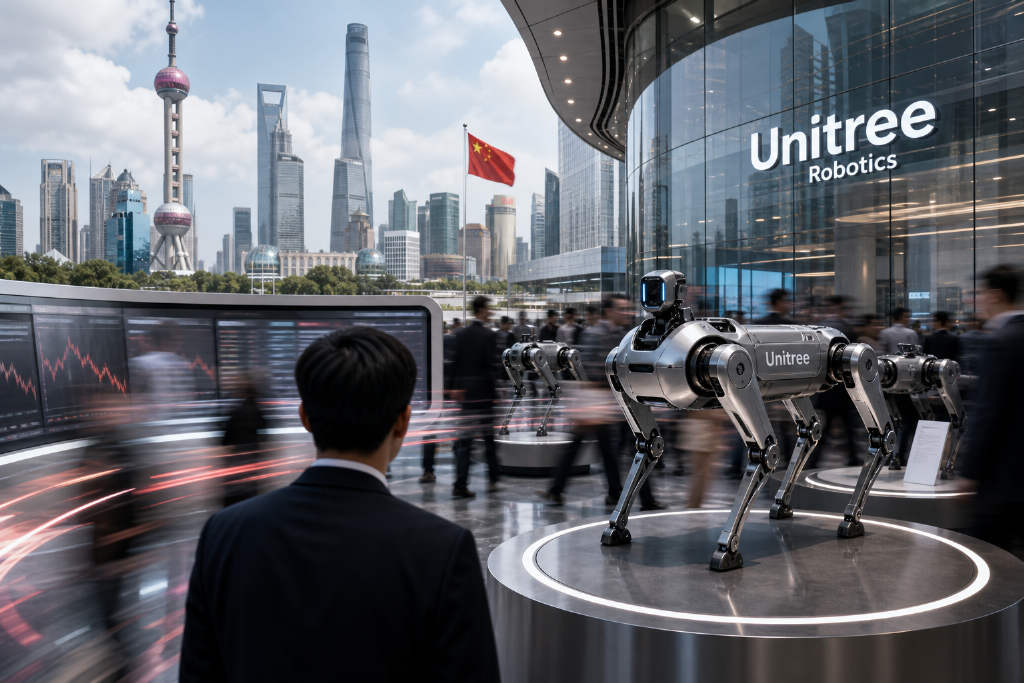
Unitree Technology listed on Shanghai’s STAR Market on Aug. 19, 2026, at RMB 150.80 a share, implying a post-offering valuation of about RMB 61 billion. On its first trading day, the stock climbed as high as RMB 1,100 intraday, briefly pushing market capitalization to roughly RMB 444.9 billion, and still finished the session at RMB 341.8 billion. The rally did not hold. The shares closed at RMB 687 on Aug. 20, RMB 672.41 on Aug. 21, and RMB 603.08 on Aug. 24, leaving the company with a market value of about RMB 243.9 billion.
That means Unitree gave back more than 45% from its intraday high in just four trading days, wiping out more than RMB 200 billion in market value, while still trading roughly 300% above its IPO price. Short-term price action may reflect limited float, sentiment and trading dynamics, but the tougher question sits behind the tape: why is a robotics company with about RMB 1.7 billion in revenue in 2025 and about RMB 1.152 billion in revenue in the first half of 2026 still valued at around RMB 243.9 billion after such a fast pullback?
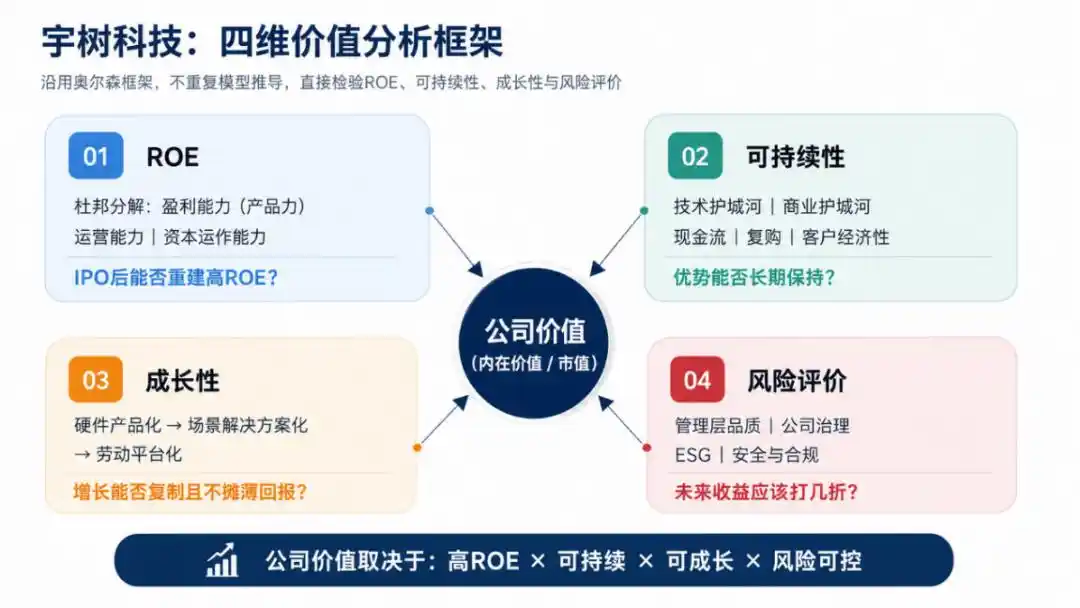
In the MarsBit article, CEIBS associate professor of accounting Zhang Feida uses the Ohlson residual income model to frame that question through four valuation dimensions: return on equity, durability, growth, and risk. In his formulation, enterprise value is not only about the book value a company has today. It also depends on whether the business can keep producing residual returns above its cost of capital.
Zhang contrasts Unitree with SpaceX, which he referenced in an earlier essay. SpaceX, in that comparison, has to show when heavy capital spending and current losses can turn into sustained cash flow. Unitree faces a different test. It is already profitable, but still small in scale. Now that it has more capital after listing, the issue is whether it can extend a phase of high returns into a longer period of high returns.
The article separates three judgments that investors often blur together: being technologically ahead is an industry judgment, being an excellent company is an operating judgment, and being a cheap stock is a price judgment. Those three can overlap, but they do not have to.
What Unitree Has Already Proven and What the Market Is Paying for in Advance
Zhang argues that Unitree is not a robotics company living on viral videos and little else.
In 2025, the company posted revenue of about RMB 1.699 billion, up 332.6% year on year. Net profit attributable to shareholders came to about RMB 278 million. Adjusted net profit attributable to shareholders, excluding non-recurring items, was about RMB 591 million. Net cash flow from operating activities reached about RMB 670 million. The article says adjusted profit exceeded reported attributable profit mainly because a one-off share-based compensation expense was booked under non-recurring items.
For a general-purpose robotics company still in a period of rapid technical iteration, Zhang says the combination of scale growth, profitability and positive operating cash flow is uncommon.
The listing document also included first-half 2026 figures. Revenue reached RMB 1.152 billion, up 48.54% from a year earlier. Attributable net profit was RMB 274 million. Adjusted net profit, however, came in at RMB 244 million, down 19.34% year on year, while net cash flow from operating activities fell 32.53% to RMB 232 million. Growth continued, but the quality of profits and cash conversion had already started to show pressure from higher R&D and selling expenses.
Unitree’s revenue expansion has not come only from expensive research prototypes, according to the article. The company used in-house core components, motion control and supply chain integration to turn quadruped and humanoid robots into products it could sell in volume. By 2025, humanoid robot shipments had exceeded 5,500 units. Zhang describes that as one of the hardest steps for a robotics startup: moving from making robots that work to making robots that sell.
But the price the market assigned goes far beyond a reward for that 2025 operating record.
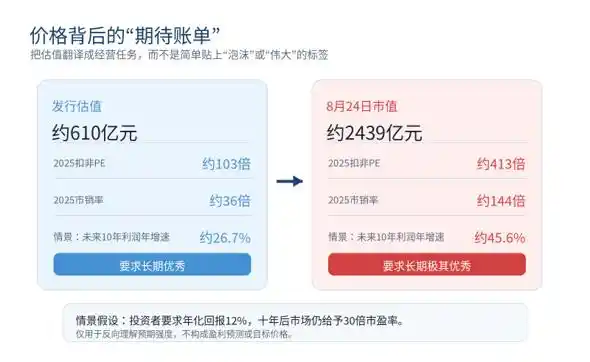
At the IPO valuation of about RMB 61 billion, Unitree traded at roughly 103 times 2025 adjusted net profit and about 36 times sales, using the article’s rough calculation. By the close on Aug. 24, when market capitalization stood at about RMB 243.9 billion, those multiples had expanded to about 413 times adjusted earnings and 144 times sales on the same basis.
In Zhang’s reading, investors are buying more than the roughly RMB 591 million in adjusted profit Unitree has already generated. They are buying an expectation of much larger commercialization: robots entering factories, warehouses, commercial services and homes; Unitree moving from a hardware maker toward an embodied intelligence platform; and today’s shipments in the thousands growing into deployments in the hundreds of thousands, or even millions.
The central issue, then, is how much of that RMB 243.9 billion valuation reflects reasonable expectations and how much depends on years of high-quality execution.
Four Lenses for Unitree’s Future Value
ROE: Can High Pre-IPO Returns Be Rebuilt After Listing?
In the Ohlson framework, ROE sits at the center of value creation because a company creates residual income only when ROE remains above the return shareholders require. Growth adds value only when fresh capital can also earn returns above the cost of capital. For Unitree, Zhang argues that a single headline ROE figure is not enough. He breaks it down with a DuPont approach into profit margin, asset turnover and equity multiplier, which map to profitability, operating efficiency and capital management.
On profitability, the article points first to product strength. In 2025, Unitree generated about RMB 1.699 billion in revenue, roughly RMB 591 million in adjusted profit attributable to shareholders, and about RMB 670 million in operating cash flow. More important than the headline numbers, Zhang writes, is that the company combined in-house core components, motion control, full-machine design and cost engineering to turn robots from expensive research prototypes into products that could be sold in batches.
For robotics companies, product strength does not mean charging the highest price possible. It means improving performance while lowering cost. Lower prices can expand installations, but if gross margin is to hold up, unit manufacturing costs have to fall faster or software, service and solution revenue has to offset pressure from cheaper hardware. Zhang says investors should track gross margin, unit manufacturing cost, R&D conversion efficiency and whether new products can keep a competitive price-performance profile.
First-half 2026 data sharpened that pressure test. Revenue still rose 48.54% year on year, but that was well below the 332.6% growth seen in 2025. During the same period, adjusted net profit dropped 19.34% and operating cash flow fell 32.53%. The company attributed the change to an expanded R&D team, new product development and higher selling expenses. For a newly listed high-growth company, Zhang says, the next step is not merely growing again. It is proving that additional R&D and selling investment can turn back into margin and cash flow.
Operating efficiency is the second piece. Before listing, Unitree benefited from a relatively light asset structure, fast product iteration and solid operating cash flow, according to the article. In robotics, operating ability is not limited to factory throughput. It stretches from project approval and product definition to procurement, production, delivery and customer payment, and the cycle has to remain short.
That becomes harder after the IPO. Proceeds will go to robot models, body R&D, new product development and manufacturing base construction. Fixed assets, inventories and R&D spending could all increase. If capacity expansion outruns real demand, or if new deployments depend heavily on manual customization, asset turnover could weaken. Zhang says the metrics worth watching include inventory turnover, accounts receivable, operating cash conversion, capacity utilization and deployment time in each application scenario.

The third piece is capital management. Zhang notes that Unitree’s high returns before listing were not mainly driven by financial leverage. The company previously had a relatively low debt ratio and limited short-term borrowing. As of June 30, 2026, attributable net assets stood at about RMB 2.88 billion, while net IPO proceeds were about RMB 5.917 billion, roughly 2.05 times that equity base.
That matters because new capital sharply raises the denominator in ROE at once, while profit does not rise by the same magnitude on day one. A temporary drop in post-IPO ROE is not surprising in that context. Zhang calls it almost mathematically inevitable. The real question is what return the new capital will ultimately earn.
Capital management, in this telling, is not mainly about whether the company uses more leverage. It is about sequencing R&D, manufacturing bases, new products and ecosystem investment; deciding which projects deserve more capital; and knowing where to stop. Only if the marginal return on new capital stays above the cost of capital does financing create value instead of simply enlarging the balance sheet.
The conclusion on ROE is straightforward: Unitree’s next phase of returns must be rebuilt through product margin, asset turnover and disciplined capital allocation, not through leverage. The IPO did not cap a period of high ROE. It reset the equity base from which ROE now has to be rebuilt.
Durability: Can the Moat Move From Performance to Labor?
A single year of high ROE does not support a rich valuation on its own. The more important question is how long those excess returns can last. Zhang frames that as a moat issue: can today’s technical edge still become profit and cash flow when competition intensifies, prices fall and the industry keeps changing?
Unitree’s clearest moat today is in motion control and full-stack engineering. Across quadruped and humanoid robots, the company has built capabilities in motors, reducers, joints, motion control, reinforcement learning, whole-body design and cost engineering. Their value is not limited to what a robot can do on video. They matter because they may let the company turn new movements, new models and new core components into products faster and at lower cost.
Zhang separates two forms of value. One is demonstration value: running, jumping, flipping or boxing to prove motion-control and engineering ability. The other is production value: working continuously in unfamiliar settings for hours or even thousands of hours, keeping task success rates stable, controlling maintenance costs, recovering quickly after faults and delivering a total customer cost lower than human labor or traditional automation. The first is better for attention and early orders. The second is what could bring repeat purchases, long-term contracts and scaled capital spending.
Two pieces of information dated Aug. 20 are used to show that gap. On one side, Unitree introduced its R1 biomimetic 7-axis dexterous robotic arm the day after listing, with a starting price of RMB 9,900 and target use cases in research and education, material sorting and assembly, and service robot exploration. Zhang treats that as evidence that hardware productization and cost reduction are still moving quickly. On the other side, founder Wang Xingxing said at the 2026 World Robot Conference that the biggest bottleneck to large-scale robot deployment in factories and homes is still insufficient efficiency and insufficient embodied intelligence generalization, with new tasks often requiring retraining.
The first point suggests stronger ability to build products and sell them more cheaply. The second warns that a more difficult threshold remains: reliable labor substitution.
Commercial moat, in Zhang’s argument, has to go beyond technical moat. Industrial customers care whether a robot can operate stably for eight straight hours, whether deployment takes weeks or months, who handles maintenance after failures, whether a new setting requires customization again, and how much total cost the customer actually saves. Only when reliability, delivery, after-sales support, data and customer economics form barriers together can technical leadership become sustainable ROE.

Even the technical barrier needs constant maintenance. The prospectus, the article notes, warns that the company’s relatively small patent count may make it harder in some cases to defend core technology rights and prevent imitation. In a robotics sector that changes quickly, Zhang argues, the moat is more likely to come from a dynamic capability set: ongoing R&D and iteration, cost engineering, supply chain execution, real-world data and organizational learning, rather than from any single static patent.
The conclusion here is one of the sharpest lines in the piece: what is easiest to price on the first day of listing is movement; what is hardest to deliver over the next decade is labor. Unitree’s durability depends on whether it can convert motion-control strength into stable labor capability that drives repeat purchases and recurring cash flow.
Growth: Is Unitree Selling More Robots or More Productivity?
Within a residual income framework, growth does not create value by itself. It matters only if new investment still earns more than the cost of capital. For Unitree, Zhang says, the key issue is not how large the robot industry may become in the abstract. It is whether the company can maintain high returns while scaling.
Right now, Unitree’s revenue still comes mainly from hardware. Hardware can become a large business, but hardware companies usually face valuation limits tied to price declines, manufacturing costs, inventory, after-sales obligations and competition. How high the long-term valuation ceiling can go depends, in Zhang’s view, on whether Unitree can complete three upgrades.
The first is hardware productization: turning robots from research prototypes into standardized products and expanding the market through volume, lower costs and rapid iteration. Zhang says Unitree has already crossed that stage relatively well.
The second is scenario-based solution delivery. Customers would no longer be buying only a robot body. They would be buying a package that includes the robot, end effectors, model training, on-site deployment, software updates and maintenance services. Revenue would shift from one-off hardware sales toward a mix of hardware, projects and services.
The third is a labor platform. Developers and industry clients would be able to build tasks on the same body, interfaces, models and data ecosystem. New scenarios would not require starting from scratch every time. More installations would generate more real-world data, and that data would improve model generalization and task success rates.
The article describes the potential loop like this: more installations lead to more data; more data leads to stronger models; stronger models raise success rates; higher success rates open more scenarios and repeat purchases.
If that loop takes shape, Unitree’s growth story becomes larger than annual shipments. If every new use case still needs heavy customization, on-site engineers and after-sales staffing, scale can make the business more complicated rather than more efficient. Revenue may continue to rise in that case, but margins, asset turnover and cash flow may not improve with it. That kind of growth can lift sales without necessarily increasing residual income.
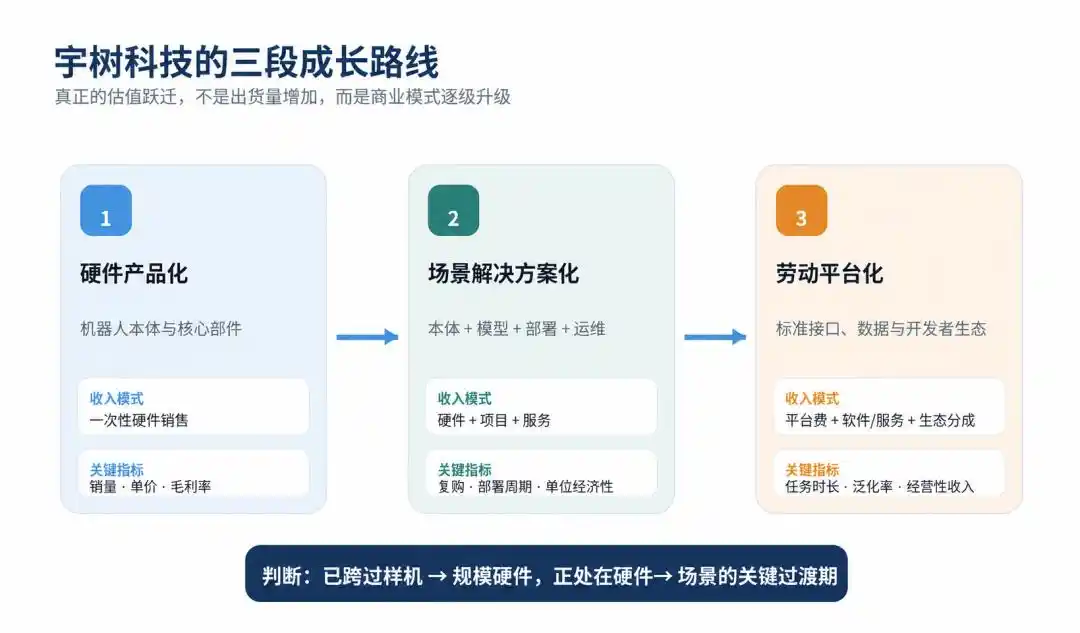
As a result, Zhang says the metrics to watch are no longer just shipment volume. They include repeat purchases by the same customer, the share of software and service revenue, whether deployment cycles in each scenario are getting shorter, whether actual robot operating hours are increasing, and how much total robot cost a customer must bear to save one unit of labor cost.
The financial takeaway is that the quality of Unitree’s growth will not be decided by how many robots it ships alone. It will be decided by whether each delivered unit turns into repeatable, scalable and continuously monetizable productivity without diluting capital returns.
Risk: Why Similar Future Earnings Deserve Different Discounts
In the Ohlson model, risk ends up in the return shareholders demand, which is to say the discount rate. The less certain future earnings are, the more compensation investors ask for, and the less they are willing to pay today.
For a founder-led hard-tech company like Unitree, Zhang says risk should be viewed through at least three areas: management quality, corporate governance and ESG.
On management, the prospectus shows that Wang Xingxing serves as chairman, general manager and chief technology officer, and is also one of the company’s core technical staff. He has more than 15 years of robotics R&D experience. That combination of founder, technical leader and operating leader has been a major organizational asset behind Unitree’s fast decisions and continuous iteration, according to the article.
But public listing changes management’s job. The company now has to do more than build robots and sell them. It has to allocate billions of yuan in new capital, manage manufacturing bases, build talent pipelines, handle investor expectations and respond to more complex global operating risks. Zhang says investors should focus on management’s long-term commitment, capital-allocation discipline, ability to cut losses on failed projects, candor in disclosure and success in building a second layer of leadership that does not depend entirely on one founder.
Governance raises another set of questions. Unitree uses a weighted voting rights structure in which Wang’s Class A special voting shares carry 10 votes per share, while ordinary Class B shares carry one vote per share. At the same time, he also serves as chairman, general manager and CTO. The benefit of that setup, Zhang writes, is a shorter decision chain and a greater ability for the founder to stick with a long-term technical roadmap without being pushed around by near-term market mood. The trade-off is that independent board oversight, constraints on related-party transactions, major capital-allocation decisions, minority shareholder protection and succession planning all become more important.
The company has already used employee shareholding platforms to establish medium- and long-term incentives, which the article says helps stabilize core talent. The bigger question is whether decision-making can rely more on institutional processes as the company grows and whether major decisions will face enough professional checks and balances.
On ESG, the article says the bigger issues for general-purpose robotics may not lie in traditional environmental risk at the factory level. Unitree mainly uses assembly-based production and is not classified as a heavy-polluting industry. The prospectus says the company had no environmental compliance violations during the reporting period and no workplace safety accidents. That suggests conventional manufacturing-related environmental and safety risks are relatively controllable for now.
Future ESG exposure could come from actual use scenarios instead: physical safety when robots work alongside people, data security and privacy questions tied to cameras and sensors, cybersecurity, supply chain and overseas compliance, and the impact of automation on employment and liability boundaries. Once robots move into factories, commercial spaces and homes, those issues can become recall costs, insurance costs, litigation exposure, compliance burdens, reputational pressure and higher customer adoption costs.
Overseas compliance risk has already become more concrete. In July 2026, the U.S. Federal Communications Commission placed newly produced foreign-made advanced humanoid and quadruped robots under tighter equipment certification restrictions. Unitree disclosed that major models now on sale and already certified by the FCC are not currently affected, but future new models could face the risk of being unable to sell in the U.S. The company also said overseas revenue accounted for more than 40% of total revenue in each of the past three years, and the U.S. market contributed about 13.30% of revenue in 2025.
That means overseas regulation and geopolitical risk can directly affect Unitree’s growth path and eventually feed into the risk premium embedded in valuation.
Zhang’s conclusion on this dimension is that Wang may be Unitree’s most important organizational asset, while also being a key-person risk that belongs in the discount rate. Concentrated control can support execution speed, but it also requires stronger institutional checks. Risk assessment is not about labeling the company. It is about deciding how heavily future earnings should be discounted.
How Much of the Future Is Already Priced Into RMB 243.9 Billion?
The last major step in the article is to separate business quality from price. The first four dimensions address the company’s internal quality. Price answers a different question: how much safety margin is left for investors at current levels?
At a market capitalization of about RMB 243.9 billion on Aug. 24, Unitree was trading at around 413 times 2025 adjusted net profit and about 144 times sales. Compared with RMB 277.9 billion on Aug. 20, the market had already marked down some expectations. Even so, Zhang argues, that valuation still assumes that Unitree can keep growing quickly, rebuild ROE after IPO dilution, maintain its moat, scale growth in a repeatable way and avoid major mistakes in management and governance.
To illustrate how demanding market expectations are, the article offers a scenario analysis rather than a forecast. Assume investors require a 12% annualized return and the market is still willing to value Unitree at 30 times earnings 10 years from now.
- At the IPO valuation of about RMB 61 billion, net profit 10 years later would need to reach about RMB 6.3 billion, implying roughly 26.7% annual growth from the 2025 adjusted profit base of about RMB 591 million.
- At the Aug. 24 valuation of about RMB 243.9 billion, net profit 10 years later would need to reach about RMB 25.3 billion, implying annual growth of about 45.6% over the next decade.
Zhang stresses that these are not earnings forecasts and not target prices. They are a translation of price into operating requirements. The IPO valuation implied the need for years of solid execution. The Aug. 24 valuation, even after a large retreat from the first-day peak, still requires Unitree to sustain high ROE for a long period, preserve its moat, maintain rapid growth and keep risk under control.
Another point in the article concerns tradable float. In Unitree’s early post-listing phase, unrestricted circulating shares accounted for only about 7.44% of total shares after the offering. In a market with intense attention and limited tradable supply, pricing in the first few sessions is shaped by fundamentals, scarcity and trading sentiment at the same time. For that reason, Zhang says short-term market cap can be useful as a heat gauge, but should not automatically be treated as a settled long-term fair value.
A rich valuation does not cancel out the possibility that Unitree is an excellent company. It does, however, reduce the room for error. A one-year product delay, a few percentage points less in gross margin, lower asset turnover, a capital-allocation mistake or greater governance risk can all have outsized effects on long-term value when expectations are already high.
The conclusion is that the four-dimensional framework helps answer how far the company may go. Price determines how much safety margin investors still have. The issue at RMB 243.9 billion is not whether Unitree is good enough. It is whether the market has already counted too much future excellence into today’s share price.
Zhang’s Bottom Line: A Good Company and a Good Price Are Separate Questions
Zhang closes by separating the company, the industry and the stock price.
On the company itself, he writes that Unitree has already shown an initial ability to commercialize products and use capital efficiently, but must rebuild high returns after the IPO. Its motion-control edge is strong, but the commercial moat still needs proof through stable work performance, repeat purchases and cash flow. Its long-term upside depends on moving from hardware to scenarios and then to a labor platform. Founder-led execution is a source of efficiency, but a more mature governance and ESG system is still needed to lower the discount rate investors apply.
On the industry, Zhang says the odds are high that this is a good one. Demographics, labor costs, the substitution of dangerous work, progress in AI models and falling robot hardware costs all support long-term demand.
He cites Reuters, which reported industry data showing that China delivered more than 40,000 humanoid robots in the first half of 2026, accounting for the clear majority of global deliveries. Yet at the same World Robot Conference, Wang Xingxing also said that robots’ efficiency and generalization in real-world scenarios still fall short of what large-scale adoption requires. In other words, fast industry growth and incomplete commercialization can both be true at the same time. A large market does not mean every company will succeed, and it does not mean commercialization will move in a straight line.
On price, Zhang says the RMB 243.9 billion valuation is no longer just a reward for what Unitree has already done right. It is an advance payment on what the company might achieve over the next decade. The stock has cooled noticeably from its first-day extreme, but the market’s recognition of the company remains very high and the margin for execution error still looks thin.
He says he is more inclined to view Unitree as an excellent hard-tech company with real technology, real products, real revenue and real cash flow. It is now at a critical stage where product strength must turn into high-quality capital returns, but the market price is already setting a demanding bar for the future.
The article also highlights five areas worth following more closely than day-to-day share moves: whether gross margin, asset turnover and capital allocation can help ROE recover after IPO dilution; whether humanoid robots can move from research, demonstrations and data collection into sustained industrial and commercial work with repeat purchases; whether software, services, solutions and a developer ecosystem can make revenue more repeatable so growth shifts from selling hardware to selling productivity; whether management capital allocation, weighted voting governance and product-safety and ESG risks will raise the discount rate applied to future earnings; and whether profit growth can catch up fast enough with the expectations already embedded in market value.
Zhang writes that investing in Unitree is not a purchase of a single backflip, nor only of the embodied intelligence theme. It is a judgment on whether the company can use product strength to keep producing high ROE, turn technical advantages into a durable moat, convert scenario expansion into high-quality growth, and let future residual income ultimately accrue to shareholders while keeping management, governance and ESG risks under control.
The article was originally published by the WeChat account of China Europe International Business School, identified as CEIBS6688, and written by Zhang Feida.