
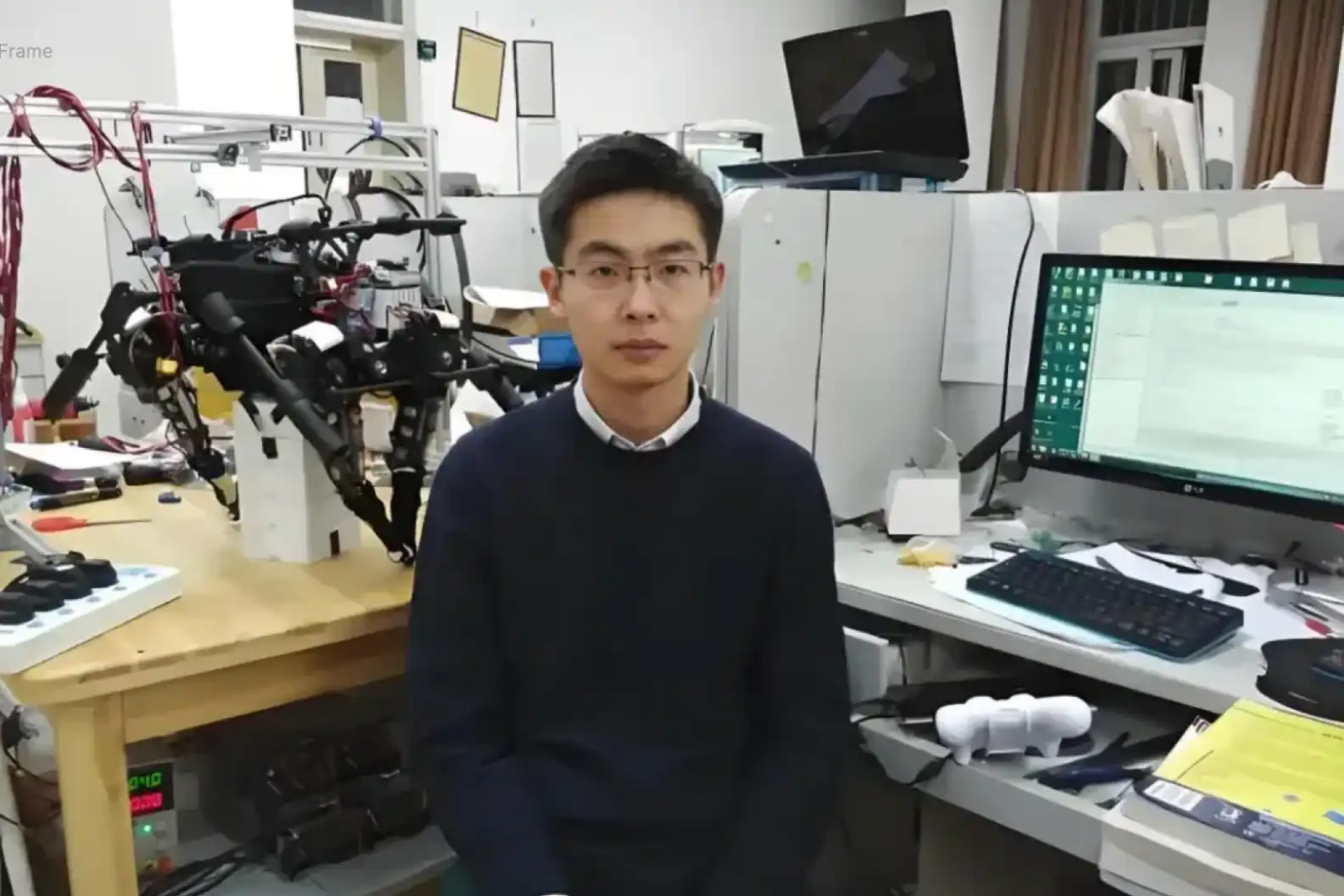
Unitree Robotics has opened subscription for its STAR Market listing at RMB 150.80 per share, giving the company a post-offering valuation of about RMB 61 billion. Based on the figures cited in the source, founder Wang Xingxing directly and indirectly controls 33.36% of the company, worth about RMB 20 billion at that valuation.
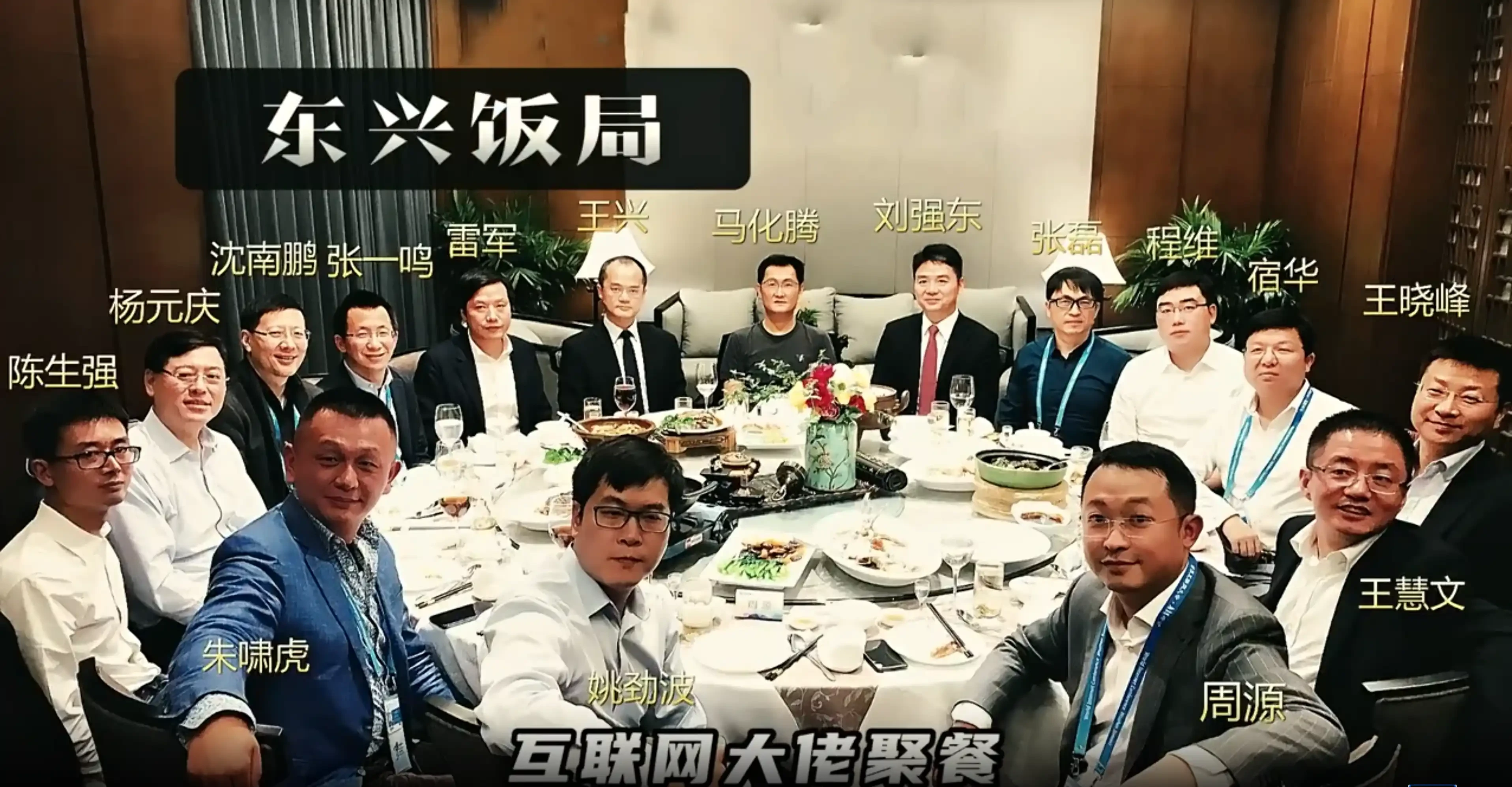
That outcome would have been hard to picture back in December 2017 at the Wuzhen internet conference. The best-known image from that event was the so-called "Dongxing dinner," a group photo built around a table of leading Chinese internet executives brought together by Liu Qiangdong and Wang Xing. Media at the time often described the combined wealth tied to the entrepreneurs and their companies at that table as roughly RMB 700 billion. Soon after, competition inside China’s internet sector intensified, and the gathering later came to be seen as a snapshot near the top of an earlier cycle.
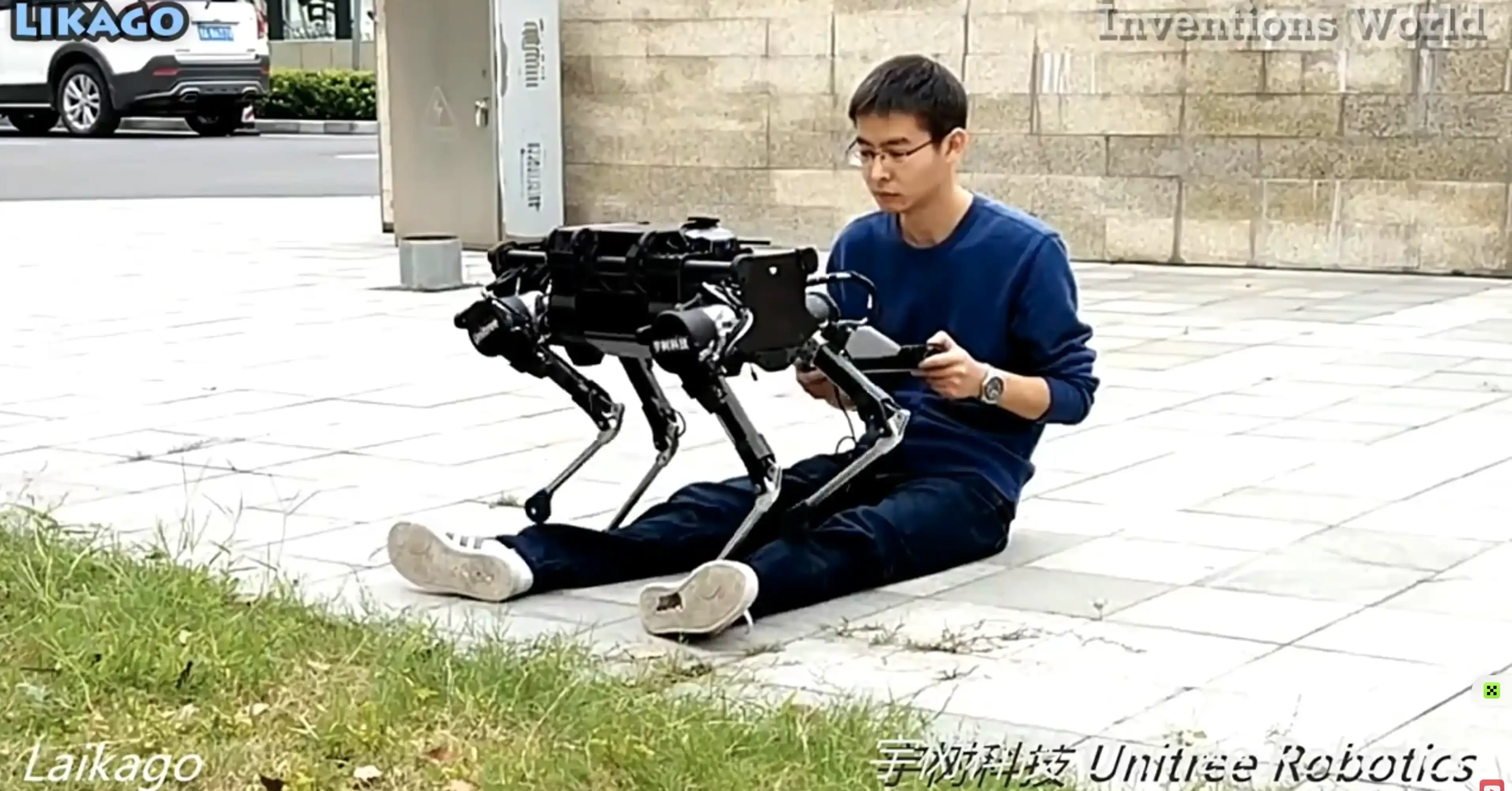
On the same day, at a smaller tea gathering outside the main venue, Wang Xingxing also appeared. The event was organized by GeekPark founder Zhang Peng. Few people knew Wang then, and some online attention came simply because his name resembled Wang Xing’s. Zhang later recalled that Wang could not even get into the formal conference venue at the time. He invited him so senior attendees could look at the robot dog he had built. When Wang finally demonstrated Unitree’s first robot dog, Laikago, the machine froze while trying to get over a threshold. He spent a long time rebooting it.
Zhang said Wang was shy then and seemed not to add the executives on WeChat. Unitree had just passed its first anniversary, and less than half of the company’s cash remained. Years later, that awkward appearance would look like an early marker of a different technology cycle.
Early years and a humanoid robot built for RMB 200
Wang was born in March 1990 in Yuyao, Zhejiang, into an ordinary family. He later said he was not the kind of top student many imagined, and singled out English as a weakness. In his own account, he passed English only three times during three years of high school and went through periods of self-doubt and anxiety.
At the same time, he spent much of his spare time building things. At age 10, he made a wind-powered toy car from discarded cardboard. At 15, he used scrap metal to build a small engine and aircraft model components.
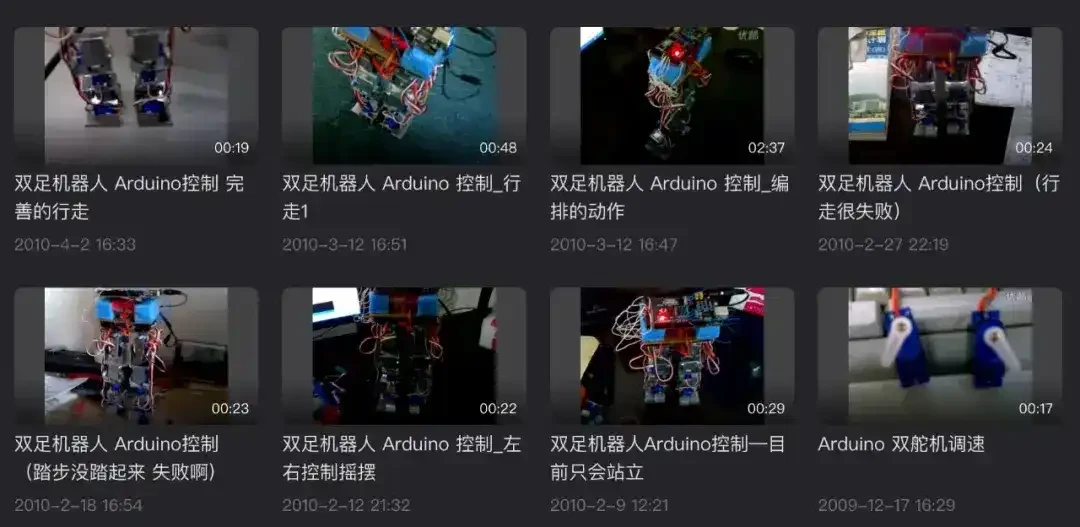
In 2009, Wang entered Zhejiang Sci-Tech University to study mechatronics. He later said attending a non-elite university made him feel inferior for a period. That winter he first encountered microcontrollers and bought an Arduino board with his pocket money for a few dozen yuan. During the winter break, he bought more than ten 9-gram servos and started building a biped robot.
He lacked almost everything. Without equipment, he used a hand drill, files and scissors. Without funding, he bought RMB 9 parts and picked up leftover scraps others did not want. Without polishing machinery, he ground parts manually on the floor until his hands turned rough. In the end he built a 14-degree-of-freedom humanoid robot that could barely walk and perform a few simple actions, all for a total cost of RMB 200. The following summer, he spent another RMB 300 to build a force-feedback glove and dexterous hand, along with 3D virtual reality interaction software. The work was still done by hand, from drawing to cutting and polishing, without electric tools.
XDog and an electric-drive path that cost less than RMB 20,000
When Wang took graduate school exams in his senior year, his first choice was mechanical engineering at Zhejiang University. His total score cleared the line, but his English score did not meet Zhejiang University’s subject threshold, and he was assigned to Shanghai University instead. Later, internet users even joked about the company name Unitree, saying it reflected being good at math and Chinese but weak in foreign language study.
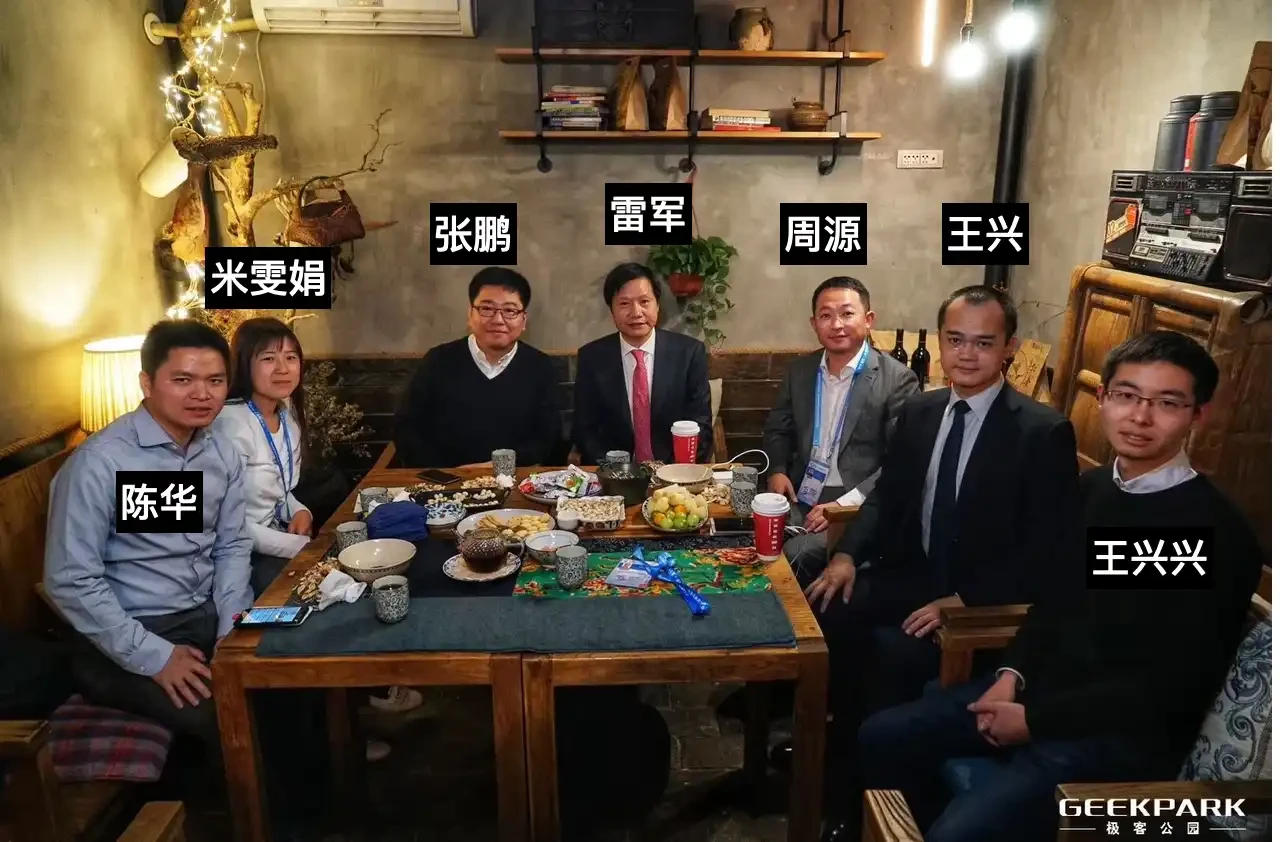
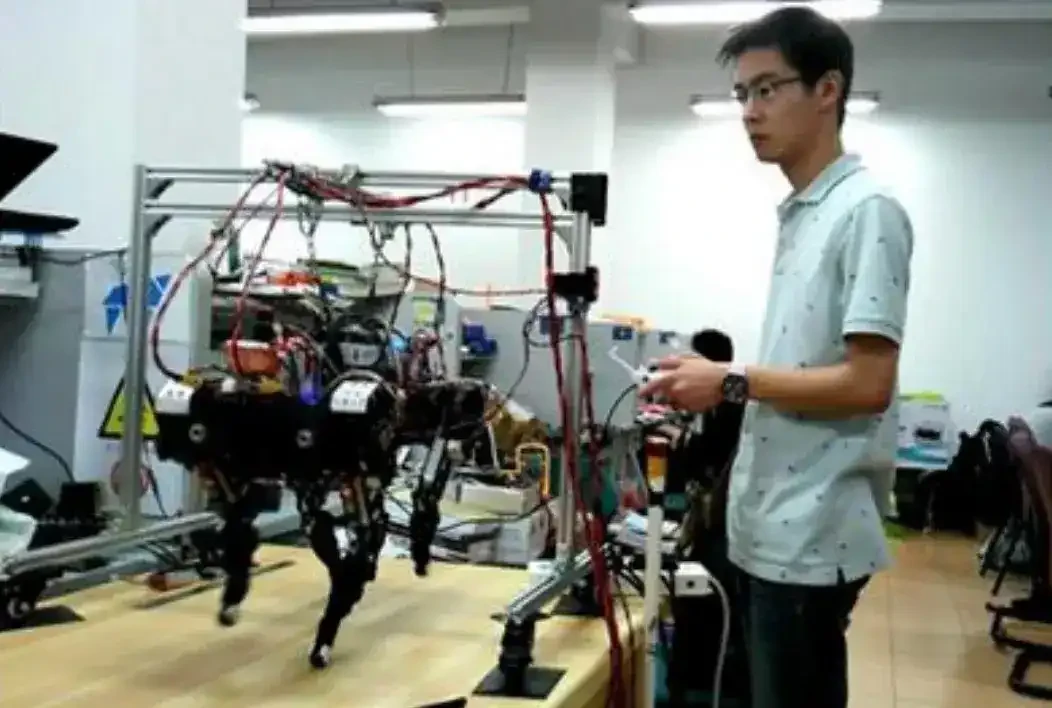
During his first graduate year, Wang built a high-dynamic robotic leg. His adviser Jia Wenchuan gave him RMB 10,000 to RMB 20,000 in research funds, and Wang turned that into XDog.
At the time, Boston Dynamics dominated discussion of high-performance quadruped robots. The usual image was hydraulic drive, large size, loud noise and very high cost, with many orders tied to military and government clients. Wang chose a different route. He used a direct-drive solution based on an outer-rotor brushless motor of his own design, keeping the whole machine under RMB 20,000. He made the electric-drive approach public in 2015, about a year before Boston Dynamics shifted toward electric drive, according to the source.
Late in 2015, he saw a quadruped robot article on IEEE Spectrum and posted the YouTube link to his XDog video in the comments.
After graduate school, Wang went to DJI as an intern. During that period, the XDog video he had uploaded to YouTube started gaining traction, and a number of investors contacted him and encouraged him to launch a company. He left DJI after two or three months.
The first RMB 2 million arrived before the paperwork
After leaving DJI, Wang spent a month in Shenzhen focused on fundraising. He later described it as the most anxious month of his life. He had investment interest, but the money had not yet arrived. The founding team had only three or four people, and the company had not even been registered.
The first money came at that point. In November 2016, Yin Fangming invested RMB 2 million as an individual and acquired 15% of Unitree, implying a post-money valuation of RMB 13.33 million. Yin had worked as a product manager and product director at MediaTek, Sohu and Qihoo 360, and in 2014 co-founded an early-stage fund focused on smart hardware.
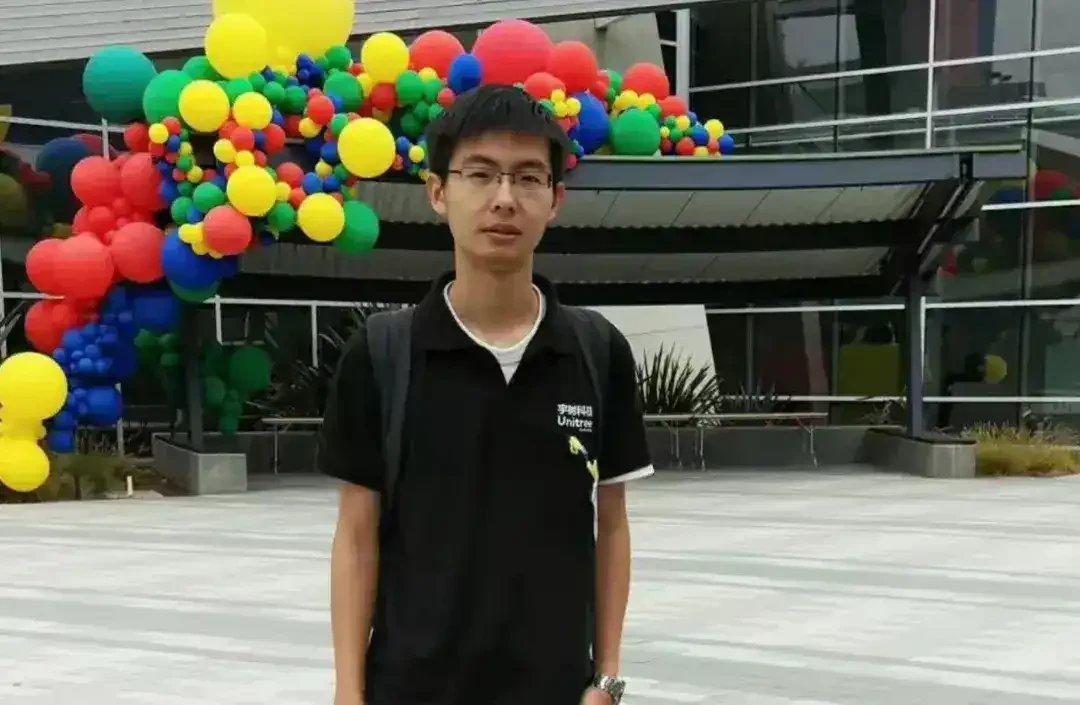
Wang later told LatePost about that investment: 「He approached me first. The terms he offered were very broad. He wired the money before we even signed an agreement.」
Corporate records cited in the source show that in April 2018, Yin transferred part of his stake to Shenzhen Anchuang Technology for RMB 1.3105 million. In August 2020, he transferred the remaining registered capital to Tianjin Junwan Hongyi and formally left Unitree’s shareholder roster. Even so, his name still appeared among the contributors behind that vehicle, and the source says his look-through interest remained about 16.62%.
Junwan Hongyi is still Unitree’s tenth-largest shareholder, holding about 11.17 million shares. Based on the offering price, that stake is worth about RMB 1.684 billion, and Yin’s corresponding portion is about RMB 280 million.
Laikago, a garage-style office in Binjiang, and an emergency investment
Wuzhen in 2017 carried a strong Tencent imprint. Two years later, in July 2019, Dexun Investment, founded by Tencent co-founder Zeng Liqing, bought 4% of Unitree for RMB 4 million.
For Unitree, though, the smaller 2017 tea session mattered more. Wang’s performance that day did not stand out, but Lei Jun noticed him. Years later, Shunwei Capital led Unitree’s Series A round in July 2021 and stayed with the company in the following Series B. Wang Xing, seated beside him at that earlier gathering, would later help make Meituan-related capital one of Unitree’s largest external industrial shareholders in February 2024.
The person who put Wang in front of Lei Jun and Wang Xing was Zhang Peng.
In September 2017, Unitree introduced Laikago, named after Laika, the first dog in space. It was no longer just a graduate-school prototype. It was the company’s first commercial quadruped product aimed at real customers, which meant joints, power supply, controls and reliability all had to move from demo-level performance to deliverable hardware.
Zhang came across Laikago that year through an obscure WeChat article, a few photos and short videos. Earlier, he had taken Chinese founders to MIT and seen the laboratory "robot cheetah," a large machine covered with cables and exposed wiring. Seeing a Chinese team build a robot dog that was smaller and closer to a product left him shocked, according to the source.
He flew to Hangzhou and found Wang in an unremarkable building in Binjiang district. Zhang recalled there was no obvious street number, the place looked partly industrial, and once inside it felt less like a standard office than a garage filled with parts and unfinished robot dogs, along with two completed machines. Wang ran a few demonstrations, including one where the robot stayed upright after being kicked. When the demo ended, the two had nowhere to sit and spent two or three hours talking on a sofa in the corridor outside the office.
Zhang later said Wang looked like a newly graduated student and a typical engineering man, but his technical talent was obvious once you spoke with him. Variable Capital soon became Unitree’s first institutional investor.
Zhang believed the company’s reasonable funding need at the time was about RMB 15 million to RMB 20 million, but Variable Capital was too small to lead and could only follow. The lead investor originally under discussion dropped out. At the same time, Laikago demanded heavy R&D spending, and the initial RMB 2 million Wang had raised was nearly gone. At one point, the company almost could not pay salaries.
To help Wang through that stretch, Zhang decided to wire the investment money first. He said: 「We really had no time to hesitate. Wang Xingxing had already run out of money. If you hesitate for another month, the company might be gone.」
Shipments, funding rounds and growing demand from labs
After getting through that period, Laikago began shipping in the second half of 2018 and sold several hundred units globally. Fundraising became somewhat easier after that.
According to the public corporate history and investor disclosures cited in the source, Variable Capital entered Unitree through Jisi Investment in 2018. In 2019, Dexun invested, and Ningbo Sequoia joined a capital increase at year-end. In 2020, Sequoia increased its investment again, while Vertex and Chuxin Capital came in.
Tian Jiangchuan of Chuxin Capital later said in an internal review that she first met Wang in 2017 at Shanghai Hongqiao railway station, but hesitated because he came from Shanghai University and a grassroots background, which she felt did not match industry demand or the fund’s preference. In 2019, after hearing from Nanjing University professor Yu Yang that many AI labs were buying Unitree products and that supply was so tight that buyers struggled to get a robot dog, Chuxin completed its pre-A investment in early 2020.
In 2021, Shunwei led Unitree’s Series A. In 2022, the company completed its Series B. Public reports cited in the source say Matrix Partners China and Dunhong Asset led that round, with Hexagon, Shunwei, Rongyi and Shenzhen Capital Group among the follow-on investors.
Large inflows from 2024 and a bigger public profile through the Spring Festival Gala
The real surge of capital came in 2024. On Jan. 31, a capital increase totaling about RMB 600.34 million brought in Meituan-linked Hanhai Information, Jinshi Growth, Source Code Capital, Xinjiang Shenzhen Capital Group and China Internet Investment Fund, among others. Another capital increase on Aug. 31, worth about RMB 284.71 million, added the Beijing Robotics Industry Development Fund and Zhongguancun Science City. That marked the first time state-backed capital became a direct shareholder in Unitree.
The entry of state-backed funds gave Unitree a clearer identity in the source’s words as an embodied-intelligence industrial asset.
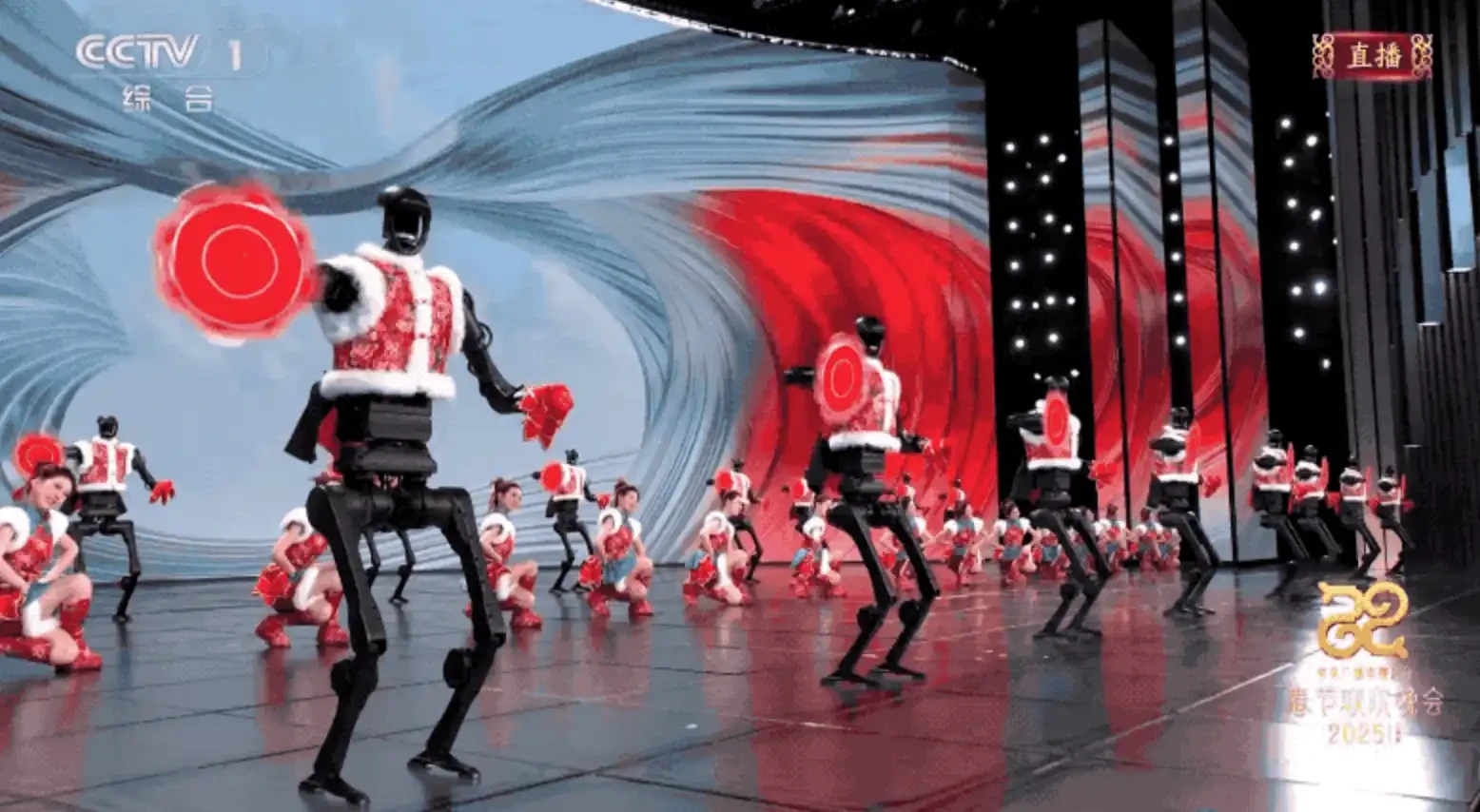
After that, Unitree’s robots appeared in Zhang Yimou-directed programming on China Central Television’s Spring Festival Gala, in the eighth performance titled "Yang BOT." Sixteen H1 robots wore red floral jackets, held red handkerchiefs, danced yangko, changed formations and twirled the handkerchiefs from different angles. Related discussion reached a cumulative 3.2 billion views or interactions, according to the source.
Huang Jiawei from Unitree’s marketing department said the company had already appeared on the 2021 Year of the Ox Spring Festival Gala and had stayed in close contact with relevant CCTV staff afterward. He said CCTV reached out again three to four months in advance. The team had previously spoken publicly about months of intensive rehearsals, tuning and choreography for the show.
The financial effect also showed up in the prospectus. Unitree said its domestic revenue share rose to 56.35% in 2025, and the company explicitly listed the nationwide visibility generated by the gala performance earlier that year as one reason. Main business revenue for the year was about RMB 1.676 billion, including roughly RMB 868 million from humanoid robots. Unitree shipped more than 5,500 humanoid robots in 2025.
Front-row seating, faster financing and the IPO clock
At a private-enterprise symposium in February 2025, a widely circulated photo showed 14 entrepreneurs in the front row, with Ren Zhengfei in the middle and Jack Ma second from the left. Lei Jun and Liang Wenfeng were also there.
Wang sat in the front row. He was the only person born in the 1990s at the event and one of six entrepreneur representatives who spoke. Meituan founder Wang Xing sat several rows behind him.
Unitree’s pace accelerated sharply over the following one to two years. On June 6, another capital increase totaling about RMB 694.50 million brought in China Mobile Innovation Industry Fund, Tencent Technology, ByteDance-linked Wuxi Jinqiu, Alibaba-linked Hangzhou Haoyue and Shanghai Yunyang. Tencent then became a direct shareholder in Unitree. In September, Wang was named to Time magazine’s 2025 list of the world’s 100 most influential people in AI. On Nov. 15, Unitree completed IPO tutoring, and the listing process moved into a formal stage.
Wang’s public persona changed too. In earlier years he used Zhihu and Bilibili to explain old projects and occasionally showed followers his early glove, dexterous hand and robot prototypes. He once posted a video saying that a single day of commercial filming paid him the equivalent of half a year of his personal salary. That was an engineer reacting to his first meaningful personal commercial income. Now, the source says, sweatshirts have given way to shirts and suits, posting frequency has fallen, and when he does post, the content is mostly product promotion rather than personal reflection.
On Lunar New Year’s Eve, Feb. 16, 2026, Unitree appeared on the Spring Festival Gala for the third time. Twenty-five robots performed with students from Henan Tagou Martial Arts School. They staged drunken boxing, nunchaku moves and sword routines. G1 handled most of the demanding group choreography, while the larger H2 closed the show in the role of a sword master. At 10 p.m. that night, JD.com listed several robots, including models promoted as the same ones seen on the gala, and they sold out within minutes.
One month later, on March 20, Unitree’s STAR Market application was accepted. It passed review on June 1, only 73 days after acceptance. In July, Wang and Unitree’s piloted mech GD01 appeared on the cover of Time. On Aug. 6, the company fixed its STAR Market price at RMB 150.80, and subscription opened on Aug. 10. DeepSeek appeared on the strategic placement list, receiving about 933,390 shares worth roughly RMB 140.76 million, subject to a 36-month lockup.
Return to Wuzhen and a 17,900-fold rise in valuation over nine years
The busy Wuzhen conference in 2017 was Wang Xingxing’s first appearance before a broad public audience. Eight years later he returned to Wuzhen. The conference was quieter than before, but among 28 large and small forums during the summit, the one featuring Wang drew the biggest audience, according to the source.
Organizers set up a special session called "Wuzhen Dialogue of the Six Little Dragons," chaired by Wang Jian, academician of the Chinese Academy of Engineering and founder of Alibaba Cloud. On stage with Wang were Han Bicong of BrainCo, Huang Xiaohuang of Manycore Tech, Zhu Qiuguo of DEEP Robotics, Feng Ji of Game Science and Chen Deli, senior researcher at DeepSeek.
Speaking first, Wang said he had strong feelings for Wuzhen, saying: 「From attending the summit as a member of the audience in 2017 to sitting on stage today to share my experience.」
Around the time of his first visit, Unitree had just received angel money at a valuation of about RMB 13.33 million. Now, the company’s STAR Market issue price is RMB 150.80 and its post-offering valuation is about RMB 61 billion. The source also says an offshore over-the-counter platform quoted Unitree’s pre-IPO shares at RMB 590, implying a market value of about RMB 238.7 billion. On that basis, successful IPO subscribers could make as much as RMB 220,000.
Using that comparison, the source calculates that Unitree’s valuation increased about 17,900 times over nine years.
Set against the 2017 "Dongxing dinner" image, the time gap becomes sharper. Media often put the combined wealth tied to the entrepreneurs and internet companies at that table at about RMB 700 billion. If Unitree were valued at RMB 238.7 billion, Wang’s post-offering 30.02% stake would be worth about RMB 71.7 billion. That would equal roughly one-tenth of the value often associated with that entire table back then.
Wang once said: 「Each generation of young people has its own opportunities.」 From being unable to enter the main conference venue in 2017 to taking a seat on stage in Wuzhen and then arriving at a STAR Market subscription window, his path and Unitree’s have become part of the same shift.