


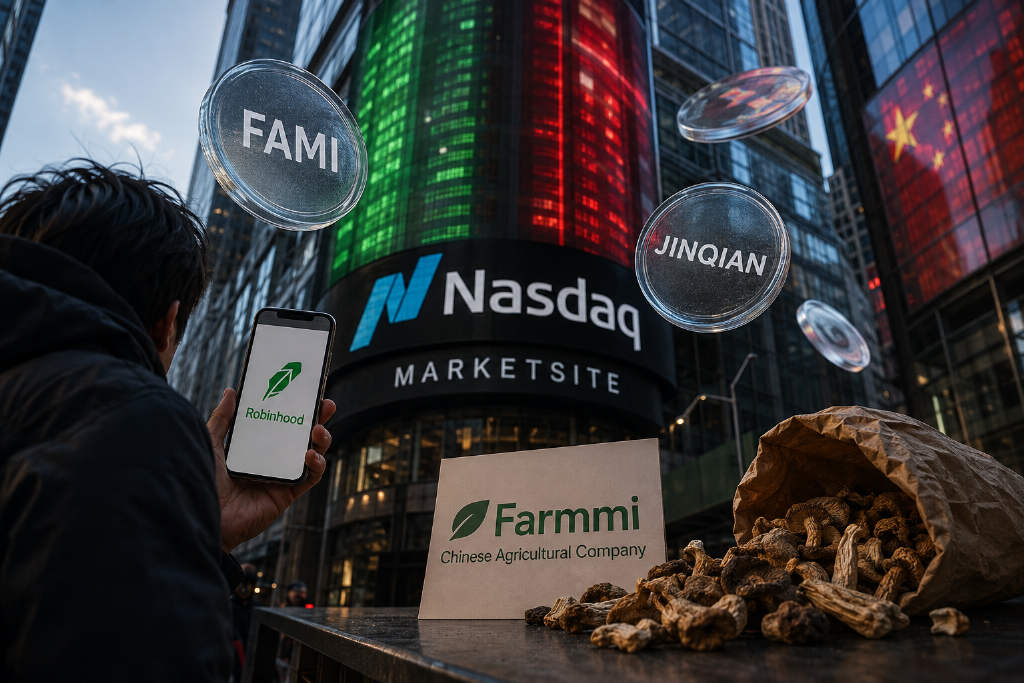
Farmmi (NASDAQ: FAMI) briefly surged from $0.12 to $0.50 on Sept. 2, a move of about 350%, with trading volume reaching 720 million shares, nearly 90 times its daily average. The China-based agricultural microcap, which sells edible dried mushrooms and has 15 full-time employees, became one of the most volatile names in the U.S. stock market that day.
The rally faded quickly. Shares fell back to about $0.18 within hours, completing a sharp boom-and-bust cycle in a single session.
The spark came from Robinhood Chain, but not from an official stock token
The trigger was a trading pair on Robinhood Chain: a meme coin called JINQIAN paired with an onchain asset using the ticker FAMI. According to GMGN data, JINQIAN reached an implied valuation of about $60 million at its peak, roughly 10 times Farmmi’s market capitalization at the time.
One point was heavily overlooked as the story spread: the FAMI token onchain was not an official Robinhood-issued stock token.
Official and unofficial tokens follow different mechanics
On Robinhood Chain, Artificial Inu (AI) trades against tokenized NVDA, while Memory Cow Moo (MOO) trades against tokenized MU. Those meme-coin pairs depend on a specific setup: the stock token is officially issued by Robinhood and backed 1:1 by real U.S. shares.
Under that structure, if onchain trading pushes up demand for the stock token, the issuer has to buy an equivalent amount of the underlying stock to mint new tokens. That creates a direct path from onchain demand to real equity buying.
The FAMI token in the JINQIAN/FAMI pair had none of that. It was an independently issued onchain asset that borrowed Farmmi’s ticker, with no mint or redemption channel, no real-stock backing, and no arbitrage link to Nasdaq.
Onchain analyst riley_gmi said on X that FAMI was not included on Robinhood’s official stock-token list.
The contrast is simple:
- Official stock-linked meme pairs: onchain demand → token minting → real-share purchases → actual buying pressure in equities.
- JINQIAN/FAMI: onchain hype → social media spread → traders assume a stock mapping exists → brokerage orders hit the real stock → the stock spike reinforces the meme narrative.
There was no mechanical transmission here. The only medium was human attention and misunderstanding.
Why Farmmi was vulnerable
Farmmi was not a random choice.
Its stock was trading at $0.12 and its market capitalization was only a few million dollars. A company that small, with thin liquidity and low normal trading volume, can move violently if hundreds or even thousands of traders rush in at once. In that setting, a 350% jump becomes possible.
That stands in sharp contrast to the AI/NVDA pairing. NVDA refers to a company with a $5 trillion market capitalization, and the article argues that even a $3.3 million pool of tokenized Nvidia onchain would have no effect on the real stock price.
The ticker itself also mattered. “FAMI” carried visual value because it looked like the genuine stock tokens already circulating on Robinhood Chain. The ticker, the trading pair format, and the candlestick charts shown on GMGN all used the same visual language. For many traders, distinguishing an official stock token from an imitation would not have been easy in real time.
When JINQIAN was trading at a $60 million valuation, Farmmi’s actual market capitalization was about $6 million. An onchain asset valued at 10 times the reference company, especially when that company was a mushroom seller with no connection to meme culture, created a bizarre ratio that was almost built for social media circulation.
A case of reverse transmission
For the past two years, the usual direction of price transmission between crypto markets and U.S. equities has been straightforward: stock prices move first, and stock tokens follow. If Tesla posts stronger-than-expected earnings, tokenized TSLA rises. If Nvidia shares reach new highs, onchain NVDA moves higher as well. Information and price generally flow from traditional markets to crypto rails.
The FAMI episode offered a clear example of the reverse possibility: onchain activity influencing the price of a real listed stock.
This reverse transmission did not require any formal mint-and-redeem system. The article says it only needed three conditions:
- a stock small enough that average trading volume is very low,
- an onchain narrative loud enough to attract attention, in this case a meme coin valued at $60 million,
- and a visual association blurry enough to invite confusion, in this case the same ticker.
Put those three together, and trader attention can cross the boundary between onchain markets and offchain equities, turning a false token relationship into real buying in the stock market.
The piece also places the event next to a proposal from Rune (@RuneCrypto_), who said he wanted to acquire Nasdaq microcaps and use meme coins to engineer a short squeeze. Rune’s idea remains at the planning stage. The FAMI move, by contrast, produced a naturally occurring prototype. The difference is that Rune aimed to build a formal mint-and-redeem channel to drive real buying, while the FAMI case suggested that no formal channel was necessary. A shared ticker and social-media spread were enough.
A structural gap now in view
The event exposed what the article describes as a structural vulnerability: anyone can create a token on Robinhood Chain, assign it the ticker of a listed company, pair it with a meme coin, and wait for social-media effects to spill over into the real stock market.
For thousands of Nasdaq and OTC microcaps, that introduces a new risk variable. For the U.S. Securities and Exchange Commission, it points to a gray area. The onchain FAMI token is not a security, and creating the pair may not itself be illegal, yet the resulting move in the stock price amounted to a real market disturbance.
Farmmi closed the day at about $0.18, down 64% from its intraday high of $0.50. Of the 720 million shares that changed hands, the article says there is no way to know how many traders understood that the onchain FAMI token was not an official stock token.
The dried-mushroom company had likely never heard of JINQIAN before this happened. After this episode, though, investor-relations teams at Nasdaq microcaps may have a new question to ask: has anyone already issued a meme token onchain using our ticker?