


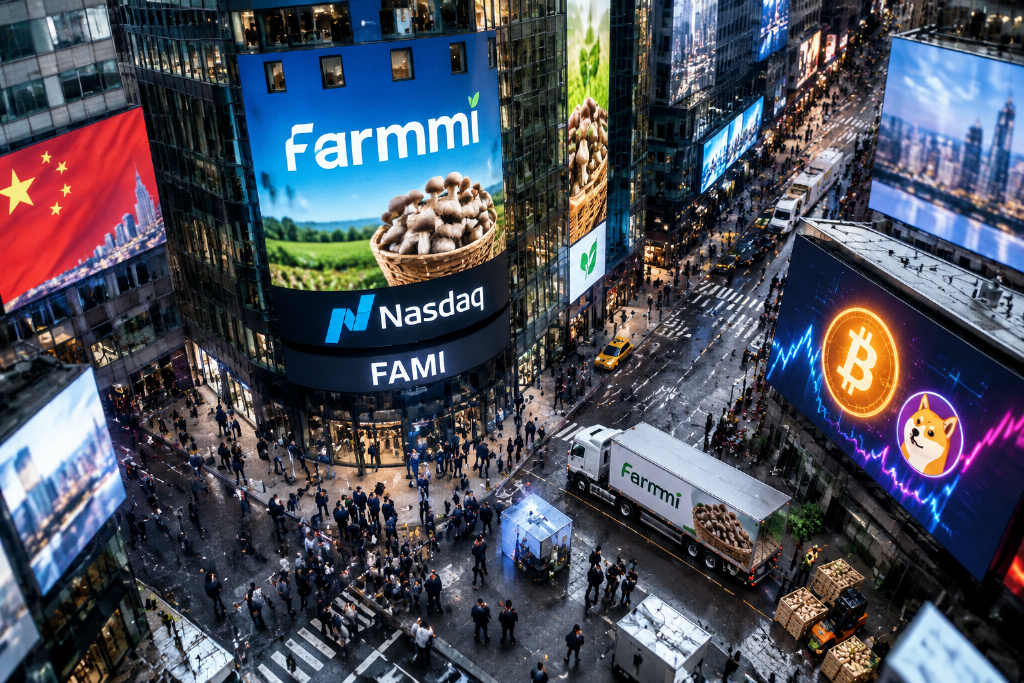
Farmmi (FAMI), a Nasdaq-listed company based in China, briefly surged from $0.12 to $0.50 during trading on Sept. 2, a jump of about 350%. Volume reached 720 million shares, nearly 90 times its average daily level. The agricultural micro-cap, which sells dried edible mushrooms and has 15 full-time employees, became one of the day’s wildest movers in U.S. equities.
The stock later fell back to about $0.18, completing the spike and reversal within a matter of hours.
The trigger came from Robinhood Chain. A meme coin called JINQIAN was paired with an on-chain asset using the ticker FAMI. According to GMGN data, JINQIAN reached an implied valuation of about $60 million at its peak, roughly 10 times Farmmi’s market capitalization at the time.
The report says one crucial fact was widely missed as the story spread: the on-chain FAMI token was not an officially issued Robinhood stock token.
Official stock tokens and unofficial look-alikes work very differently
On Robinhood Chain, Artificial Inu (AI) trades against tokenized NVDA, while Memory Cow Moo (MOO) trades against tokenized MU. These meme-stock pair structures depend on one condition: the stock token is officially issued by Robinhood and backed 1:1 by real U.S. shares.
Under that setup, if on-chain demand pushes up demand for the stock token, the issuer has to buy the same amount of real shares to mint new tokens. That creates a transmission path from on-chain activity to actual equity purchases.
The FAMI token in the JINQIAN/FAMI pair did not have that mechanism. It was an independently issued on-chain asset that borrowed Farmmi’s ticker. It had no mint-and-redeem channel, no real-share collateral, and no arbitrage relationship with Nasdaq.
On-chain analyst riley_gmi said on X that FAMI was not on Robinhood’s official list of stock tokens.
The distinction can be stated plainly:
- Official meme-stock pairs follow this sequence: on-chain demand → token minting → real share purchases → genuine buying pressure in the stock market.
- JINQIAN/FAMI followed a different path: on-chain speculation → social media spread → traders assume a stock link exists → buying flows into the real shares through brokers → the stock jump feeds the meme narrative.
There was no mechanical transmission here. The only bridge was attention, combined with misunderstanding.
Why Farmmi was vulnerable to this setup
The report argues that Farmmi was not chosen by accident.
The stock was trading at $0.12, its market capitalization was only in the low millions, and its liquidity was thin. In a name that small, a sudden wave of buying from hundreds or even thousands of traders can move the price sharply. That made a 350% intraday jump possible.
The comparison with NVDA makes the point. In the AI/NVDA pair, NVDA represents a company valued at $5 trillion. Even if there were $3.3 million worth of tokenized Nvidia in the on-chain pool, the effect on the real stock price would still be zero, according to the report.
The ticker itself also mattered. FAMI looked similar to genuine stock-token tickers already present on Robinhood Chain. The shared visual language — ticker symbols, trading pairs, and candlestick charts on GMGN — made it hard for ordinary traders to tell at a glance which token was official and which one was not.
At the point when JINQIAN was trading at a $60 million valuation, Farmmi’s actual market capitalization was about $6 million. A meme-linked on-chain asset reaching 10 times the implied value of its reference company, while that company itself was simply a mushroom seller with no link to meme culture, became a powerful piece of social media bait.
A reverse transmission path from crypto to equities
For the past two years, the usual direction of price transmission between crypto markets and U.S. equities has been easy to identify: stock prices move first, and tokenized stock prices follow. When Tesla posts stronger-than-expected earnings, tokenized TSLA rises. When Nvidia makes a new high, on-chain NVDA moves with it. Information and pricing normally flow from traditional markets to the chain.
The FAMI episode, the report says, offered a clear example of the opposite possibility: on-chain activity affecting the price of a real stock.
That reverse path did not require any formal mint-and-redeem mechanism. It only needed three elements:
- a stock small enough that average daily volume is very low,
- an on-chain story loud enough to spread, such as a meme coin carrying a $60 million valuation,
- and a visual association vague enough to confuse people, in this case a matching ticker.
Once those three factors line up, trader attention can cross the boundary between on-chain and off-chain markets and turn a false token association into real buying pressure in the stock.
The report also links the event to a separate idea promoted by Rune (@RuneCrypto_), who has said he wants to buy Nasdaq micro-caps and use meme coins to create a short squeeze. The article says Rune is still at the concept stage, while the FAMI episode has already supplied a naturally occurring prototype. The difference is that Rune has tried to imagine a formal mint-and-redeem route that would create real stock demand. In the FAMI case, the report argues, no such formal route was needed. Ticker similarity and social distribution were enough.
A structural loophole and a regulatory gray area
The episode exposed what the report describes as a structural loophole: anyone can create a token on Robinhood Chain, assign it the ticker of a listed company, pair it with a meme coin, and then wait for social media effects to spill into the real stock market.
That creates a new risk variable for thousands of Nasdaq and OTC micro-caps. For the U.S. Securities and Exchange Commission, it also raises a gray-area problem. The on-chain FAMI token is not a security, and creating the pair may not itself be illegal, but the resulting disturbance in the stock market is already a matter of fact.
Farmmi closed the day at about $0.18, down 64% from its intraday high of $0.50. Of the abnormal 720 million shares traded that day, the report says there is no way to know how many traders understood that the on-chain FAMI was not an official stock token.
The company, which sells dried mushrooms, has probably never heard of JINQIAN, the report says. But after this episode, investor relations teams at Nasdaq micro-cap companies may have a new question to ask: has someone issued a meme coin on-chain using our ticker?