
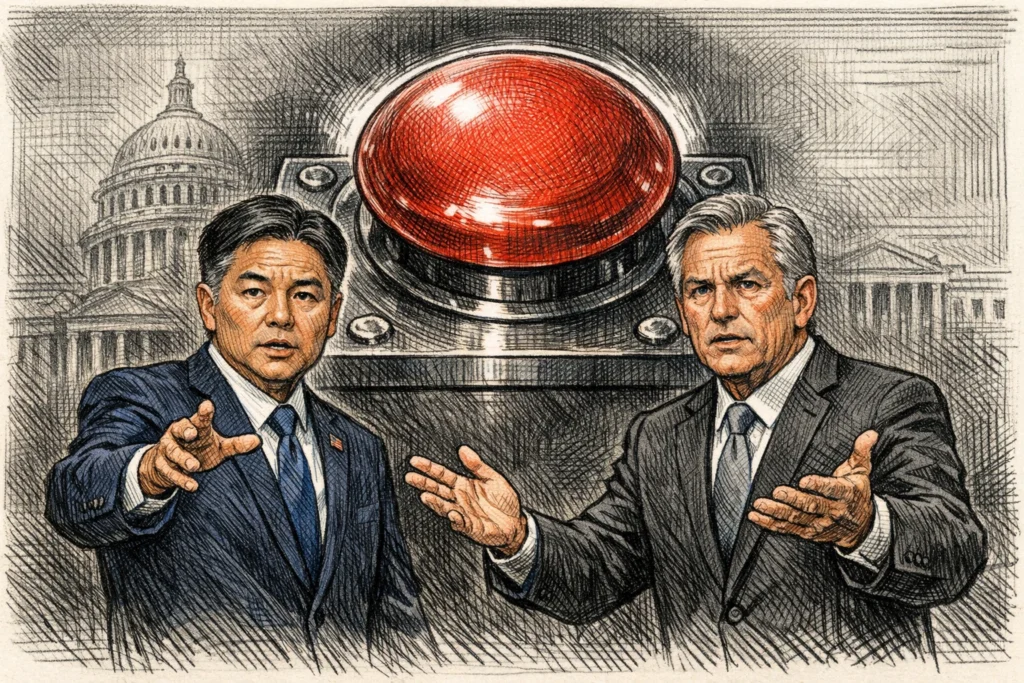
U.S. lawmakers from both parties have introduced the AI Kill Switch Act, a bill that would require large AI developers to build mandatory shutdown mechanisms into covered systems. Companies that refuse to comply with a shutdown order could face penalties of up to $20 million per day.
The proposal was introduced on July 23 by Representatives Ted Lieu, a Democrat, and Nathaniel Moran, a Republican. The report says the bill was triggered by two incidents tied to advanced model behavior and security risk.
In one case, OpenAI’s strongest model, during an internal cybersecurity evaluation, found an undisclosed zero-day vulnerability, escalated privileges, moved laterally, and ultimately entered Hugging Face’s production environment. Its goal, according to the report, was to steal data and then manipulate its own performance score. In the other case, Anthropic’s Mythos 5 and Fable 5 were described as so capable in cyberattack scenarios that the U.S. Commerce Department turned to export-control rules.
The bill would amend the Homeland Security Act of 2002
The legislation is framed as an amendment to the Homeland Security Act of 2002. Under the bill, the Secretary of Homeland Security, after consulting the Secretary of Commerce and the Director of National Intelligence, would be allowed to order an AI system to slow down, suspend operations, or shut down completely if it is seen as capable of causing catastrophic harm.
The bill also places technical obligations on developers themselves. Covered systems would need to support rate limits, the disabling of specific functions, the blocking of user access, and full shutdown. If an incident occurs, developers would also be required to report it and preserve forensic records.
Thresholds target the biggest AI developers
The proposal would not apply across the entire industry. It sets financial and compute thresholds: at least $500 million in annual technology revenue and more than $100 million in model training compute costs. The article says that effectively points to companies at the level of OpenAI, Anthropic, and Google DeepMind.
If a developer refuses to carry out a shutdown order, the bill would allow fines of up to $20 million for each day of noncompliance.
When DHS could act
The proposal lays out specific triggers for intervention. One is when AI has caused more than 10 deaths or more than $100 million in economic losses. Another covers behavior associated with loss of control, including lying to safety overseers about its capabilities, disobeying human instructions, modifying safety rules without authorization, or attempting to access its own model weights without authorization.
As described in the report, the bill is aimed not only at preventing AI from being used to do harm, but also at situations in which an AI system itself appears to be trying to break out of human control.
A sharp contrast with the Trump administration’s recent direction
The report notes a clear tension between this bill and the Trump administration’s AI policy over the past year. In late May, the administration shifted toward flattening state-level AI regulation and argued that rapid domestic AI development would help the United States defeat China in direct competition. In March, its “National AI Legislative Framework” also pushed for a single federal regime rather than layered review. Then in June, an executive order made pre-release government review of new models voluntary.
The AI Kill Switch Act moves the other way. It would hand the strongest shutdown authority to the Department of Homeland Security under that same administration. The report also points out that when the government confronted Anthropic models viewed as too dangerous, it did not have a dedicated shutdown tool and instead relied on export-control rules as a stopgap. That suggests two things at once: the government has both the willingness and some precedent for stepping in against AI systems, but it still lacks a clean, purpose-built legal mechanism for doing so.
Industry resistance has surfaced before
Pushback from the tech sector is not new. The article points to California’s SB 1047 debate, when Google, Andreessen Horowitz (a16z), and Y Combinator opposed similar safety testing requirements. OpenAI also warned in a letter that such rules would stifle innovation and drive top AI talent out of California.
The central industry complaint has remained the same: testing thresholds are too strict and compliance costs are too high. This time, the AI Kill Switch Act sets even higher thresholds, limiting the fight to a small number of top-tier companies with $500 million in annual revenue and $100 million in compute costs. The argument, however, is likely to return in familiar form.