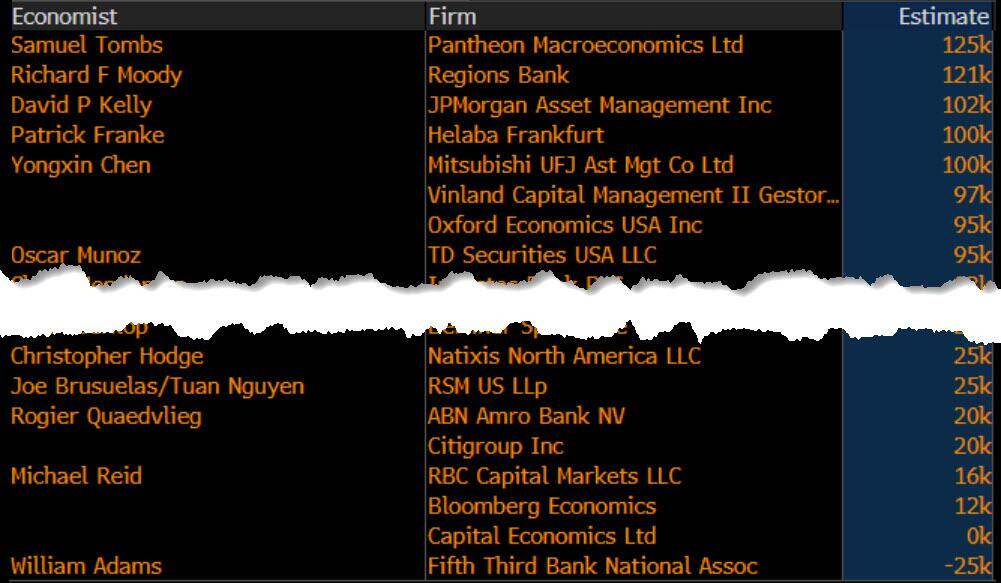
The U.S. August nonfarm payrolls report is due tonight, with economists expecting 55,000 new jobs, an unchanged 4.1% unemployment rate and 0.3% month-on-month wage growth. But the market’s focus has shifted: a strong number may push Treasury yields higher and weigh on equities, while a weak print is not automatically a disaster. JPMorgan says next week’s CPI will matter more for the Fed’s Sept. 16 meeting. Bloomberg economist Anna Wong said that if August payrolls are negative again, there is no precedent in modern Fed history for the central bank to keep hiking after two straight months of job losses. The report also comes against a mixed backdrop of private-sector hiring data, a temporary protected status expiration for roughly 300,000 migrants, and a baseline revision showing payrolls were understated by 79,000 through March 2026.
The U.S. August nonfarm payrolls report is due tonight, and markets are no longer treating the release as a simple good-news-or-bad-news event. Consensus calls for 55,000 new jobs, up from July’s decline of 23,000. The unemployment rate is expected to hold at 4.1%, while average hourly earnings are seen rising 0.3% month on month.
Goldman Sachs is more cautious, forecasting just 40,000 new jobs. JPMorgan’s market intelligence team says Fed Chair Warsh made clear at Jackson Hole that the economy is at full employment and inflation remains elevated, which puts payrolls into a “good news is bad news” framework: stronger hiring could lift bond yields and pressure U.S. stocks.
JPMorgan argues next week’s CPI report will matter more than tonight’s payrolls for the Federal Reserve’s Sept. 16 meeting. The bank pegs the S&P 500’s implied one-day move from options expiring Sept. 4 at about 1.1%. Bloomberg chief economist Anna Wong said that if August payrolls are negative again, there is no precedent in modern Fed history for the central bank to continue hiking after two straight months of declines.
The run-up data have been mixed. ADP said private payrolls rose by just 38,000 in August, the slowest pace since January and below the 47,000 consensus estimate. Revelio’s public labor statistics showed 36,500 jobs added across the economy, down sharply from 79,200 in July. Initial jobless claims rose to 207,000 during the BLS survey window, versus 189,000 in the July survey period. Goldman’s average reading from alternative hiring trackers was 31,000, down from 65,000 in July. Challenger reported 52,900 announced layoffs in August, up from 33,400 a month earlier.
Still, layoffs remain restrained overall. Challenger’s tally of layoffs in the first eight months of 2026 totals about 530,000, the lowest for the same period since 2022, while hiring plans are the highest since 2023. The monthly average for initial claims came in at 204,000, below July’s 210,000, and the JOLTS layoffs rate fell 0.1 percentage point month on month to 1.0%.
There is also room for some normalization in sectors that had already weakened. Employment in leisure and hospitality fell by 83,000 over the prior two months, while local government education employment declined by 61,000. Job openings, using a composite of JOLTS, Indeed and LinkUp, were roughly flat in July and have shown no clear trend recently.
Business surveys are also sending mixed signals. The ISM manufacturing employment index slipped to 51.2, still in expansion territory but slower than before. The ISM services employment index rose slightly to 47.8, marking a second straight month in contraction. By contrast, employment components in S&P Global’s manufacturing and services PMIs both strengthened, with the services gauge posting its fastest job growth in nearly 18 months.
A policy factor could mechanically depress the payroll figure. Roughly 300,000 migrants, mostly from Haiti, saw their Temporary Protected Status expire at the end of July, ending their U.S. work authorization as well.
Barclays estimates that about 200,000 of them were still counted as employed in the July payroll survey, and roughly 25,000 are expected to disappear from the August count as employers stop placing them on payrolls. As the remaining workers complete eligibility reviews in the coming months, the drag could continue. Some had already applied for asylum before the deadline; some were approved before their status expired and still retain work authorization; others may still appear in employer payroll records because work-eligibility checks have not been completed.
Wong said these factors make a second straight month of negative payrolls a fairly high-probability outcome.
A separate backdrop comes from the Bureau of Labor Statistics’ annual benchmark revision preview, released in August. It showed that as of March 2026, seasonally adjusted employment was 79,000 lower than previously estimated, a 0.1% downgrade. That was far smaller than last year’s revision, which cut the March 2025 benchmark by 911,000 jobs.
The private sector took the largest hit, with employment revised down by 178,000, implying average monthly job growth of 24,000 rather than the previously reported 38,000. By industry, retail saw the biggest downward revision at 154,600, transportation and warehousing the largest upward revision at 135,100, and government was revised up by 99,000 even after federal job cuts. Final revisions will be folded into the February 2027 employment report.
For the Fed, the market message is relatively clear. If payrolls land near expectations and unemployment stays stable, that would fit the view that the labor market is cooling without deteriorating sharply, leaving policymakers focused on inflation. A much weaker number, especially another negative print, would change the conversation quickly.
Wong said there is no precedent in modern Fed history for continuing to raise rates after two straight months of payroll losses. JPMorgan also argues that with only one more payrolls release and one CPI report left before the Sept. 16 meeting, inflation will carry the bigger weight.
Its “Goldilocks” range is 30,000 to 70,000 new jobs. Above 100,000, U.S. stocks would likely come under clear pressure, 10-year Treasury yields would move higher, and markets would price a greater chance of a September hike. Between 70,000 and 100,000, equities would likely soften and yields would rise modestly. Below 30,000, or into negative territory, front-end rates would drop quickly, but a negative print could also revive stagflation concerns and make the policy path harder to read.
Goldman expects average hourly earnings to rise 0.4% month on month, above the 0.3% consensus, saying favorable calendar effects should support stronger wage data. Its wage tracker shows second-quarter hourly earnings running at a 2.8% annualized pace quarter on quarter and 3.6% year on year, still below the firm’s 4% threshold that it associates with the Fed’s 2% inflation goal.
This article was originally published by Bit.Fan. For more cryptocurrency news and market insights, visit www.bit.fan. Disclaimer:
The market information, project data, and third-party content displayed on this platform are for industry information sharing only and do not constitute any form of investment advice or return commitment.
Cryptocurrency trading carries high risks. Users should fully assess their risk tolerance and make independent decisions. All profits, losses, and legal responsibilities are borne by the users themselves.