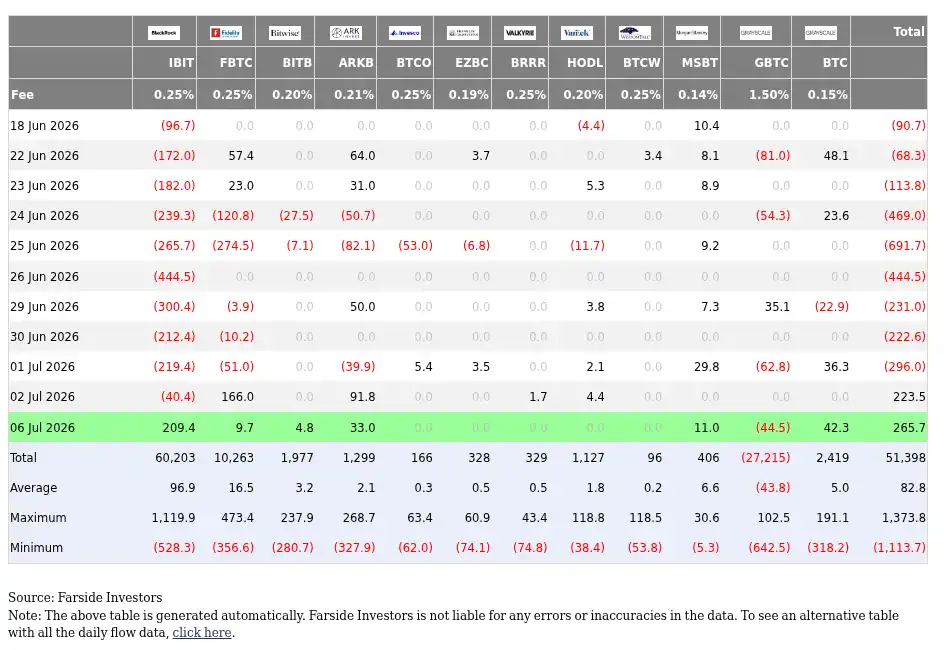
US spot Bitcoin ETFs recorded net inflows of $265.7 million in the latest session, marking the second consecutive trading day with net inflows above $200 million, according to data tracked by Farside Investors. BlackRock’s IBIT accounted for the bulk of the movement, posting $209.4 million in net inflows. Meanwhile, spot Ethereum ETFs also stayed positive, attracting $20.7 million on the day, with ETHA alone bringing in $23.3 million. The gap between ETHA’s inflow and the aggregate Ethereum ETF figure suggests offsetting outflows from other products. Market commentary cited in the report said some capital may be rotating back into crypto ETFs after enthusiasm around AI-linked US equities cooled, particularly as investors revisit crypto products that had previously been viewed as oversold.
BlockBeats reported on July 7, citing data monitored by Farside Investors, that US spot Bitcoin ETFs posted $265.7 million in net inflows in the latest session. This marked the second straight day in which daily net inflows exceeded $200 million. Among the products, BlackRock’s IBIT led the group with $209.4 million in net inflows.
Spot Ethereum ETFs also remained in positive territory. The segment recorded $20.7 million in net inflows for the day, while ETHA alone brought in $23.3 million. That difference indicates that some other Ethereum ETF products likely saw outflows, partially offsetting ETHA’s gains at the aggregate level.
According to market commentary referenced in the report, the recent cooling of the AI-driven rally in US equities may be prompting some capital to rotate out of those trades and back into crypto ETFs, especially products that had previously been seen as oversold.
This article was originally published by Bit.Fan. For more cryptocurrency news and market insights, visit www.bit.fan. Disclaimer:
The market information, project data, and third-party content displayed on this platform are for industry information sharing only and do not constitute any form of investment advice or return commitment.
Cryptocurrency trading carries high risks. Users should fully assess their risk tolerance and make independent decisions. All profits, losses, and legal responsibilities are borne by the users themselves.