
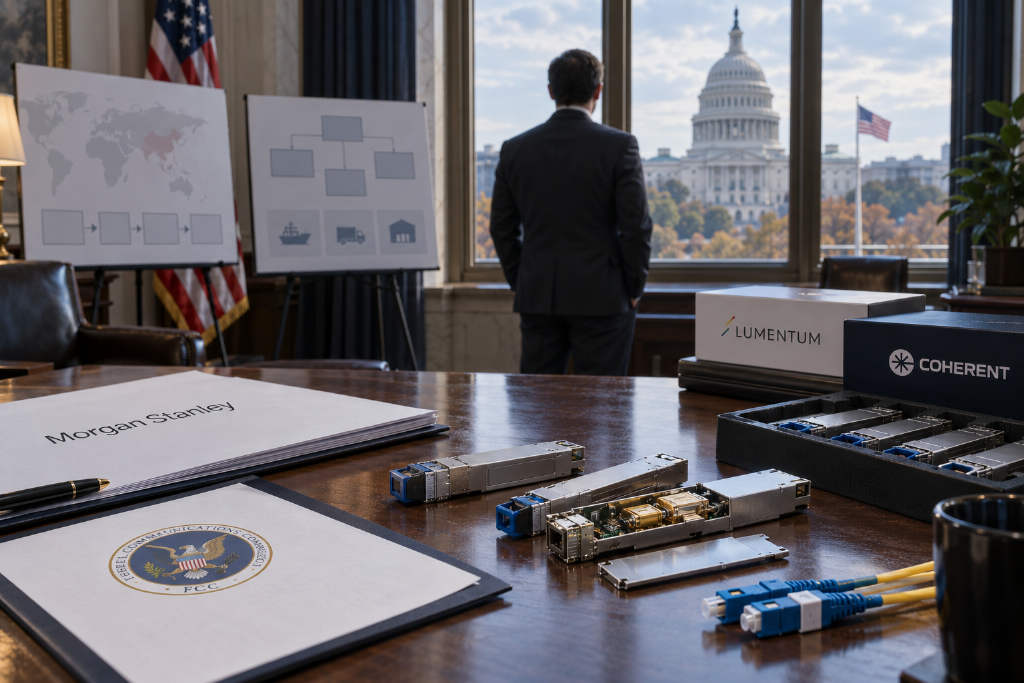
Morgan Stanley said in an Oct. 1 update on the North American telecom and networking equipment sector that U.S. restrictions on China-made optical transceivers are most likely to be rolled out in phases starting with the 3.2T generation, with October seen as the earliest possible start date.
The report said the approach would avoid blocking current buildouts by hyperscalers while keeping the laser market tight, a setup Morgan Stanley said would benefit U.S. suppliers including Lumentum (LITE) and Coherent (COHR). The bank also said the information came from policy discussions and does not represent formal rules published by the Federal Communications Commission, or FCC.
Covered List seen as the likely mechanism
According to the report, Morgan Stanley's strategy team recently traveled to Washington and spoke with the FCC, export control legal teams, and telecom equipment companies before writing the note. The central issue was how the U.S. government is trying to reduce reliance on Chinese technology, and the FCC's Covered List was described as the most likely mechanism for optical transceivers in the near term.
On timing, the report said specific restrictions could arrive as early as October and would be introduced in stages beginning with the 3.2T generation. Industry participants have recently been asked to present credible domestic U.S. or friend-shoring supply plans before large-scale 3.2T deployment begins.
Not a full ban on China-made products
The report said China-made transceivers could still be imported in the 3.2T era if 65% of the bill of materials, by value, comes from U.S. companies. Morgan Stanley said its sources indicated that using U.S.-made digital signal processors, or DSPs, and lasers would get suppliers "quite close" to that threshold.
In that reading, the restriction would function less as a blanket exclusion of China-made products and more as a way to shift procurement of key components toward U.S. suppliers. The report also said volume ramp for early 3.2T products is not expected until 2029, which means even an earlier rule rollout would have limited impact on near-term revenue.
Tighter laser supply seen as a positive for Lumentum and Coherent
On industry impact, Morgan Stanley said the framework could preserve hyperscalers' current build capacity. At the same time, because lasers would largely need to come from U.S. suppliers to meet the 65% threshold, the laser market would remain tight. The bank said that would be a positive signal for Lumentum and Coherent.
The report added that the arrangement could create a "win-win" for both companies: they would benefit from laser demand without having to take on lower-end module assembly work. Morgan Stanley said that view was consistent with a conversation it had with Lumentum at a Nasdaq Asia event in late August, when the company said any FCC restrictions would need to be phased in.
What Morgan Stanley is watching next
Morgan Stanley said one key variable is whether indium phosphide, or InP, substrates can be delivered smoothly, as that will determine whether laser supply can keep pace with demand. As for when the rule will be formally released and what the final details will look like, the report said that still depends on official action from the FCC.