
The U.S. effort to establish a statutory framework for digital asset markets has stalled, while Hong Kong continues to build its virtual asset regime in stages. The contrast puts a central industry question in focus: what is regulatory certainty worth to firms and investors making long-term commitments?
This analysis was written by EX.IO. It examines the stalled CLARITY Act, the role of U.S. agencies in the absence of congressional legislation, and the rules already in force or still being developed in Hong Kong.
CLARITY Act faces a narrow legislative window
The Digital Asset Market Clarity Act, or CLARITY Act, is a proposed foundational law for the U.S. digital asset market. It is intended to clarify whether a token is a security or a commodity, whether the Securities and Exchange Commission (SEC) or the Commodity Futures Trading Commission (CFTC) oversees it, and how trading platforms should register.
The bill moved through early stages with relative speed. The House passed it 294–134 in July 2025. In May 2026, the Senate Banking Committee advanced it by 15–9, and a consolidated text combining the work of two committees was released in July. But on September 15, a Senate cloture motion failed 49–50, falling 11 votes short of the 60 needed to begin formal debate. No Democrat crossed over in support, while three Republicans opposed the motion.
Senators never cast a final vote on the bill’s substance. With the midterms over and Congress entering its lame-duck session, the remaining path narrowed: supporters would need to secure 60 votes before the chamber adjourns on January 3, 2027, or introduce a new bill in the 120th Congress and repeat the committee process and negotiations.
Three provisions remain at the center of the dispute
The bill did not stall because lawmakers rejected regulation in principle. Negotiations ran into disagreements over three specific provisions.
Ethics rules for federal officials and their families
The parties have not agreed on how to prevent federal officials and their families from profiting from crypto businesses. The White House agreed in July 2026 to add a revised ethics provision. Democrats argued that it could still be circumvented through intermediaries or family-affiliated companies, and that it would expire in January 2029, leaving it too weak.
Section 604 and DeFi developers
Section 604 is intended to protect developers of non-custodial software from being classified as money transmitters. Critics say the provision could leave a regulatory gap for decentralized finance (DeFi).
Section 404 and stablecoin rewards
Section 404 limits yield on payment stablecoins and has brought the banking and crypto industries into direct conflict. Banks are concerned that stablecoins could draw deposits away from them; platforms view stablecoin rewards as a core source of revenue. This provision alone prompted leading industry companies to withdraw support for the Senate draft twice in early 2026.
Each dispute has its own opponents. Resolving one does not necessarily unlock the others, which helps explain why scheduling another vote is easier than restarting negotiations over the bill.
Midterm results complicate the U.S. outlook
The November 3 midterms reshaped the legislative picture. Democrats won both chambers and are pushing for major changes to the CLARITY Act, including broader SEC oversight, a narrower CFTC remit and tighter ethics rules for officials. Republicans have called the proposal a “messaging bill.”
Committee leadership could also matter. Elizabeth Warren, who has taken a hard line toward the crypto industry, is widely expected to lead the Senate Banking Committee. Bryan Steil, the House bill’s prominent champion and chair of the Digital Assets Subcommittee, lost his seat in the midterms. TD Cowen analysts expect the bill to have virtually no path to passage over the next two years.
There are still signs of bipartisan support. Nearly half of the candidates endorsed by industry organizations were Democrats. The question is whether that support can translate into 60 votes in a divided Congress.
Agencies can fill gaps, but cannot replace Congress
As legislation has stalled, U.S. crypto oversight has shifted toward administrative action. The SEC released a proposed “crypto asset rule” in August 2026, setting up a two-tier fundraising exemption with a maximum of $75 million. In October, it proposed new custody rules for crypto assets. The CFTC has sought public comment on rules for retail crypto trading and clarified the capital treatment of crypto assets used as margin.
Administrative rules have three structural limits. First, a change of administration can reverse them, and courts have previously struck down several SEC rules as exceeding the agency’s authority. Second, agencies do not have complete jurisdiction: the CFTC cannot establish a licensing system for spot exchanges, while congressional legislation is needed to determine the priority of customer assets in bankruptcy. Third, agency rules do not offer the same certainty as statutory text. For institutions planning investments over several years, that distinction affects investment decisions.
Hong Kong is building its framework in stages
Rather than rely on a single market-structure bill to settle the rules, Hong Kong has chosen incremental legislation, bringing each stage into law. The approach is based on setting requirements first, then allowing firms to build their operations against rules already in force.
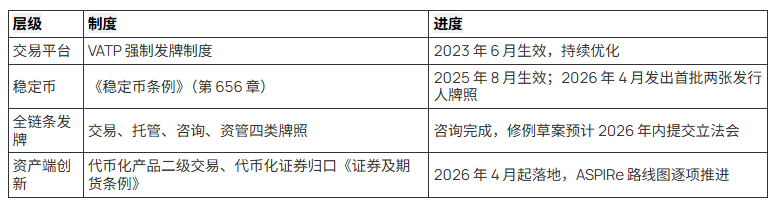
The framework has four components. First, mandatory licensing for virtual asset trading platforms (VATPs) took effect in June 2023. Second, the Stablecoins Ordinance and its issuer licensing regime took effect in August 2025; the first licences were issued in April 2026. Third, amendments covering licensing across dealing, custody, advisory and asset-management services remain in progress. Fourth, the policy agenda includes secondary trading of tokenized products and market measures under the ASPIRe roadmap.
The Hong Kong Monetary Authority’s regulatory regime for stablecoin issuers has moved into the licensing stage. The Securities and Futures Commission (SFC) has also issued a circular on relevant stablecoin services offered by VATPs and licensed corporations. The Financial Services and the Treasury Bureau and the SFC published consultation conclusions on licensing virtual asset dealing and custody service providers. Further arrangements for advisory and asset-management services, as well as trading in relevant stablecoins, remain under development.
Regulatory certainty comes with costs
Hong Kong’s more predictable framework still carries compliance costs. Capital requirements, custody standards, insurance and audit arrangements create real barriers to entry. The regime is designed for firms prepared to operate over the long term.
Some details remain unsettled, including cross-border rules, the treatment of DeFi and transition arrangements for new licensing regimes. A clear regulatory direction is not the same as a complete set of operational rules. Nor does certainty automatically create market scale: the value of a regulatory framework ultimately depends on liquidity depth and participation from international capital, neither of which regulators can deliver alone.
EX.IO Research: predictability is a form of infrastructure
EX.IO Research argues that the comparison between the United States and Hong Kong shows how regulatory certainty can function as scarce infrastructure—and how institutions can create it through policy design.
The U.S. experience shows that even a market with a deep legislative tradition and strong industry lobbying can see a market-structure bill pushed into a countdown by political issues unrelated to crypto. Agency rulemaking can address immediate gaps, but it cannot provide the same certainty as legislation. That statutory certainty is a prerequisite for institutions making allocations over multiple years.
Hong Kong’s distinction is not that it regulates more or less strictly, but that its rules are more predictable. Requirements are introduced through ordinances, circulars and consultation conclusions, with public timelines and increasingly defined boundaries. For firms, that means compliance investment is less likely to become worthless overnight because of a political shift. For platforms choosing a licensed route, building capabilities against established rules can create long-term value.
The industry may face a “two-speed world” over the next two years: the United States recalibrating between a renewed legislative effort and agency rules, while Hong Kong continues to extend a framework already underway. The practical question for businesses is whether their structures can remain resilient across both timelines.
Developments to watch
- January 3, 2027: The 119th Congress adjourns. Whether senators hold a second cloture vote before then is the CLARITY Act’s last theoretical window.
- The 120th Congress: Watch for a new version of the market-structure bill, as well as the selection of the Senate Banking Committee chair and the party balance on the committee.
- The SEC’s “crypto asset rule”: The outcome of public consultation and the scope of the final rule will shape how much ground agency action can cover.
- Hong Kong’s Legislative Council: Track deliberations on amendments covering licensing for dealing, custody, advisory and asset-management services.
- Hong Kong’s stablecoin market: Watch the timing of a second batch of issuer licences and actual use of licensed stablecoins by retail and institutional customers.
Frequently asked questions
What is the CLARITY Act?
The CLARITY Act, H.R. 3633, is a U.S. digital asset market-structure bill intended to divide regulatory responsibilities between the SEC and CFTC and establish a registration framework for trading platforms. The House passed it in July 2025. In September 2026, a Senate cloture vote failed 49–50.
What does the bill’s failure mean for the crypto industry?
In the near term, U.S. digital asset oversight will rely more heavily on SEC and CFTC administrative rules. Those rules can be reversed and do not cover every issue, so uncertainty around market structure is expected to persist into the next Congress.
What does Hong Kong’s virtual asset framework cover?
It includes mandatory VATP licensing, effective since June 2023; the Stablecoins Ordinance and issuer licensing regime, effective since August 2025; licensing across dealing, custody and other services that is still being developed through amendments; and secondary trading of tokenized products and market measures under the ASPIRe roadmap.
Why does regulatory certainty matter?
Institutions making allocations over several years need stable rules. Statutory certainty affects whether compliance investments can withstand political changes, making predictability part of a jurisdiction’s competitive position.