

The U.S. Bureau of Labor Statistics will release September CPI data on Oct. 14, with Barclays and Morgan Stanley both expecting a hotter headline reading because of a sharp rise in gasoline prices, while core inflation is seen easing slightly from August.

Both banks forecast monthly core CPI at 0.24%, below August’s 0.29%. The report is expected to feed directly into the Federal Reserve’s October policy decision. Barclays said that, despite lingering upside inflation risk, Fed officials are likely to keep rates unchanged in October, watch incoming data, and shift a 25 basis point hike to December.
Minutes and market pricing point to no rush in October
Minutes from the Fed’s September meeting showed that 「大多数」 officials expected one more rate increase this year, but also suggested there was no urgency to move in October. Fed Governor Christopher Waller said rate hikes do not need to happen at consecutive policy meetings and that officials can adjust timing based on economic data. Markets have already pushed expectations for the next hike from October to December. Goldman Sachs said a December hike is more likely, though the possibility that the Federal Open Market Committee ultimately decides no further tightening is needed remains meaningful.
Energy seen driving the jump in headline CPI
Barclays forecasts September headline CPI rising 0.58% month over month on a seasonally adjusted basis, with the annual rate climbing to 3.7% from 3.4% in August, up by about 0.3 percentage point but still below the 4.2% high seen in May this year. Morgan Stanley’s estimate is slightly higher, at 3.69% year over year and 0.62% month over month.
Energy is the main driver behind the expected rise in headline inflation. Barclays projects the energy component up 5.05% on the month, with gasoline prices up 9.23% month over month and 34.8% year over year. Heating oil is seen rising 38.8% from a year earlier.
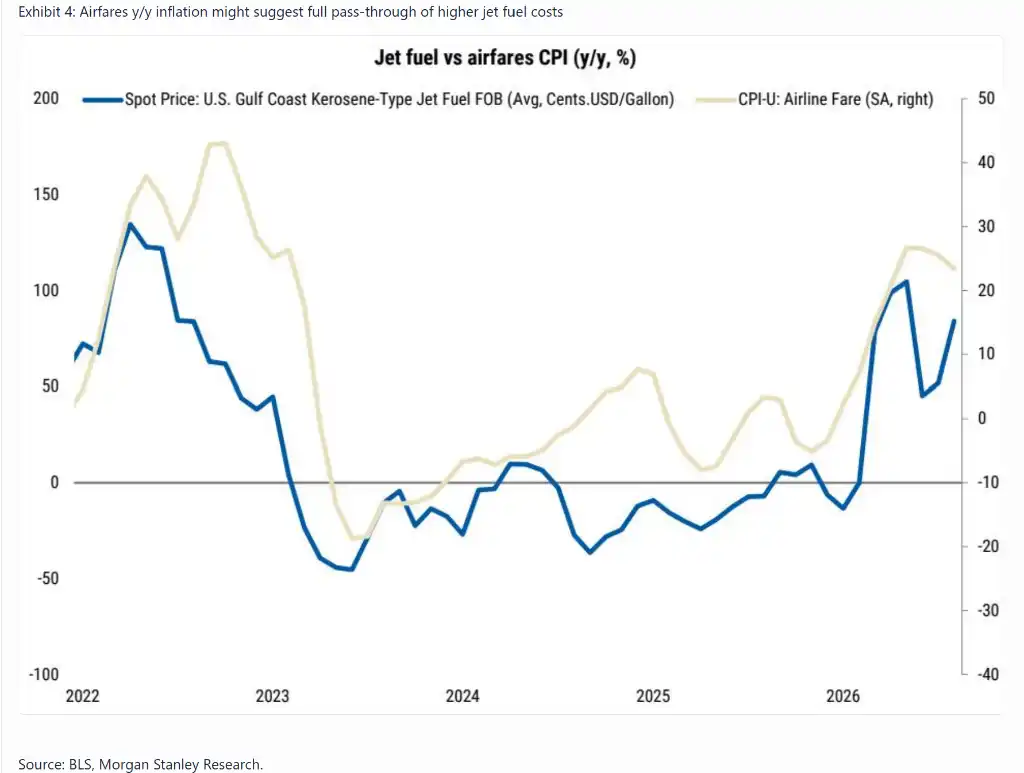
Morgan Stanley said continued tension in the Middle East has been an important factor behind higher oil prices and could keep feeding through to airfares and transportation costs. Barclays had also warned in an earlier report that higher diesel prices were gradually being passed on to U.S. consumers.

Core inflation is expected to cool slightly
Even as headline inflation moves higher, pressure in core CPI is expected to ease a bit. Barclays forecasts September core CPI at 0.24% month over month and 2.5% year over year. Morgan Stanley has the same monthly estimate at 0.24%. Both are 5 basis points below August’s 0.29% monthly reading.
The main reason for the slowdown is the education and communication category. In August, wireless communication services posted an unusual jump and contributed about 0.1 percentage point to core CPI for the month. Barclays expects Verizon’s latest round of price increases, together with a smaller planned increase from AT&T, to keep the category supportive in September, but with a much smaller effect than in August.
Airfares and medical services are still expected to support core inflation. Morgan Stanley said airfares were already up 23% year over year in August and still sees them rising 1.8% month over month in September. Barclays expects a 2.6% monthly increase in airfares. Morgan Stanley added that jet fuel prices are up nearly 90% from a year earlier, while fuel accounts for about 20% to 30% of airline operating costs. On that basis, the bank said airlines may be close to fully passing through higher fuel costs. For medical services, Morgan Stanley expects a 0.55% monthly rebound in September after weakness in August.
For core goods, Barclays and Morgan Stanley both expect monthly gains in a 0.13% to 0.14% range, broadly in line with August, with new and used vehicle prices edging higher.
Shelter stays steady while auto insurance weighs
Shelter inflation is expected to remain stable. Barclays forecasts owners’ equivalent rent, or OER, rising 0.24% month over month in September, with rent of primary residence up 0.23%. Morgan Stanley expects OER at 0.25% and rent of primary residence at 0.20%. The bank said shelter inflation has averaged about 0.24% a month since May, slightly below the pre-pandemic long-term trend of 0.26%, and is likely to keep moving around that level in the near term.
Auto insurance is expected to remain a drag on core inflation. Morgan Stanley forecasts motor vehicle insurance premiums falling 0.20% in September and said the negative trend could continue through 2027, driven by improved insurer profitability and price cuts aimed at winning market share.
For hotels, Morgan Stanley said prices rebounded strongly in August after two unusually weak months and expects a flat 0% month-over-month reading in September.
PCE outlook and the Fed path
The CPI report also matters for the Fed’s preferred PCE inflation gauge. Barclays forecasts September core PCE at 0.22% month over month and about 3.0% year over year. Morgan Stanley’s estimate is slightly higher at 0.23% on the month.
Barclays researchers Pooja Sriram, Marc Giannoni, Jonathan Millar and Colin Johanson said there is still uncertainty around financial services PCE prices, especially because the U.S. Bureau of Economic Analysis, or BEA, is using a new method to estimate portfolio management service prices. The nominal spending and hours-worked data needed for that calculation may not be available in time, making the forecast harder. The team said it would revise its estimates after next week’s CPI and PPI releases.
On policy, Barclays kept its base case for a 25 basis point Fed hike in December. The bank said base effects will make it difficult for Chair Waller’s preferred six-month and 12-month medium-term inflation measures to improve meaningfully this year, though the outlook for 2027 should look much better. Recent comments from Fed officials suggest uncertainty around the inflation distribution could support more tightening from a risk-management perspective, but Barclays expects policymakers to wait in October for more evidence.
Three variables Morgan Stanley is watching
Morgan Stanley said investors should watch several variables closely in this report:
- Apple raised prices on some older iPhone models by 10% to 14% when it launched its new iPhone on Sept. 9, but smartphones account for only about 0.2% of the CPI basket, and some regions are sampled on a bimonthly basis, so the direct effect is expected to be no more than 1 to 1.4 basis points.
- Whether airfare increases are nearing their ceiling.
- Whether shelter inflation can maintain its current stable pace.