
WuBlockchain’s weekly Top 10 covered exchange financing, U.S. regulatory proposals, bank-led crypto access, Ethereum infrastructure progress, and a fresh round of cryptography security warnings.
OKX closes a new round at a $25 billion valuation
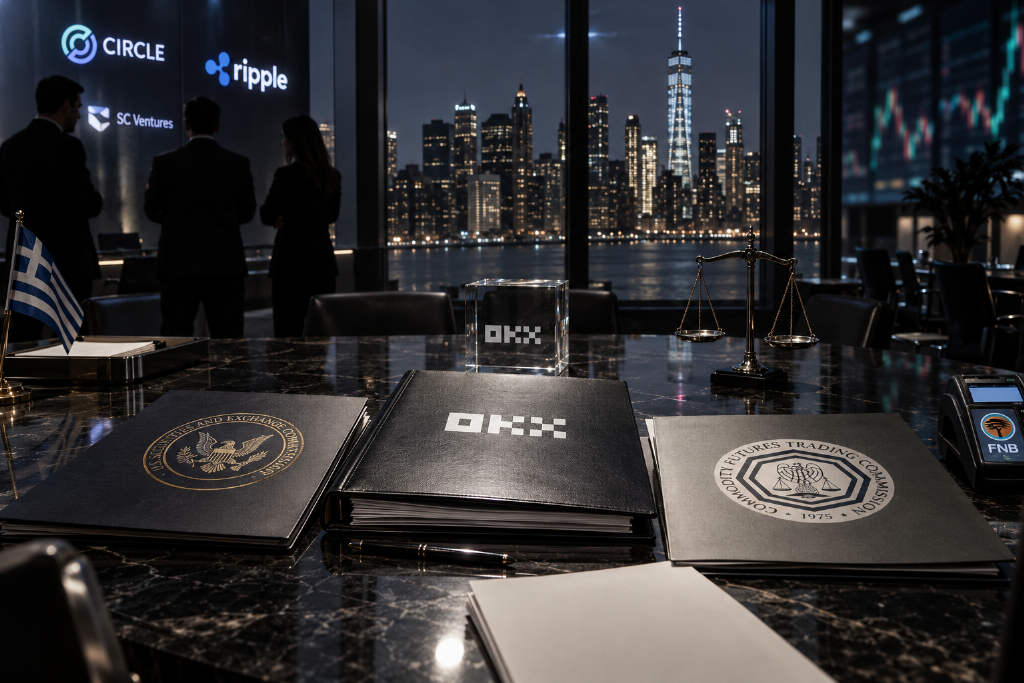
Crypto exchange OKX completed a new financing round at a $25 billion valuation, with participation from Circle, Ripple, Standard Chartered’s SC Ventures, and London-based quantitative hedge fund Qube Research & Technologies, or QRT. The size of the round was not disclosed.
The report said the financing extends a round announced in March this year, when Intercontinental Exchange, the parent company of the New York Stock Exchange, invested about $200 million in OKX at the same valuation. OKX said the fresh capital will be used to strengthen its long-term market infrastructure.
OKX has also filed with the U.S. Securities and Exchange Commission to launch a tokenized stock trading platform. OKXICE LLC, a joint venture formed by OKX and ICE, plans to apply to offer tokenized stock trading for an initial group of 63 NYSE-listed companies. Relevant issuers would be able to opt out within 30 days before trading begins.
According to the roundup, the SEC last month opened the way for blockchain-based securities trading in the U.S. under a temporary exemptive framework. Those digital assets must include full shareholder rights such as dividends and voting rights. The launch date for the OKXICE platform depends on the end of the 30-day opt-out period and the completion of other requirements.
CFTC proposes its first crypto market rule set
According to The Wall Street Journal, U.S. Commodity Futures Trading Commission Chair Michael S. Selig said the agency is putting forward its first crypto market regulatory rules, including the Crypto Asset Transactions, or CTX, and Crypto Asset Markets, or CAM, frameworks. The stated goal is to use existing statutory authority to build a federal oversight framework, along with listing and trading standards, for crypto asset trading platforms.
Under the proposal, crypto platforms that want to come under CFTC supervision would have a single federal registration path. Eligible venues would also be allowed to offer crypto trading with margin, leverage, or financing support to retail investors. Selig said the move is intended to shift away from a model that had largely relied on regulation through enforcement and toward clearly written rules.
Retail access, actual delivery, and digital commodity examples
Selig later disclosed more details about the CTX and CAM structure. The proposed rules would generally require relevant retail crypto transactions to be conducted through futures commission merchant, or FCM, intermediaries. They would also set requirements for customer asset segregation, capital, anti-money laundering controls, and proof of reserves.
For on-chain transactions, the CFTC is considering clarifying that delivery of crypto assets to a user’s external non-custodial wallet within 28 days would usually satisfy the actual-delivery exception.
Selig also said the agency is studying a long-term policy approach for developers who only publish software, do not solicit or receive orders, do not control trade execution, and do not custody customer assets. He cited a joint CFTC-SEC crypto asset classification that lists BTC, ETH, SOL, XLM, XTZ, and XRP as examples of digital commodities.
FNB launches crypto investing in South Africa
South African newspaper Business Day reported that First National Bank, or FNB, has launched a Crypto Investing service that lets clients trade BTC, ETH, XRP, SOL, and USDT directly through its existing stock trading platform.
The service is offered in partnership with South African licensed crypto exchange VALR. Minimum trade size is 10 rand, and the product supports 24/7 trading. FNB said the launch responds to rising customer demand for crypto asset investing and that more crypto investment options are expected later.
Greece opens consultation on a 10% crypto tax proposal
Greece’s Ministry of Finance said the government has opened public consultation on a new crypto asset tax bill. The proposal would impose a 10% tax on capital gains from personal sales of crypto assets, while annual gains of up to 500 euros would be exempt.
Crypto-to-crypto exchanges would not trigger capital gains tax under the proposal. Income from staking, lending, and providing liquidity would be taxed at 10% as interest income.
Investors who voluntarily declare past crypto trading gains within 12 months after the law is published could qualify for relief from fines and interest, provided they meet the conditions.
Ethereum mainnet records an atomic L1-to-L2 cross-chain transaction
Ethereum Economic Zone core contributor Eduardo Antuña said in a post that Ethereum mainnet has executed its first atomic cross-chain L1-to-L2 transaction.
He described the event as a sign that atomic synchronous composability has reached mainnet and is no longer confined to theory. Antuña added that this is only the start of EEZ’s effort to push synchronized cross-layer interaction and unified liquidity on Ethereum.
Vitalik Buterin and Justin Drake raise cryptography concerns
Ethereum co-founder Vitalik Buterin warned that AI-driven acceleration in mathematical research could materially weaken the practical security of lattice-based cryptography within the next two years. He pointed to areas including ML-DSA and fully homomorphic encryption, or FHE, and said ECDSA could face break risk earlier than expected.
Buterin wrote that AI could deliver an amount of mathematical progress over two years comparable to the previous 50 years. He said Ethereum’s Lean roadmap has therefore been shifting over the past year toward pure hash-based signature schemes in order to reduce reliance on lattice assumptions.
On user security, he said that when practical, funds should preferably be held in addresses that have never sent a transaction. At the same time, he did not recommend rushed asset migration, saying the migration process itself carries risk of loss. He also suggested that multisig wallets should use off-chain signature confirmation where possible to avoid publicly exposing signature data.
Security researcher Justin Drake separately called on the blockchain industry to prepare for what he described as a bunker mode. His personal recommendation was to move assets in an orderly way to fresh addresses where the public key remains hidden behind a hash and that have never signed a transaction. Once an address signs, he said, remaining assets should again be moved to a new address. He also stressed that users should not panic or rush.
Drake said preparation is now needed for the possibility that ECDSA could be broken before Q-Day. In the worst case, he said, the risk could emerge in months rather than years. He defined a break as the ability to recover private keys in roughly one week using existing hardware such as large GPU clusters.
He linked that concern to recent mathematical advances and improving AI capability, and said classical algorithms could also see a breakthrough comparable to Shor’s algorithm, threatening both elliptic-curve cryptography and RSA. Drake said large institutions should strengthen cold storage defenses first, while key signers such as oracles and L2 security councils could consider rotating ECDSA public keys after every signature or combining them with hash-based schemes such as SPHINCS. Over the longer term, he argued for a shift toward hash-based cryptography and faster progress on the related defense work in Ethereum’s roadmap.
Bitmine sets a 5% ETH ownership cap
Bitmine Chairman Tom Lee said the company will stop buying ETH once its holdings reach 5% of circulating supply. Bitmine currently holds 6,016,414 ETH, equal to about 4.9% of supply, meaning it needs to buy roughly another 100,000 ETH to reach that threshold.
At last week’s pace, Lee said, that would take another six to seven weeks. Bitmine has been buying ETH every week since launching its Ethereum treasury strategy in June 2025. The latest figures show it bought another $41 million worth of ETH last week and holds about $643 million in cash and marketable securities.
Stablecoin expansion at Stripe and Coinbase
Stripe plans to expand its stablecoin card program to more than 100 countries by the end of 2026. Henri Stern, head of stablecoins and crypto at Stripe, said current clients include Kraken, Ramp, and Morse.
Paymentscan data shows stablecoin card spending reached about $1.2 billion last month, up about threefold from a year earlier. Stripe is also exploring tokenized deposits, DeFi, and support for more digital asset payments, though most of that work remains centered on stablecoins for now.
Coinbase, meanwhile, said it is expanding its partnership with Samsung Electronics. In the last week of October 2026, the companies plan to launch stablecoin services inside Samsung Wallet in the U.S., with USDC becoming the default U.S. dollar stablecoin when users top up stablecoin balances.
The related USDC assets will be custodied through Coinbase Prime, Coinbase’s institutional platform, while the underlying infrastructure will be supported together with regulated stablecoin service provider Bastion.
Notable funding deals of the week
- Meanwhile raised $37.5 million, led by Bain Capital Crypto.
- Catalyst raised $30 million, led by Sequoia Capital.
- Vest Labs raised $13 million, led by Portal Ventures, with participation from Citadel and BlackRock executives, among others.
- Noah added $16 million, bringing its seed round total to $38 million.
- Navra raised $19 million in a Series A led by Ribbit Capital.
- OKX completed a financing round at a $25 billion valuation, with Standard Chartered and Circle among the investors.
- Tokenized cash fund issuer Spiko raised $90 million in a Series B led by NEA.
- iPiD raised $16 million in a Series A led by Foundation Capital.
- Umia raised $6.11 million through a seven-day auction, reaching an FDV of $18 million.
- HyperLink raised $2.5 million with participation from Alliance, Reverie, and Breed VC, among others.
For more industry fundraising activity, the roundup pointed readers to crypto-fundraising.info.